
Walking through a neighborhood of El Salvador built on a hill, Adélia Rosales points to a street: “Here five dead appeared.”
For years she lived with her husband and two young children in La Campanera, a neighborhood outside the capital, San Salvador, which in the last decade gained the fame of being one of the most dangerous on the planet.
“We went to church with my children when we heard the thunderstorm,” Adélia recalls. “It was then that we realized there were many dead in the colony.”
Pre-school teacher, she tells us that days like that were common in the time when the Campanera hosted leaders from Barrio 18, one of the criminal gangs that made El Salvador, a country of six million inhabitants, the nation with the highest homicide rate in the world in 2015.
Much of the deaths were due to the war between the 18th Quarter and its rival, the Mara Salvatrucha or MS-13.
However, Adélia says that in 2022 the scenario began to change.
It was then that the Legislative Assembly of El Salvador, controlled by allies of President Nayib Bukele, decreed an exceptional regime and imposed drastic measures to combat crime.
Among other things, the measures allow police to arrest people without judicial orders and keep them in detention for long periods before a formal indictment, as well as make it difficult for detainees to access defence.
Since the beginning of this emergency regime, which is still in force, some 90,000 people have been jailed and accused of bonds with gangs, including, according to Adélia, all the criminals who terrorized their colony.
“Not even in dreams I imagined that one day that would change, and that it would do so quickly!” exclaims the teacher.
During a visit to the Campanera in late May, this BBC News Brazil team did not identify any signs of gang presence: children played in the streets until late at night, customers ate at food stations, and dozens of rifle-armed soldiers patrolled the neighborhood.
In several Latin American nations, candidates who promised to take measures similar to those of the Salvadoran president in the fight against crime have been imposed in recent presidential elections.
The so-called “Bukele model” is also now at the center of the debate in Brazil ahead of the October general elections, with candidates like Flávio Bolsonaro (PL), Renan Santos (Mission), Ronaldo Caiado (PSD) and Romeu Zema (Novo) saying they are inspired by the president of El Salvador and promise to adopt policies aligned with their methods if they win.
Bukele has become a reference for politicians from other countries and enjoys great popularity in El Salvador thanks to the transformation of La Campanera and other neighborhoods that were previously controlled by gangs.
In July, a ranking by consultancy CB Global Data noted Bukele, with a 67.4% approval in the Central American country, as the most popular leader in Latin America.
To enforce his security policy, however, the president has concentrated power at a level unprecedented in the country’s recent history, a scenario that has led his critics to accuse him of intimidating the opposition and weakening democratic institutions. He denies the accusations.
Today, 57 of the 60 deputies of the Legislative Assembly support Bukele.Master Adélia Rosales acknowledges that many voters do not even know the names of the deputies.
“We vote blindly, as long as they commit to supporting the president,” he admits.
Since 2021, Bukele has also not faced any relevant opposition from the Judiciary. That year, Congress, aligned with the president, dismissed five magistrates from the Constitutional Chamber of the Supreme Court of Justice, replacing them with names related to the government.
Other recent legal changes and sentences have paved the way for possible unlimited re-election and extended the presidential term to six years.
Bukele has already announced that he will run for a third term in the 2027 elections.
A victory would keep him in power until 2033, adding a total of 14 years in office.
The BBC News Brazil team was in El Salvador for 10 days between May and June, and visited different regions of the country’s interior and coast, as well as the capital.
One of the most visible reflections of the improvement in security indicators is the country’s real estate boom, driven in part by Salvadorans who reside abroad, support Bukele and are investing in their homeland.
In real estate projects splashing across the coast and the capital, San Salvador, a three-bedroom apartment can cost more than $500,000.
In 2025, according to the International Monetary Fund (IMF), El Salvador’s economy grew by 3.9%, above the average growth in Central America (2.6%) and the average growth in the five years prior to the Bukele government (2.4%). Unemployment closed the year at 4.72%.
However, those favorable economic indices have not translated into a reduction in poverty levels, rather the opposite.
According to the World Bank (BM), between 2019 and 2023 (last year with available data), the proportion of Salvadoran households below the national poverty line increased from 22.8% to 27.2%, while the proportion of households below the extreme poverty line increased from 4.3% to 8.8%.
The BM notes that the increase in poverty in an economic growth scenario is explained, in part, by a decrease in incomes and the quality of work among the poorest Salvadorans.
Many Salvadorans interviewed by BBC News Brazil said they are concerned about the economy, the labor market and the cost of living in the country.
In the centre of San Salvador, the scene of an urban reform that has become one of the main apparatus of the Bukele government, the contrasts between the old and the new El Salvador are evident.
In the few revitalized apples, there are tourists, the electric wiring has been buried and the sidewalks and parks are wellined.
But in the neighboring squares, the landscape is different: there is a lot of garbage on the streets, walking sellers, and poorly conditioned buildings.
For José Manuel, a debris seller, few Salvadorans have benefited from the country’s economic momentum, while the majority of the population struggles to survive.
According to him, the renovation of the historic center is “a makeup so that they believe we are well.”
“There’s no hope of getting out of this cycle, because there’s no jobs,” she says as she walks between old televisions, used bikes and other discarded objects.
For Juan Carlos Torres, security analyst and professor at Don Bosco University in San Salvador, Bukele attacked the most visible face of violence, but not its causes, such as poverty and inequality.
For the expert, the president’s popularity is due, in part, to his ability to communicate and convince the Salvadorans that they live “in the safest country in the world”.
“That makes people believe that and raise the phone to report if they see a criminal,” Torres said.
In 2025, the country recorded 1.3 homicides per 100,000 inhabitants, the lowest rate in the Americas, lower even than that of countries such as the United States (4,0), Argentina (3,6) and Canada (2,0).
In 2015, four years before the start of Bukele’s first government, the country recorded 103 homicides per 100,000 inhabitants, the highest rate in the world that year and the worst indicator ever recorded in the country.
Under the exceptional regime, El Salvador reduced levels of violence, but also became the country with the highest incarceration rate in the world.
Today there are 1,659 prisoners per 100,000 inhabitants, which is 1.6% of the country’s population.
In the United States there are 542 prisoners per 100,000 inhabitants and in Cuba 794, two other countries that crown the list of countries with the highest prison population, according to the World Prison Brief.
While, in Brazil, which occupies the 15th place in the world ranking, the rate is 0.46%.
However, human rights organizations say that the fact that there are so many prisoners is a reflection of the use of questionable criteria by the Salvadoran security forces.
According to these entities, many arrests are made from anonymous complaints, physical appearance or weak evidence.
The Salvadoran government, for its part, says the arrests are backed by law and that some 9,000 people detained during the exceptional regime have been released after investigations concluded that they had no links to criminal organizations.
This group accounts for about 10% of the total of detainees under the regime.
The brothers José Alfredo and Vidal Adalberto Vega González were arrested on May 17, 2022.
To get to the region, the BBC News Brazil team travelled by land roads that border mangroves and cross humble communities.
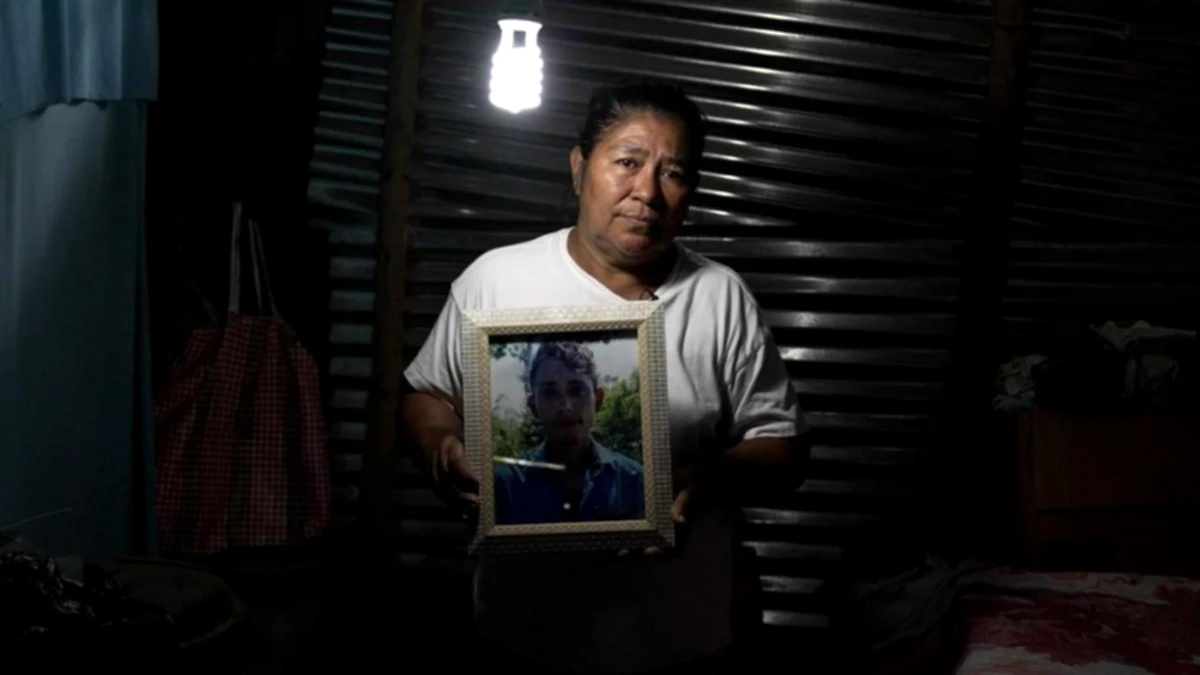
Her mother, Marta Elena González, says her children worked in shrimp fishing and never had a relationship with criminals.
However, she said, both were arrested on anonymous complaint and accused of having ties to the gangs.
Martha spent three years not knowing anything about her children. He only knew the name of the prison in which they were and, every month, went there to deliver food and basic hygiene items, which the relatives of the detainees simply call “package.”
He did so until April 2025, while reviewing Facebook, he saw a photo of his younger son, José Alfredo, in a post lamenting his death.
“That’s how we learned about his death.Nobody in prison warned us,” he says.
Contacting the funeral office, Marta says she found out that, before she died, her son spent nine days in a hospital due to a bacterial infection.
“And they didn’t even warn me so I could see him for the last time,” the mother told the BBC, with a broken voice.
“When they took him, he wasn’t even sick,” he says.
“We have a lot of unanswered questions.”
José Alfredo left behind a 7-year-old daughter, who he now raises his ex-wife.
He is one of the 537 people arrested during the emergency regime who died while under state custody before being tried, according to Aid Legal Humanitarian, an NGO in El Salvador.
Human rights organizations say the country’s judicial system is saturated and unable to handle the number of prisoners waiting for trial.
They say detainees can spend years in prison without a formal indictment or without knowing what they are accused of.
Families of detainees who spoke to BBC News Brazil even cases of detainees who, even after the justice ordered their release, have been waiting for months for the order to be fulfilled.
BBC News Brazil consulted the government of El Salvador on these cases, but received no response.
Repeated requests for interviews with government ministers and Bukele’s allied MPs to talk about the country’s security policy were also rejected.
In 2026, to ease the judicial system, El Salvador launched collective trials of thousands of accused of belonging to factions. But critics say these mega-trials prevent the analysis of individual cases and undermine the accused’s right to defend themselves.
Samuel Ramírez, coordinator of the Regime Victims Movement (Movir), a group that brings together families of people imprisoned under the exceptional regime, says El Salvador is now a dictatorship.
“He (Bukele) runs the country as if it were his own company and does not allow anyone to contradict it,” says Ramírez, who, during the Salvadoran Civil War (1979-1992), was a guerrilla member of the Farabundo Martí Front for National Liberation (FMLN).
The group, with Marxist ideology and supported by the Soviet Union, fought against US-funded government troops.
After the end of the conflict, the FMLN became a political party. Under this group, Bukele began his political career, when in 2012 he was elected mayor of the municipality of Novo Cuscatlán and, in 2015, of San Salvador.
Today, the president belongs to New Ideas, a party he created after being expelled from the FMLN for internal disagreements and rejecting left and right-wing labels, although analysts describe him as conservative.
However, Ramírez matches that he does not consider the Bukele administration a classic dictatorship, as he says the government tries to present itself as a democracy.
“[Bukele] is not like Hitler or Pinochet.He never ordered us to be shot during a demonstration, he never ordered us to be murdered, because he knows that today we all carry a cell phone,” Ramírez explains.
This engineer spoke to BBC News Brazil during a demonstration on a sunny morning in May, when a few dozen women walked to the headquarters of the Prosecutor General of the Republic, in San Salvador, to deliver a letter calling for the release of their children.
For Canadian political scientist and public security expert Robert Muggah, the results of Bukele’s security policies are indisputable, but they were given “at the expense of the democratic system.”
“My concern is that, in the long run, this has serious implications for the independence of the courts, for civil rights and for citizens’ guarantees,” he says.
Critics accuse Bukele of pursuing his opponents, including journalists and human rights defenders.
The digital newspaper El Faro, one of the most critical El Salvador media with Bukele, moved its headquarters to Costa Rica in April 2023.
Media representatives said the change was due, among other factors, to the fear that journalists would be accused of collaborating with the gangs, in view of the broad interpretation of legislation adopted to combat them.
On several occasions, the media interviewed gang members about alleged ties and alleged negotiations between these groups and government officials.
Bukele refuses to persecute journalists and human rights organizations.
On several occasions, he said, these groups seem to be more concerned about protecting the rights of criminals than those of citizens affected by crime.
Muggah also questions the possibility of replicating Bukele’s security policy in larger countries, such as Brazil.
According to him, the Salvadoran gangs “were very territorial and had very clear marks, like tattoos, that made it relatively easy to know who was who.”
In addition, El Salvador is neither a relevant drug market nor an indispensable route for international trafficking, which limits the power and capacity of these organizations to expand, the politologist says.
Meanwhile, the Red Command (CV) and the Primeiro Comando da Capital (PCC), the leading Brazilian criminal groups, “function more like multinational companies than street gangs,” which makes it much more complex to combat them, according to Muggah.
According to the expert, the case of Ecuador — where, since 2024, the government has also used the exceptional regime to fight organised crime — shows the difficulty of replicating the Bukele model in larger countries.
After adopting this strategy, the country recorded a record number of homicides last year.
“What happened there was that violence ended up shifting to other areas,” says Muggah.
With the decline in rates of violence in El Salvador, some wonder why the governmentins the exceptional regime, a measure that needs to be renewed every 30 days.
For artist Melvin Gómez, who gives painting classes to young people in a poor community outside San Salvador, “the fear now is another: that people cannot raise their voice, their right to manifest, because there is a regime.”
In La Campanera, teacher Adélia Rosales says she expects Bukele to stay in power for several years.
“I feel that the project has not yet been completed to leave us the security already established,” he says.
When asked if she is afraid that El Salvador will repeat a history that is already common in the region, in which popular presidents become authoritarian leaders who refuse to leave power, she reflects: “It can happen. Nothing is written on stone, politics is a dynamic process.”
Still, she says that the security changes promoted by Bukele make her feel hopeful about new advances.
“Some might say life is expensive, but eating a quiet dish of beans is not the same as eating a piece of meat thinking they’ll knock on your door and they’ll take you.”
Download the new BBC World Service app. Choose BBC News World and receive news alerts, documentaries and analysis, all in one place. Important: The new app is not available in the United Kingdom or the United States.
You can also follow us on YouTube, Instagram, TikTok, Facebook, X and on our WhatsApp channel.
And don’t forget to subscribe here to our newsletter to receive every Friday a special selection of our best content.