
The elimination of one-cent coins from everyday transactions in the United States is prompting changes in the way businesses handle cash exchanges. To mitigate potential confusion, new legislation has been enacted to establish guidelines for handling payments.
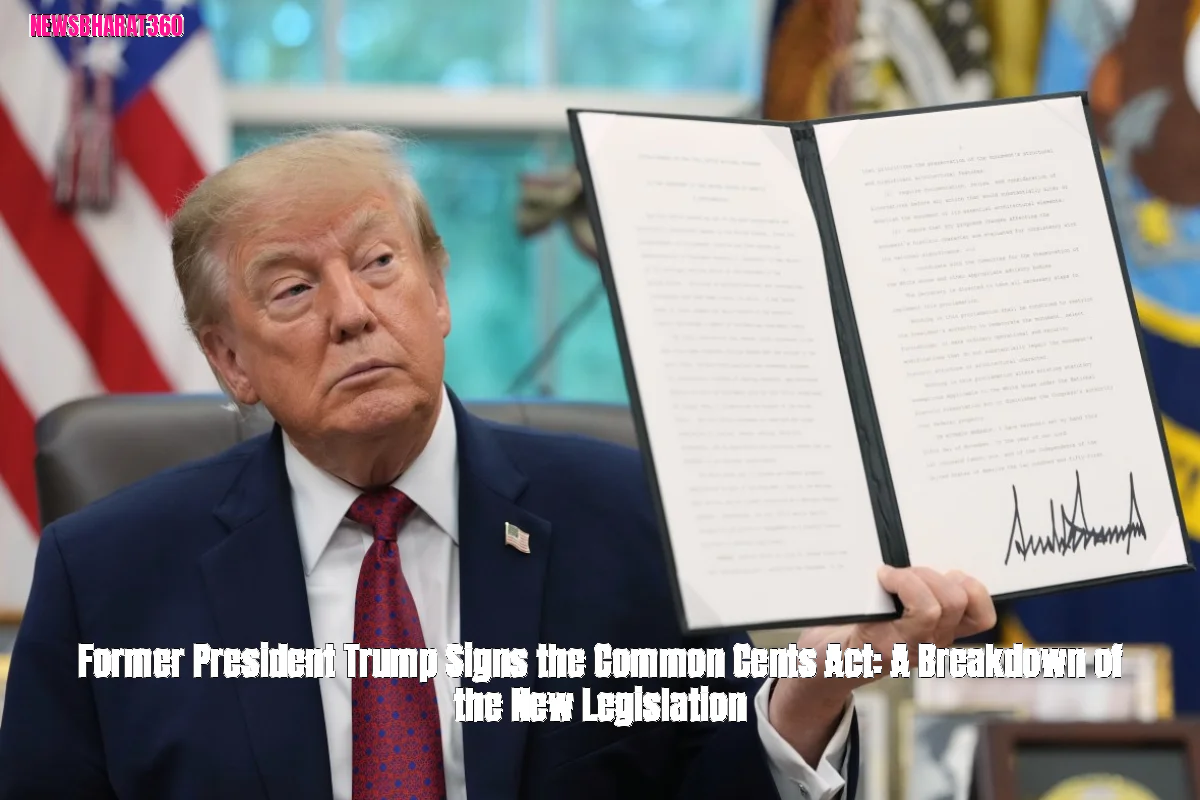
President Donald Trump signed the Common Cents Act into law on Friday, implementing a provision that allows for the rounding of cash transactions to the nearest five-cent multiple when exact change cannot be provided. The legislation sets a federal standard for consumers and businesses, contingent on the discontinuation of the one-cent coin.
A recent legislative update allows merchants to round cash transactions to the nearest cent, taking into account the total purchase price, including applicable taxes.
Businesses can round down a customer's balance to the nearest dollar, such as $10, when the exact amount is $10.02. Conversely, if the total is $10.04, they can round up to $10.05.
The regulation operates under the following parameters.
A new policy will affect cash transactions where the exact change is not available, while payments made through credit cards, debit cards, electronic transfers, and other digital methods will remain unaffected, continuing to be charged the exact amount.
The primary objective behind the decision was to alleviate the uncertainty surrounding businesses that were unable to accept the one-penny coin. Prior to its approval, establishments risked facing legal issues for not providing exact change, even when they chose to round up a purchase to benefit the customer.
The National Association of Convenience Stores (NACS), a leading trade organization in the fuel retail and convenience store sectors, marked a significant milestone with the implementation of a new policy.
Brennan Duckett, director of regulation and policies at NACS, stated that retailers have been seeking federal guidance on cash transaction processing since the production of one-cent coins ceased. The association's members are expected to directly benefit from the new law, and NACS welcomes President Trump's official endorsement through his signature.
Kwik Trip's CEO and chairman, Scott Zietlow, emphasized the importance of establishing clear guidelines for processing cash transactions.
Retailers have expressed gratitude for the establishment of a legal guide on rounding cash transactions, according to Zietlow. The guide provides long-awaited clarity on the matter, particularly following a period of several months during which cash transactions highlighted the need for federal guidance.
The phase-out of a specific denomination of currency does not result in the devaluation of existing coins. The previously minted one-cent coins will retain their legal tender status in the United States and can continue to be used for transactions.
Legislation aimed at enhancing trade efficiency has been introduced in response to the scarcity of available currencies, with the intention of preserving the purchasing power of existing consumer funds.
To facilitate more accurate transactions, a new calculation method will be implemented for cash purchases, taking into account the absence of small coins, whereas card and electronic payments will continue to display the exact amount of the transaction.
Individuals may also find related information of interest.