
Chen Tianyu says," I sleep and the world modifications. "
Their planet is, of course, changing. This 28-year-old keeps up with the most recent solutions by visiting companies that are implementing technology in his spare time. In this way, you can decide what topics to emphasize in your teaching of robotics and artificial intelligence ( AI ) classes.
About 30 college students study programming in front of him. One of them repeatedly switches the screen's and the robot's appearance while alternating the two:
She says," The idea is to take that circular piece and move it there. "
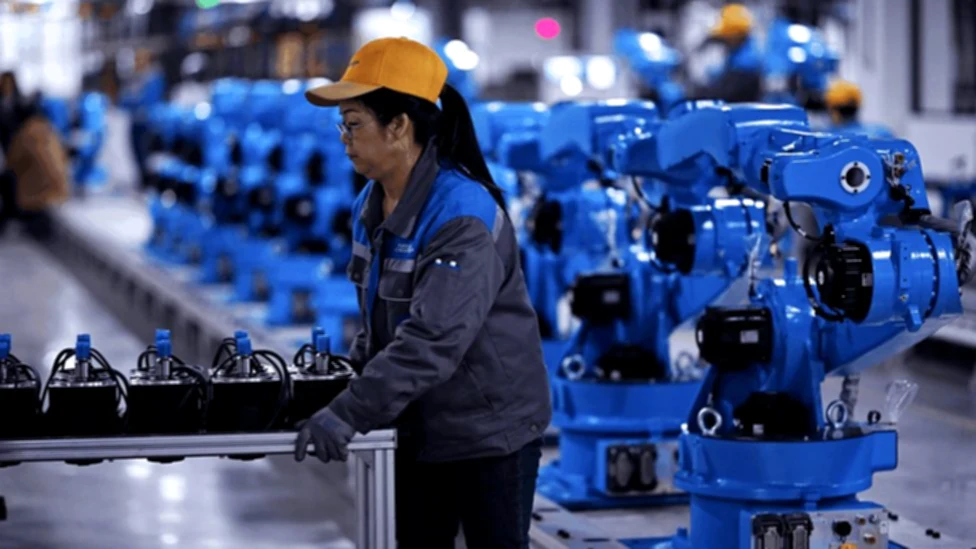
Students work with other students in the classroom to create mechanical medical instruments while a row of industrial robots are on the verge of programming. Chen declares while guiding them:
" If the world of AI and robotics doesn't have them, then they'll undoubtedly be replaced," he says.
This is a step, or quite a leap, in the direction of a future China is methodically creating: Xi Jinping's$ 20 billion plan to put his nation in direct competition with the US and at the forefront of innovation.
The proof is numerous.
One of the numerous sizable vocational training facilities built specifically to educate the next generation of technology-expert designers is the Hangzhou Technical Institute.
The campus is situated on the edge of Hangzhou, a former royal capital with a contemporary outlook that hardly qualifies it as a global technology hub.
More than two million computers work in factories across the nation, more than anywhere else in the earth, and their number is growing exponentially.
This wager is one that will undoubtedly transform the world, much like it did the previous day the Chinese economy underwent a significant change.
China is now exporting its industrial robots abroad: more than half of the world's are being produced there.
The effects of such common automation in a nation that is at the forefront of global manufacturing, trade, and development is less clear.
And how could we accurately assess the cost of this change in a system that strictly controls data?
In the midst of the industrial revolution, which includes outstanding thermal networks, passive peak hours thanks to electric vehicles, and faster machines than Usain Bolt, the future of Chinese workers is uncertain.
The second edition of the World Humanoid Games, which was held over the weekend, saw computers compete, run, and festival.
Another less obvious trend that is taking place in factories and classrooms is what feeds this program.
The BBC has visited professional locations where it was shown robots that work 24 hours a day without breaks or pay for labor benefits but don't have any physical features and can't dance or climb on stage.
Some also have the ability to construct more computers. We even went to universities where China will teach people who will join this artificial labor.
It offers a unique perspective on what Xi refers to as China's "new successful causes" and how they might affect the nation.
Old and new work side by side in a factory in Chengdu's southern town.
The celebrity product of CRP Technology, a mechanical arm capable of performing various business tasks, is an assembly line made up of about 30 middle-aged men and women who grind, chisel, and jump.
Four young engineers work together in a system to solve the problems of a design, a new robot they hope will aid in the development of different robots, in the same room.
Pang Kai, a 31-year-old part of the research and development staff, is one of them. Push the mechanical construction all the way through. The reason is that China's labor of the future is not yet prepared to take its personal actions. You can only currently do basic repetitive motions, like QR code scanning.
Pang smiles and says," Maybe in another six weeks I may do another task. "
The group applauds every little advance as the road is long.
For the past nine years, CRP Technology, which has about 300 employees, has been producing mechanical hands.
Each can be tailored to a factory's certain requirements in order to produce either cars, electrical parts, or wind turbines. A one shoulder can be programmed to do more than 90 % of repetitive tasks, according to the company.
Professionals are even considering whether they will ever be able to replace the entire workforce of the company.
Our fresh machine should resemble a human being, we want it. We hope it may consider for itself, says Pang.
And he continues," We need this kind of computers because sometimes there won't be enough workers in China in ten years. "
Beijing is rushing to transform its businesses, one of the reasons why the population is declining and the workplace is getting older. By 2035, more than a third of the Chinese community will be over 60 years old, according to official projections.
In addition, some estimates predict that the nation will lose about 60 million people over the next ten years, which is almost equal to the people of France.
The goal is that more technology will make up for this labor shortage before it has a significant impact on an already-slowly-growing market.
The manufacturing industry employs about 120 million people today. Jobs could be a fatal punch to millions of people who depend on stock wages if China expands very quickly.
In theory, devices can operate 24 hours a day, which is unquestionably advantageous over individual workers. They need regular servicing as well. Every moment, we must spend some time to that, and each month, the manufacturing line needs maintenance and inspections, says Cao Li, vice president of Leapmotor, the company's vice president.
The Hangzhou factory's economical, high-tech cars are becoming increasingly popular in Europe, and drones are employed at every stage of assembly. More people workers show up at the creation line's end.
The company employs more than 25, 000 people, and lots of them perform last checks as newly developed automobiles advance the range.
Cao responds," It's wholly possible," and says "it's possible. "
" And it might occur fairly quickly. We have essentially achieved 100 % automation in the sessions for stamping, welding, and painting. adds.
China is superior to the United States. due to the company's extensive developing center. Everything you need to create a robot's body is at your disposal, including vehicles, batteries, electrical components, engines, sensors, and motors.
China has a concept, too. He has a strategy. You are aware of where you want to remain in five years. They have a main program, but they restrict the scope to local communities and regions, according to Dr. Susanne Bieller, the International Federation of Robotics director common.
There is an entire habitat in Shenzhen if you want to build a machine it. The important elements are delivered to the factory in less than an hour. He goes on to say that in Europe it can take up to a week.
He acknowledges, nevertheless, that the US continues to be in charge of the development of artificial intelligence that can program them, even though China is very good at creating the "body" of computers.
Foreign businesses like DeepSeek and Moonshot have also developed fresh AI models that, in their opinion, can compete with the best that have been created in the United States.
Foreign innovation has advanced faster than anticipated thanks to an "open source" approach, which allows new AI companies to promote their programming, despite U. S. restrictions on the export of crucial advanced chips.
The second stage of this competition, according to experts, won't be dependent on who has the best language model but rather on who can assemble that knowledge into thousands of machines.
China is also investing in education a generation of students who can envision what will come next, which is why.
For instance, fresh people at the Hangzhou Technical Institute can begin their training as young people do at the Hangzhou Technical Institute at age 15.
And the depth of the content may be astounding. A limited campus is also available for students who want to work with China to maintain its position at the forefront of rare-earth control, another important strategic resource in the face of Washington.
One in five young people in China struggle to find employment, according to some as a result of this policy.
Our kids are in high demand, and businesses also reserve them before they are finished with their studies. They are free to worry about finding employment, and we hold contests as part of their training, Chen says.
It's better to get your niche within the evolving technology. In every stage of development structural changes certainly occur, and precisely those changes lead to the creation of student employment opportunities.
China is still grappling with significant financial issues, including a growing real estate crisis, significant local government debt, and consistently subdued consumption.
It's unclear whether or not the trend Beijing promotes will solve these issues, and how well-known is it how those whose jobs might be in danger of changing hands may think. May robots bring them wealth, or will they merely take over many of their responsibilities?
My students inquire what may happen in the future, Chen says.
And I'm telling you, I'm not sure. Technology is evolving to quickly. However, we are unable to sleep or remain silent around. He says," We have to keep going until we know what we can do. "