
Canadian Prime Minister Justin Trudeau's predecessor, Mark Carney, is not the current Prime Minister of Canada. However, I assume you're referring to a hypothetical scenario. Canadian Prime Minister Justin Trudeau's government has reportedly prepared for a previously unlikely scenario, an American invasion, although no such event has occurred.
US President Donald Trump acknowledged the need to consider all potential scenarios in the redefined US-Canada relationship, despite deeming the risk low and the likelihood of a specific outcome highly unlikely.
The White House Chief of Staff described the administration's actions as a standard approach to managing potential risks.
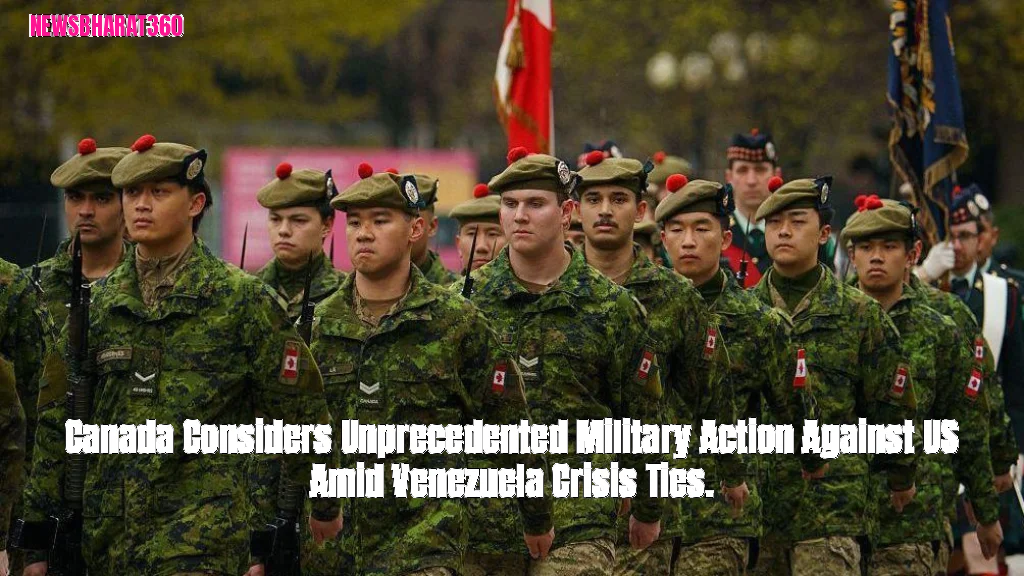
Canada has conducted military simulations in response to concerns over potential US aggression, fueled by President Trump's imposition of global tariffs and his expressed desire to annex the country as the 51st state.
In a statement made in 2025, the U.S. president expressed skepticism about the likelihood of the U.S. resorting to military action against Canada, describing such a scenario as highly improbable.
The White House issued a statement to the BBC this week, asserting that President Trump has taken unprecedented actions to safeguard the well-being of the Canadian people.
Military analysts consulted by the BBC share the assessment that an invasion is improbable, highlighting the extensive cooperation between the two nations in defense matters.
Concerns surrounding this matter are of significant interest to Canadians.
A January poll conducted by Leger found that over 30% of Canadians believed a U.S. invasion of Venezuela was probable following the capture of Venezuelan President Nicolas Maduro by American forces.
A hypothetical war between Canada and the United States would be a complex and challenging scenario to envision, according to Lieutenant General Christopher Coates, a veteran of the Royal Canadian Air Force with 34 years of service and multiple senior leadership roles.
A military leader expressed surprise at the notion of a military operation originating from U.S. soil, stating that such a scenario has never been considered during his career, which has spanned various military operations.
Canada and the United States have a long-standing collaborative relationship in various aspects of military defense, as evidenced by their joint participation in NATO missions.
The two countries are member nations of the North Atlantic Treaty Organization (NATO), a collective defense alliance that obligates its member states to provide mutual defense in the event of an attack against any member country.
The two nations collaborate on joint defense operations in the Arctic region, operating under the auspices of the North American Aerospace Defense Command (Norad), and regularly exchange intelligence information.
Coates expressed the opinion that a hypothetical US attack on Canada would likely begin with covert methods, rather than a direct armed assault, potentially involving cyber warfare tactics.
Following the conclusion of World War II, Canada and the United States developed a strong alliance, with their relationship deepening in the latter half of the twentieth century to encompass significant economic, military, and cultural ties.
A core aspect of Canadian identity has historically been its resistance to 18th and 19th-century American expansionism, according to Tim Foran, a researcher at the Canadian War Museum.
A central aspect of Canada's political identity is rooted in its fear of the United States.
Canada's origins date back to the British colonies in North America that maintained allegiance to the British monarchy during the American Revolution, in which the colonies that now comprise the United States declared independence.
Prior to the establishment of modern-day Canada, the United States had launched an unsuccessful invasion of the British colonies in North America, capturing Montreal in 1775 and coming close to seizing control of the city of Quebec.
During the War of 1812, the United States launched multiple invasions of Upper Canada, Lower Canada, and the maritime colonies, ultimately leading to a stalemate in the conflict.
British forces responded to the conflict by setting the White House ablaze as a retaliatory measure.
At the time, the colonies that would eventually form Canada relied heavily on the United Kingdom and its naval forces for defense, as well as the indigenous peoples who played key roles as military leaders in major battles.
Following the conclusion of World War I, Canada began to consider the prospect of a potential conflict with the United States, driven by concerns over the country's increasing power and global influence.
Canadian army generals devised a covert strategy involving secret visits to border cities, where they posed as tourists to gather intelligence by photographing bridges and roads.
Community outreach efforts were undertaken by law enforcement officials to gather insight into the perspectives and concerns of local residents.
Andrew Burtch, a researcher at the Canadian War Museum specializing in 20th-century Canada, stated that a war was not a likely scenario at the time, yet Canadians still sought to be prepared.
The individual stated that the actions being described are a component of the military's operations.
The individual noted that various scenarios are being considered.
An American invasion of Canada is considered highly improbable, yet the notion is being entertained by some Canadians, according to Matthew Schmidt, an associate professor of National Security at the University of New Haven in Connecticut. This development is seen as indicative of a significant shift in the global power dynamics.
Canadian leaders are facing challenging decisions regarding the extent of their cooperation with the U.S. military, a partnership that offers them valuable intelligence in the event of potential security threats.
The situation is causing significant strain on diplomatic ties with the US, and a genuine concern for potential repercussions exists.
Canadians are taking seriously comments made by former US President Donald Trump suggesting the possibility of their country becoming the 51st US state, prompting them to consider defensive measures if necessary.
Potential Consequences of a Speculative Scenario Remain Unclear.
Initial combat phases in a conflict often exhibit a relatively brief duration.
A Canadian military model predicts that a U.S. attack would overwhelm Canada's strategic positions within a week, as reported by the Globe and Mail newspaper earlier this year.
Canadian military forces were on the cusp of being outmanned, prompting a shift in their tactics towards unconventional guerrilla warfare in an effort to counter their adversary.
Senior government officials have indicated that in the event of a hypothetical scenario, Canada would likely seek support and defense from its key allies, including France and the United Kingdom.
A newly proposed theoretical model has sparked concern by suggesting the possibility of a U.S. military action against Canada for the first time in over a century.
The model in question represents the most basic form of military combat planning, according to Coates.
Canada is facing a gap in its preparedness compared to its NATO allies, as it has historically lacked a comprehensive response plan in the event of a land invasion. However, in light of the increasingly unpredictable global geopolitical landscape, the country is now actively working to rectify this situation and align its defense strategies with those of its international partners.
Canada's defense chief has proposed a significant expansion of the country's armed forces, potentially incorporating up to 300,000 troops, many of whom would require additional training to meet operational standards.
A hypothetical invasion of Canada from the United States would likely present significant logistical challenges.
US Support for War with Canada Unlikely, According to Analyst.
US military officers would likely refuse to carry out an order to invade Canada, with a significant number potentially resigning in protest.
The individual in question views such an order as both unlawful and unethical.
Canadian and American soldiers reportedly engage in regular joint training exercises, fostering a spirit of mutual respect and understanding between the two nations' military forces.
In the event of a significant deterioration in relations, the U.S. is likely to prioritize leveraging Canada's strategic resources, including oil and minerals, as a key component of its strategy.
The official suggested that a potential operation could bear resemblance to a similar military action undertaken by Washington earlier this year to apprehend Maduro, drawing a possible comparison to the situation in Venezuela.
A Canadian military official countered that while the U.S. possesses superior military capabilities, he maintained that in close combat situations, Canadian soldiers would have a distinct advantage due to their ability to engage with enemy forces on a personal level.
The original article was written in English and was translated using artificial intelligence technology. Prior to publication, a BBC reporter reviewed the translated text to ensure accuracy.