
The United States is achieving something unprecedented in Venezuela: promoting profound changes and reforms in that country while counting, at the same time, on the collaboration, consent or resignation of both the Venezuelan government and the Venezuelan opposition.
Immediately after the shocking capture of Nicolás Maduro on January 3, Donald Trump's government surprised again by supporting Delcy Rodríguez - then Maduro's vice president - as the person in charge of carrying out the changes that Washington wants to achieve in Venezuela.
“She is essentially willing to do what we believe is necessary to make Venezuela great again,” Trump said, adding, “She has no choice.”
Rodríguez was recognized as interim president and does not seem to have disappointed Trump, judging by his frequent praise for her.
In recent months, the US assumed control of the sale of Venezuelan crude oil - the country's main source of wealth - and has encouraged the return of US oil companies to the country with a view to reactivating that sector.
Washington has promoted changes in Venezuela's oil and mining legislation in order to favor private investment in these sectors, while exploring options to recover the Venezuelan electrical system, an essential factor for there to be an economic recovery in the country.
In addition, it has been lifting sanctions and paving the way for Venezuela's gradual reintegration into international programs and organizations from which it had been marginalized.
In terms of domestic politics, the United States is considered the driving force of the political dialogue that is just beginning between the Rodríguez government and a group of opponents led by Dinorah Figuera, the last president of the National Assembly elected in 2015.
While, in foreign policy, its influence is felt in the quiet distancing between the Rodríguez government and traditional allies of Chavismo such as Iran or Cuba.
The key actor
These changes promoted by the Trump government respond to a three-phase plan - stabilization, recovery and political transition - outlined by the Secretary of State, Marco Rubio.
Although they contain elements that, in general, can be considered positive or necessary by Venezuelans of any political tendency, such as the recovery of the oil industry or the electrical system, they have also been harshly criticized for different reasons.
Among the main questions is that this process means a serious loss of sovereignty for Venezuela, whose government no longer controls the use of funds generated by the sale of oil, while the current National Assembly is approving laws that seem tailored to Washington's wishes.
The lack of transparency is also pointed out because, for example, the US does not inform Venezuelans about how much money has been collected or what use is being given to those resources.
These criticisms are formulated from sectors of the opposition, Chavismo and independents, but curiously they never come from the mouths of the main government officials or the biggest opposition leaders.
And the US seems to have become a pivotal actor: it depends on Washington whether Chavismo can remain in government longer; It depends on Washington to advance the democratic transition that the opposition has sought for years.
“Suspended sovereignty”
But how do you explain that a government of Chavismo, a political force that made anti-American discourse a hallmark, now submits in such an apparently docile manner to the mandate of its reviled “empire”?
“Whether we like it or not, there is an intervention here, so the decisions made in Venezuela are controlled by the power that intervenes in the country and this determines what is done and what is not,” Benigno Alarcón, founder and former director of the Center for Political and Government Studies at the Andrés Bello Catholic University, tells BBC Mundo.
“We could say that Venezuela is in a state of suspended sovereignty due to this intervention, and that will be the situation until things return to normal: that there is a new elected government and we are governed by our own institutions again,” he adds.
The expert indicates that the US has two levers – one military and the other economic – that it can use to control the decisions and attitude taken by the Venezuelan government in relation to what Washington wants to do at a given moment.
"Those in power with Delcy Rodríguez, the elite that governs Venezuela, try to avoid at all costs the same fate as Maduro. It is true that there have been no new interventions, but the capacity to do so is there, and everyone is aware that it could happen at any time," he says.
The economic lever, on the other hand, is based on the control of resources from the sale of oil that the government needs to finance itself, as well as the application or lifting of financial sanctions, which facilitate or hinder the entry of international investments into Venezuela, its access to resources from international organizations or even to Venezuelan resources frozen abroad.
The signs of US influence are everywhere.
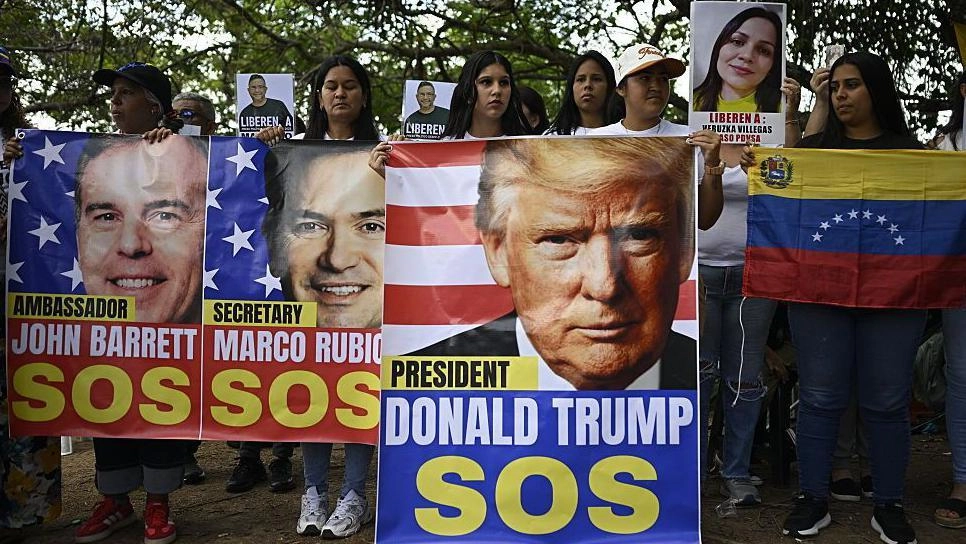
In Trump's messages praising Delcy Rodríguez and suggesting that Venezuela could become the 51st state of the Union, in the now frequent visits of US officials to Caracas and in his statements about the great "collaboration" he receives from the government, which approves and does what Washington asks of him.
It can also be seen in the massive US military presence on the ground, coordinating humanitarian efforts after the double earthquake of June 24; in the visit of the chargé d'affaires of the embassy in Caracas, John Barrett, to the Guri dam as part of the diagnostic tasks of the works needed to recover the Venezuelan electrical system.
And judging by information published by The New York Times, also in the WhatsApp chat through which Marco Rubio and Delcy Rodríguez communicate.
Publicly, the interim president has rejected the idea of ??Venezuela becoming the 51st state. "That is not planned. It would never be planned because if Venezuelans have something, it is that we love our independence process," Rodríguez said last May, adding that the "path" is the existing cooperation agenda with the United States.
But Washington's influence is also visible in the Venezuelan opposition, as was proven with the return to Venezuela of Dinorah Figuera, after years of exile, to lead "at the request of the State Department" the dialogue with the government for the institutional recovery of bodies such as the National Electoral Council or the Supreme Court of Justice.
This Thursday, August 6, the government and opposition delegations met in Caracas for the first face-to-face meeting.
It can also be seen in the frequent recognitions that María Corina Machado, leader of the opposition, makes to President Trump for the help he provides to Venezuela; and, by omission, in the almost non-existent criticism on the part of the opposition leadership regarding a situation in which the country's sovereignty seems to be compromised.
Between necessity and strategy
Government and opposition in Venezuela, at odds for years, need Washington to achieve their opposing interests.
“In 2024, there was electoral fraud in Venezuela and the opposition could not assume the presidency because the government was willing to do whatever it took to maintain power, including resorting to the bloodiest repression,” says Benigno Alarcón.
“This ended up showing that the opposition alone cannot solve the problem in Venezuela,” he adds.
In the case of the ruling party, the expert considers that the apparent harmony with Washington responds to the need for survival, but also to a long-term strategy.
"Chavismo is risking its survival and if survival involves bending so as not to break, as many people there say, then that is what it is doing. It is not that Chavismo reflected and now feels that the US is its best friend. It is a tactic that seeks to buy time," says Alarcón.
Configured in this way, for the expert this situation entails the risk that the promised democratic transition will not materialize because the Trump government focuses too much on its economic objectives in Venezuela and the political change will be postponed until a moment in which Washington no longer has the capacity or interest to continue promoting it.
According to Alarcón, such a scenario could occur due to a loss or weakening of Donald Trump's power due to a Republican defeat in the midterm elections in November or a possible impeachment of the US president.
“This process depends entirely on the US using the levers so that the negotiation does not become a dialogue without an agreement,” he says.
"If tomorrow the US withdraws from Venezuela for some reason, the ruling party would revert this entire situation to its original state and would begin to have greater alliances with Russia, with China, with other countries and would distance itself from North American alliances."
For now, the US assures that the political transition remains on track for Venezuela.
“I think it will require some perseverance and a little patience; not years, but months and weeks,” he said on August 4 when asked by journalists during a visit to Paraguay.
What matters is the change
Colette Capriles, university professor and member of the Academy of Political and Social Sciences of Venezuela, warns that this American influence could extend even if the opposition came to power, since the US plans for the country are long-term.
The expert highlights that it is an unprecedented situation since a kind of guardianship has been established over Venezuela, but at the same time it seems to be accepted by the different actors inside and outside the country.
“An intervention is being carried out, a political and economic management of the country that is unprecedented: it is not an armed intervention, it is not bloody, it does not imply repression and, at least until now, it is not receiving ideological resistance,” he tells BBC Mundo.
Capriles considers that this type of protection is a consequence of the actions and decisions of political actors, including, in the case of the government, acceptance through facts of what is happening, as well as Maduro's refusal to negotiate with Trump in 2025.
Regarding the opposition, Capriles points out that when the so-called interim government of Juan Guaidó was established in 2019, a kind of discourse was generated according to which Venezuelans cannot understand themselves and that to solve the country's crisis it was necessary to apply a force that Venezuelans did not have.
“Seen completely from the outside, we are in a situation of renunciation of sovereignty, of sovereignties: sovereignty as political actors and sovereignty in the popular dimension and, of course, national sovereignty,” Capriles points out.
“We are in a situation in which the only truly effective agent from a political and institutional point of view is the United States government itself,” he adds.
“It seems that for everyone this is a situation of equilibrium, a situation in which everyone is somehow better off than they were before,” he notes.
Partly due to the prolonged and profound multidimensional crisis that Venezuela has experienced, a part of the population sees what is happening not so much as a threat to sovereignty, but as a promise of improvement.
That promise seems to be reflected in the opinion that Venezuelans have of Trump. According to a survey conducted at the end of July and beginning of August, 51% of those surveyed have a favorable opinion of the American president, who is more than 30 points above Delcy Rodríguez and about 20 points below María Corina Machado, the highest-rated leader.
"The problem is that you have a trade off: on the one hand, you have a risk of continuing this renunciation of sovereignty. On the other hand, there is a promise of stability."
“There are people who say: ‘Politics is very complex but I still believe that Trump is going to solve this.’ And in that case, solving does not mean solving the situation politically, but economically so that I as a citizen can once again have a minimum of well-being that I lost,” says Capriles.
"That is very curious because it tells you a lot about where we have reached in Venezuela as a society. Deep down, it is very unimportant who carries out the changes: what people are waiting for is for there to be changes," he concludes.