
NEW YORK.- President Donald Trump's immigration policy seeks any way to find undocumented immigrants who could be processed for deportation, including using social assistance programs essential for the survival of families.
Such is the case of the Temporary Assistance for Needy Families Program (TANF), the federal government's main program to provide financial assistance to very low-income families with children, whose information is shared by the authorities.
As of June 23, 2026, the Office of Family Assistance (OFA), part of the Administration for Children and Families (ACF) of the Department of Health and Human Services (HHS), published “a notice indicating that it would grant other federal and state agencies, particularly the Department of Homeland Security (DHS), access to information about individuals who received benefits from the TANF program.
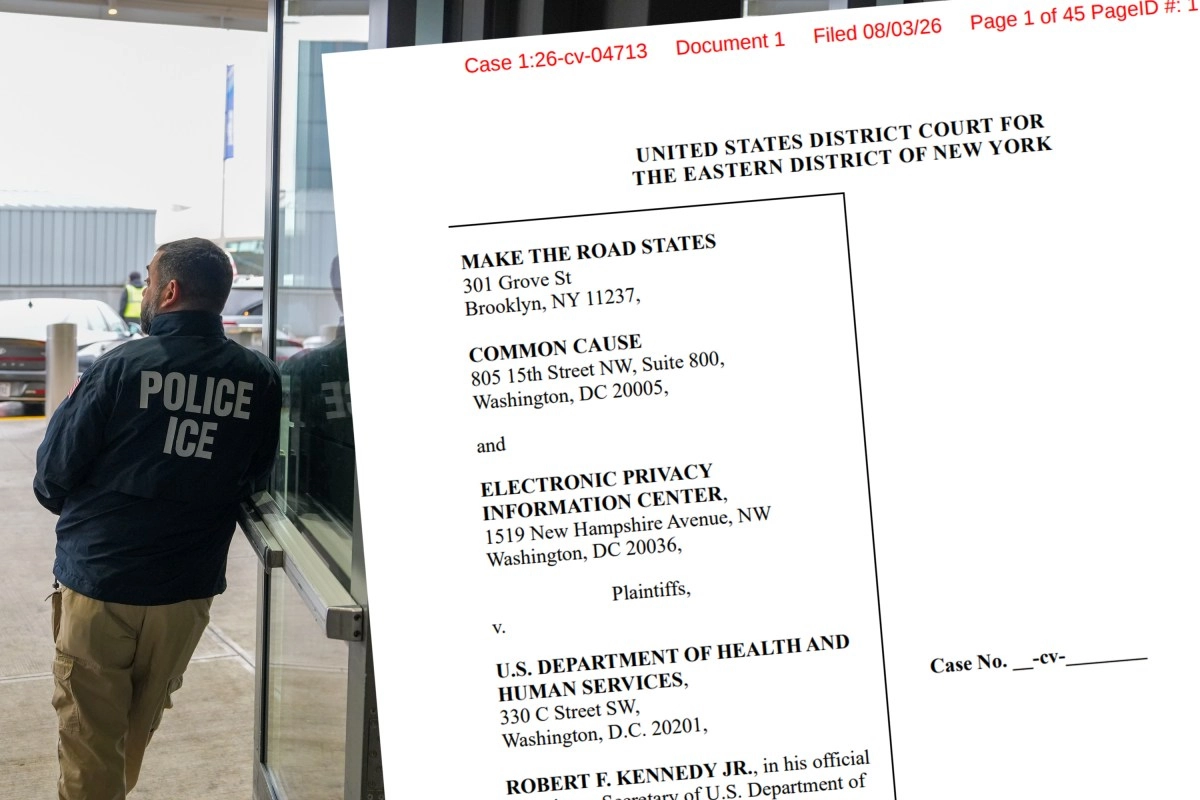
The information they share is not only about the beneficiaries, but about all the people who live in their homes, including Social Security numbers, income, marital status and immigration status, which is why a lawsuit before the Eastern District Court of New York seeks to stop such action.
The lawsuit is brought by Make the Roads States, Common Cause and the Electronic Privacy Information Center (EPIC), which allege violations of the TANF Act, the Social Security Act, the Privacy Act of 1974, the Privacy Protection Computer Matching Act of 1988 and other federal laws.
“This administration is once again attempting to exploit Americans' personal information and use it for completely unacceptable purposes,” said John Davisson, Deputy Director and Chief Compliance Officer at EPIC. “People seeking financial help for their families should not fear that their data will be used as a weapon for immigration enforcement or other harmful purposes.”
The plaintiffs – represented by Democracy Forward and the National Center for Economic Law and Justice – ask the court to enjoin the Trump administration from implementing this information disclosure policy.
“The TANF program helps families meet a basic need, and weaponizing it in this way is cruel and destroys the safety net that Congress created,” said Jay Young, Senior Director of Civil Rights and Civil Liberties Policy at Common Cause. “If this is allowed to happen, it could lead to children going hungry as families fear retaliation.”
The Privacy Act requires meaningful public notice and a real opportunity to comment before agencies make far-reaching changes to their handling of personal information. This is not just a formal requirement, but an essential safeguard against abuse of government power. “The administration must comply with the law.”
The plaintiffs warn that masked Immigration and Customs Enforcement (ICE) agents are kidnapping and making immigrants disappear “through violence and unconstitutional tactics.”
“Increasingly, ICE is using artificial intelligence surveillance systems, developed by controversial technology companies like Palantir, to combine government data sets, including sensitive personal information that families have shared with state and federal governments when applying for benefits, in order to deport these families,” warned Theo Oshiro, co-executive director of Make the Road States. “We are proud to join Democracy Forward in stopping the administration’s illegal attempt to share TANF data with ICE and other federal agencies and private entities.”
Under the Privacy Act, federal agencies must notify the public – and take public input into consideration – about the ways they plan to use personal information.
“[The Trump administration’s] policy change is an attempt to illegally circumvent the Privacy Act and other federal laws and safeguards that protect the confidential information of TANF recipients,” the plaintiffs add.
According to the plaintiff organizations, TANF funds more than $16 billion annually in grants to all 50 states, the District of Columbia, and several territories and tribal governments, meaning that while the federal government distributes the funds, the states administer the efforts “to alleviate poverty.”
“The TANF program also helps finance a variety of state benefits and services for very low-income families with children, including child care assistance, employment and training programs, services for children at risk of neglect or abuse, and after-school programs for youth,” it notes.