
Although there are still several months until the coldest time of the year, the first signs of what winter 2026-2027 could be like in the United States are already beginning to appear. And the outlook anticipates important differences depending on the region of the country.
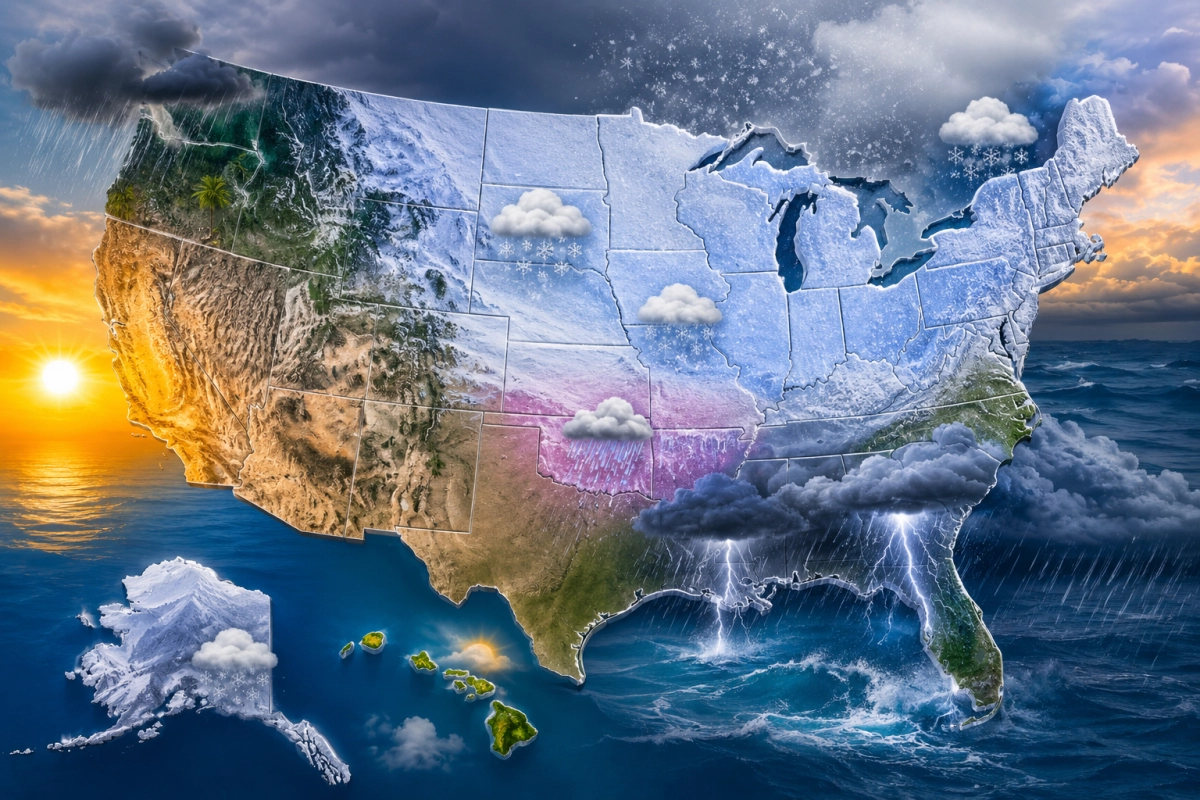
The new Farmers' Almanac forecast calls for a winter marked by an active storm track in the South, brief but intense spells of cold and snow in the North and an especially complicated mix of rain, ice, sleet and snow in the Northeast.
Behind much of this scenario appears El Niño. NOAA confirmed that the phenomenon is active and expects it to strengthen in the coming months. In its latest available diagnosis, it estimated a 97% probability that it will continue until early spring 2027 and an 81% chance that it will reach a “very strong” intensity between October and December 2026.
New York and the Northeast: a winter that is difficult to anticipate
For Connecticut, Delaware, Maine, Maryland, Massachusetts, New Hampshire, New Jersey, New York, Pennsylvania, Rhode Island and Vermont, the Farmers' Almanac anticipates one of the most variable scenarios in the country.
Coastal areas could see a higher proportion of rain and mixed precipitation, while inland areas could receive several rounds of heavy, wet snow, especially during January and February.
A slight difference in a storm's track or temperature could determine whether cities like New York receive rain, sleet, ice or accumulated snow.
Illinois, Michigan, Ohio and the Midwest: cold in bursts
Illinois, Indiana, Kentucky, Michigan, Ohio and Wisconsin form another of the regions covered by the Almanac.
Winter temperatures could end up close to their normal values ​​on average, but that doesn't mean it will be a quiet season. Expect rapid drops in temperature, brief snow storms and periods of intense cold, alternating with milder breaks.
A similar pattern is projected for Colorado, Iowa, Kansas, Minnesota, Missouri, Montana, Nebraska, North Dakota, South Dakota and Wyoming. Blizzards and strong gusts of wind could also occur in more northern areas, although some periods would be drier than usual.
Florida and the Southeast: more storms and a wet winter
The scenario changes as we move towards Alabama, Florida, Georgia, Mississippi, North Carolina, South Carolina, Tennessee, Virginia and West Virginia.
El Niño usually favors a more active storm path over the southern United States and the Farmers' Almanac precisely expects a wetter and stormier winter in this area.
Florida and other southeastern states could see frequent rain systems. Further north, if cold air masses match available moisture, some events could turn into sleet, freezing rain or even wet snow.
NOAA also projects that during the winter the probabilities of above-normal rainfall will be greater in much of the south of the country, with one of the most marked signs precisely over the southeast.
Texas and south-central: El Niño can change winter
Arkansas, Louisiana, New Mexico, Oklahoma and Texas will be directly exposed to that southern storm track.
The forecast points to increased precipitation opportunities during the winter. The combination of humidity and occasional entries of cold air also increases the possibility of ice, sleet and snow events in sectors that normally receive fewer winter events.
New Mexico and the mountainous areas of the southern Rockies could be among those to benefit from more snow at altitude.
California, Arizona, Nevada and Utah: a more active winter
For Arizona, California, Nevada and Utah, the focus will be primarily on the arrival of storms from the Pacific.
The Farmers' Almanac expects above-normal rainfall from Southern California and the Southwest desert to the east of the country. In the mountains, some of that moisture could translate into significant snowfall.
It is one of the typical patterns associated with El Niño: greater storm activity over the southern United States, although that does not mean that all areas will receive more rain or snow or that it can be anticipated from now on when the strongest events will occur.
Washington, Oregon and Idaho: less certainty about snow
In Washington, Oregon and Idaho, the forecast is different. The Farmers’ Almanac anticipates a more changeable and less reliable snow season, with breaks between winter periods.
The outlook is broadly consistent with NOAA, which expects the El Niño pattern to favor below-normal precipitation from the Pacific Northwest to northern and central parts of the country for part of the winter.
What will happen in Alaska and Hawaii?
These two states are not part of the seven continental regions used by the Farmers' Almanac, so attributing that same forecast to them would be incorrect.
For Alaska, NOAA favors above-normal temperatures across much of the state during the winter, although confidence is lower in northern areas. The precipitation pattern will be more variable.
In Hawaii, El Niño typically has a different effect: NOAA projects that the chances of below-usual precipitation will increase beginning in late fall and remain elevated through the winter of 2026-2027. The signal of above-normal temperatures is clearest at the beginning of the season and loses strength as winter progresses.
El Niño will be one of the keys to winter 2026-2027
The forecast should be interpreted as a seasonal trend and not as a prediction of specific storms.
The Farmers' Almanac uses its own methodology that combines natural cycles, solar activity, lunar influences, historical background and modern meteorological tools. It is not the official forecast of the federal government.
NOAA, in contrast, uses weather and climate models to estimate probabilities of temperatures and precipitation above, near or below their normal values.
For now, both forecasts agree on a central element: El Niño will have an important role in the 2026-2027 winter, favoring a more active and humid southern United States and a very different panorama in much of the north of the country.