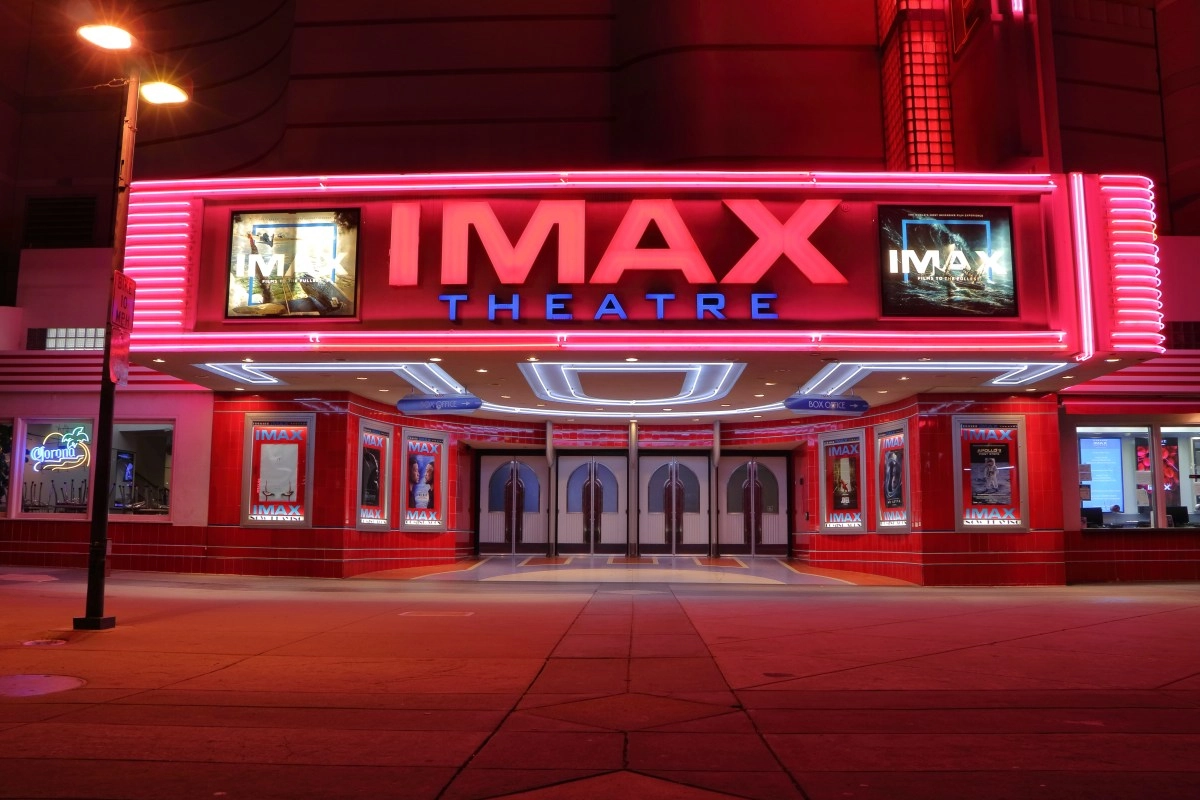

Christopher Nolan repeats it at every press conference as if it were a mantra: “The Odyssey” must be seen in IMAX, and it is not simple marketing. When the room goes dark and the curved screen begins to swallow your entire field of vision, you understand why the director has been obsessed with this format for years since he was a child at the Museum of Science and Industry in Chicago.
The question that almost every movie buff asks themselves today is simple: is there really that much difference between watching a movie in IMAX and in any other room, or even on the most expensive smart TV in the house?
What makes the IMAX format unique
The first difference is obvious as soon as you enter the room, literally. IMAX screens measure up to 22 meters wide by 16 meters high, compared to the 20 by 12 meters of a conventional cinema, and they also have a concave shape to surround your peripheral vision. That curvature is not an aesthetic whim, it is designed so that the screen “disappears” from your perception, as Nolan himself explained to the AP, generating an immersive sensation that no television can replicate.
The resolution also plays in another league. While a normal theater projects something like 2,048 by 1,080 pixels, IMAX can reach 10,000 by 7,000 pixels, thanks to a double projector system (one laser and one digital) that also improves contrast with deeper blacks.
And be careful, this does not only include the image, the sound is also completely transformed, because instead of having speakers hidden behind the screen as in a traditional cinema, IMAX distributes speakers from the floor to the ceiling, covering every corner of the room with up to ten times more power than a standard system.
Why “The Odyssey” loses so much outside of IMAX
Here comes the interesting thing to understand why your 4K Smart TV, no matter how expensive it is, falls short with this type of movies. “The Odyssey” is reportedly the first feature-length fiction film shot entirely with IMAX cameras in native 70mm, and that changes the whole game. Tapes shot in this format capture up to 40% more image than conventional productions, with clarity comparable to 18K resolution.
This means that when you watch the movie in a traditional theater or at home, in most cases you are getting cropped from the top and bottom to fit the standard 2.39:1 rectangular aspect ratio, rather than maintaining the almost square 1.43:1 aspect ratio that IMAX offers.
In other words, it's not that the quality looks “worse,” it's that you're literally seeing less content than the director filmed and scored for that scene. Nolan sums it up by saying that shooting in IMAX 70mm makes “the screen disappear,” a sensation that is completely lost when the image is squeezed into a 55-inch rectangular window with built-in speakers, no matter how much you paid for the TV.
The experience that no TV can replicate
Beyond the technical numbers, there is something almost physical about watching these types of movies in an IMAX theater, and it has to do with how the entire space around you is designed. The seats have a more pronounced inclination, arranged in an angular format to match the curvature of the screen, so that you almost end up watching the movie lying down instead of sitting. That arrangement, coupled with the sound that literally travels and bounces throughout the room, makes the show feel less like something you “watch” and more like something you “inhabit.”
That's why when someone says they're going to see “The Odyssey” at home expecting the same experience, they're technically missing out on real information about the image, not just sensations. The scale of the sea, the faces in the foreground, the battles, all of this is designed to expand and not to be reduced to a flat window, as the specialized analyzes of this production explain. So if you have the opportunity to choose a theater, the most honest decision, as several critics say, is to look for the largest possible screen and give the film the conditions for which Nolan designed it from day one.