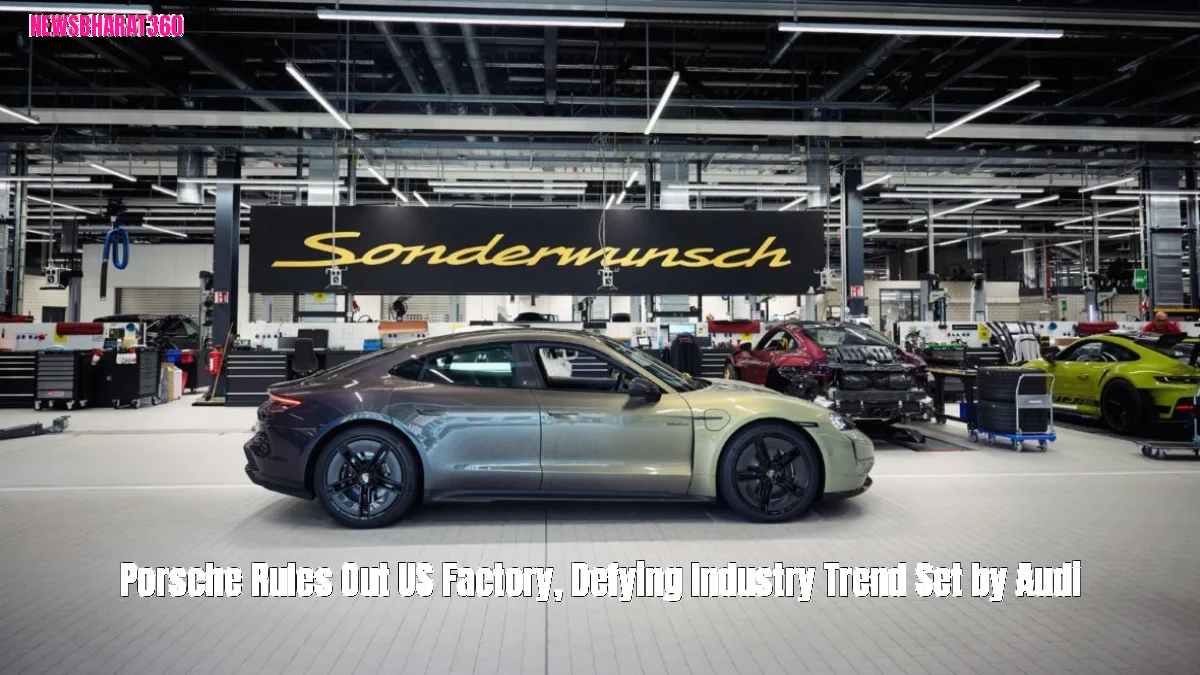

Porsche has stated that it will not establish a manufacturing presence in the United States, despite the potential for Audi to construct its first US plant. According to Jochen Breckner, the company's chief financial officer, Porsche does not see a significant economic benefit in setting up operations in the US.
Kia has announced that its 2027 EV6 model will retain the same seven trim levels as its predecessor, with no changes to the existing lineup.
During a discussion with investors regarding the company's financial performance for the period ending September 2026, further clarification was provided.
Ford has conceptualized a vehicle designed to deter theft by being parked in a way that makes it difficult for potential thieves to access.
Porsche has stated that it does not intend to leverage Audi's upcoming project, despite both companies being part of the Volkswagen Group and sharing certain industrial facilities.
Audi's U.S. manufacturing plans do not imply a relocation of Porsche production, according to company officials.
The executive expressed concerns that the investment and features of the proposed range would not be financially beneficial for the company. He cited the complexity of their product offerings, lower production volumes, and additional investment requirements as key factors that would make this move unadvantageous.
Porsche primarily focuses its manufacturing operations within Germany. Additionally, Audi operates a shared facility in Slovakia, where vehicles like the Cayenne, Q7, and Q8 are produced. The company also maintains assembly operations in Malaysia.
Audi has unveiled plans for its first US-based manufacturing facility, with a projected investment of approximately $4 billion and a potential workforce of 4,500 employees. The new factory is expected to have an annual production capacity of up to 200,000 vehicles.
Production plans for the initiative are set to commence in 2027, with output anticipated to begin in the early years of the following decade. Nevertheless, the project remains subject to ongoing internal discussions within the Volkswagen Group, which involves representation from the trade union IG Metall and the state of Lower Saxony on the supervisory board.
Criticism in Germany arose following the presentation of the project, with particular focus on the involvement of Audi's top executive in a political event alongside Donald Trump.
Porsche has adjusted its strategy to focus on the value of each vehicle sold, rather than solely prioritizing delivery growth. In the first nine months of 2026, the company reported revenue of $25.28 billion, representing a 5.9% decline compared to the same period in the previous year.
The company's operating profit totaled $1,740 million, despite a decline in global deliveries, which decreased by 16% to 178,532 units.
The imposition of U.S. tariffs had a substantial impact on the company, resulting in an estimated $200 million loss over the third quarter. Furthermore, vehicles imported from the European Union remain subject to a 15% tariff.
US consumers can expect business as usual, with the brand's vehicles continuing to be manufactured at existing production sites and subject to applicable tariffs.
Porsche has not disclosed any adjustments to its pricing in response to the decision. The company's strategy focuses on maintaining an exclusive and cost-efficient model, rather than expanding production capacity through a new US facility to boost volume.
Audi has announced plans to proceed with its existing project in Georgia, whereas Porsche has opted to maintain its existing industrial framework.