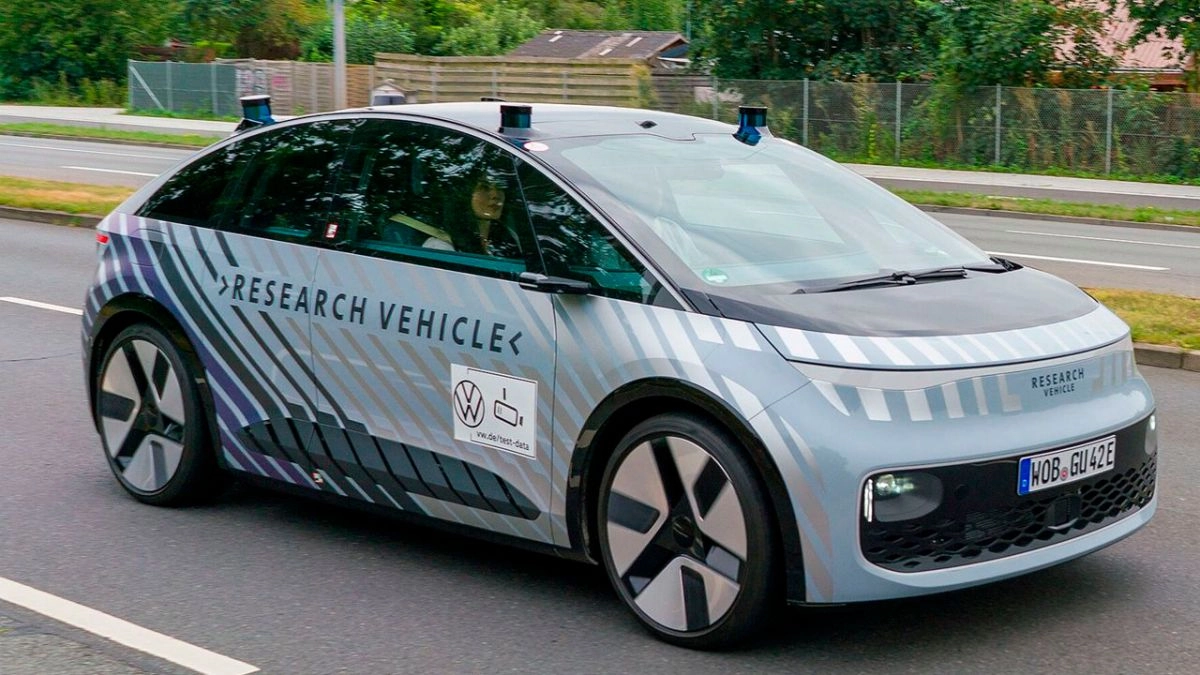

Since the advent of the electric motor, it is well known that the electrical industry has undergone one of its biggest alterations. A subsequent significant technological advancement is now being considered, besides electricity, called autonomous driving. Classic brands and brand-new companies are competing to take the lead in a market that promises to redefine cosmopolitan mobility in this situation.
Tesla has paved the way for its Cybercab strategy, but it's not the only one. Ford has chosen to move autonomously, and the company is currently testing its personal interpretation of the city car in real-world settings.
The Volkswagen Group has begun testing the study model, which was created specifically to evaluate the experience of driving alone. It is neither a design nor a direct creation of a production automobile. Instead, it is an experimental platform created to understand, analyze, and learn how the upcoming autonomous cars from the German conglomerate may be built. The Gen. Urban is comparable to a small town car in terms of length and proportions, similar to a Ford ID. 3 or perhaps somewhat less. However, its scope extends far beyond just appearance or sizes. Its goal is to become a rolling laboratory capable of addressing important animal behavior questions in a completely automated setting. A lab on wheels to comprehend the traveler. Skoda places an emphasis on the user in contrast to other projects that focused only on developing autonomous driving software. The idea is simple: it needs to inspire confidence and comfort for those driving it. It is not enough for the car to drive itself. Dr. Nikolai Ardey, Head of Innovation at the Volkswagen Group, succinctly stated the site's philosophy:" Autonomous driving systems is rapidly developing. We want to know how passengers experience autonomous driving with our Gen. Urban study car.
To accomplish this, the Volkswagen Innovation Group has assembled a cross-disciplinary group of materials, individual factors, software engineers, and designers. This combination enables us to examine both how the vehicle reacts to traffic and how people react when there is no such thing as a standard driver present.
Traveling without a wheel wheel: a thought-provoking experience.
For the most part, getting into a car, sitting in the driver's seat, and finding either a steering wheel nor wheels remains a disconcerting experience. To the extent that it is intended to study every aspect of customer habits, from their degree of relaxation to how they spend their time traveling.
Answering specific questions: Are customers secure? What are the actions they concentrate on while the vehicle is self-driving? What kind of pleasure is most important to them? How do the experience's lights and noise affect it? or how does the understanding of health change as a result of climate change?
Because, according to Ardey, the key to a good user experience is building trust through meaningful interaction, a peaceful environment, and clever assistance systems that effectively respond to passengers ' needs. In the end, technology does react to people, not the other way around. The whole Group will profit from this information over the long term.
Full independence under the supervision of a human.
The Gen. Urban was intended to be a car with the highest level of autonomy. It lacks the wheels or wheel vehicle, further supporting the concept of? a vehicle that fully assumes the driving position. A skilled health drivers is always present during testing, perhaps for safety and governmental reasons.
This specialized uses a specially designed controller to intervene when necessary while sitting in the passenger seat. Ford ensures a secure environment by collecting useful data about the intelligent system's performance and the reactions of the passengers.
Artificial intelligence, personalization, and the online world
Personalization is another wall of the job. Before the journey, each user may modify their preferences either through an application or straight from the vehicle itself. The settings for elements like desk place, climate control, and ambient lighting are automatically adjusted. upon arrival.
Additionally, artificial intelligence allows the Gen. Urban to adapt their whole electronic environment to their preferences. The vehicle's goal is to create a customized experience that reinforces the user's sense of control even when they are not driving, taking into account behavior, interests, and needs.
Real-world assessment in Wolfsburg, Germany
Volkswagen Group employees will be the only ones who will be able to participate in the original testing phase over a number of weeks. The path begins in the headquarters visitor parking lot and winds its way through Wolfsburg, where it will take you for about 20 minutes, along an industrial circuit that will span roughly 10 kilometers.
The path is not arbitrary. With the intention of subjecting the automatic system to various scenarios representative of normal city driving, it includes roundabouts, traffic lights, residential areas, true traffic, and different everyday situations.