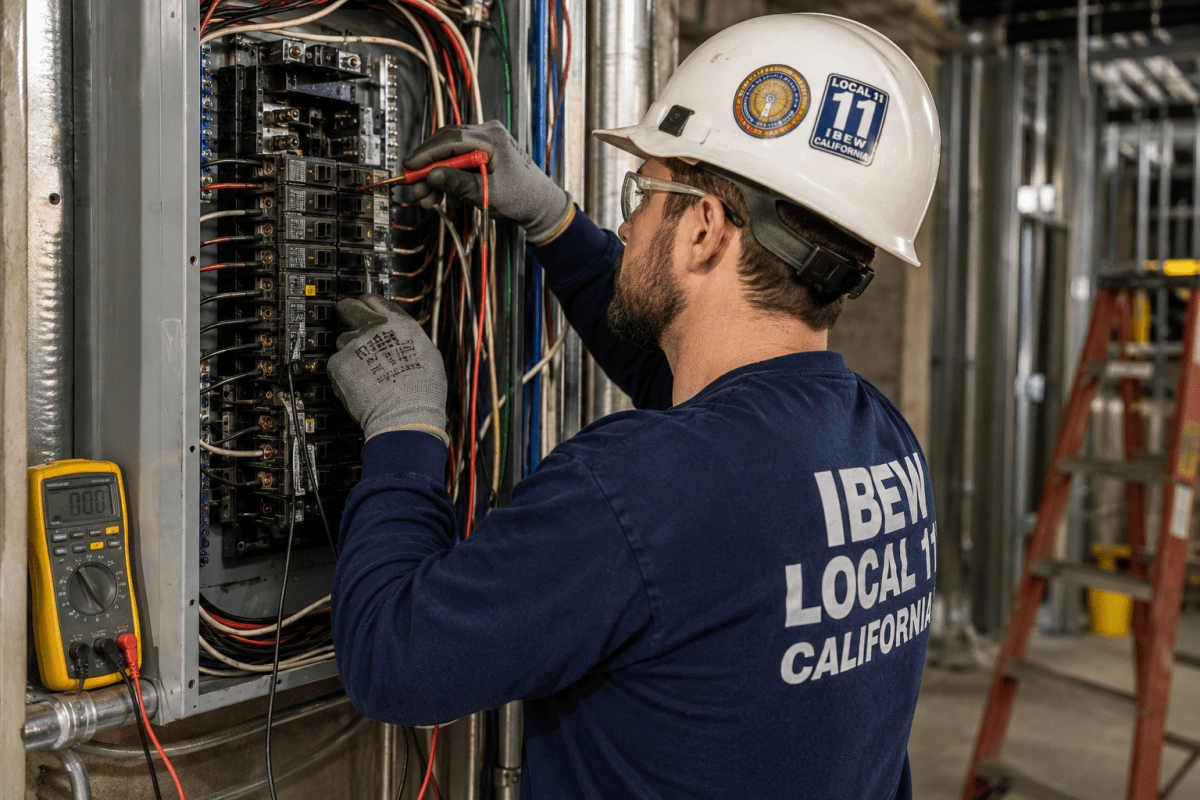

In a job market permeated by artificial intelligence and automation, one of the jobs that arouses the most interest in California is not linked to programming nor does it necessarily require a university degree. This is the profession of electrician, a profession whose demand is growing at the rate of construction, the electrification of homes, electric vehicles and the expansion of data centers.
Some union apprenticeship programs receive so many applications that available spots can fill up within minutes. The explanation is simple: they allow you to learn the trade while earning a salary, offer job benefits, and can lead to six-figure annual income.
Salaries of up to $130,000 a year, however, do not apply to all starting workers. That figure is typically associated with experienced electricians, unionized employees, specialized positions, or professionals who accumulate overtime.
Why so many young people want to become electricians
Unlike a traditional university degree, apprenticeship programs allow you to combine technical classes with paid experience on construction sites, homes, factories and commercial buildings.
The process usually takes between four and five years. During that period, the apprentice works under the supervision of experienced electricians and receives progressive increases as they complete hours of training.
In one of Northern California's union programs, for example, an electrician apprentice can start at a wage of more than $40 an hour. Compensation increases during the different stages and, upon completion of training, the basic salary can exceed $90 per hour, in addition to medical benefits and retirement contributions.
That level of compensation does not represent the reality of all electricians in the state, but it helps explain why certain calls attract hundreds or thousands of applicants.
You can see: A California county would increase the minimum wage for some workers to $30
How much can an electrician earn in California
Income depends on city, experience level, specialty, union membership, and project type. Workers involved in large public works, industrial facilities, power plants, or technology projects typically receive higher wages than those who perform residential repairs.
In California, public works contractors must also adhere to prevailing wages determined by the Department of Industrial Relations. These rates are set by trade and project location, and are often based on collective bargaining agreements.
State records show that some trainees can start at base rates close to $25 per hour and advance to more than $50 per hour before completing the program. By adding health insurance, pension, training, and other benefits, your total compensation can be considerably higher.
Therefore, the figure of $130,000 per year should be interpreted as an achievable level in certain markets and positions, not as a guaranteed starting salary.
Why it is considered a job resistant to artificial intelligence
Electricians use digital tools, automated systems, and increasingly sophisticated equipment, but much of their work requires physical presence and the ability to solve problems in unpredictable environments.
Their tasks include installing wiring, interpreting plans, detecting faults, repairing panels, working with control systems and adapting old installations to new safety standards.
Artificial intelligence can help diagnose breakdowns or plan projects, but it still cannot easily replace a person who must enter a building, identify a particular problem and execute a safe repair.
In fact, the growth of artificial intelligence itself could increase the need for electricians. Data centers require huge electrical installations, backup systems, cooling and ongoing maintenance.
You can see: Electrical problems that you should never ignore
Demand for electricians will continue to grow
The Bureau of Labor Statistics projects that employment of electricians will grow over the next decade. The agency highlights that the expansion of alternative energy sources, such as solar and wind, will require trained workers to connect these systems to homes and electrical grids.
Added to this are other factors:
Construction and extraction occupations, in general, will generate hundreds of thousands of job openings each year due to growth and turnover, according to federal projections.
What it takes to work as an electrician in California
Most workers start through a technical school or registered apprenticeship program. California has an official database that allows you to search for programs by occupation, county, and sponsoring organization.
Each call sets its own requirements and dates. Some programs ask for:
The Department of Industrial Relations advises that a registered program may exist even if it is not currently receiving applications. That is why it is recommended to contact each organization directly to find out when their next call will open.
Opportunities can also be found on the Department of Labour's apprenticeship finder, which brings together vacancies from registered employers and organizations across the country.
It is not an easy job nor is it risk-free.
The attractive salary does not eliminate the demands of the job. Electricians work on their feet, carry tools, climb ladders, and may spend hours in confined spaces or outdoors.
They are also exposed to electric shocks, burns and falls, so training and compliance with safety regulations are essential.
Schedules may include nights, weekends and overtime. In certain projects, this availability is precisely one of the factors that allows us to exceed $100,000 annually.
An alternative to university, but not a shortcut
Becoming an electrician can offer a route to the middle class without taking on large student debt. The trainee gets paid while training and upon completion of the program earns an industry-recognized credential.
But the process requires years of training, discipline and practical experience. The most attractive spots are limited and competition can be intense.