
Reports of a Chinese invasion in Salvador de Bahía, a city in northeastern Brazil, surfaced at the start of 2026, but were later found to be unfounded.
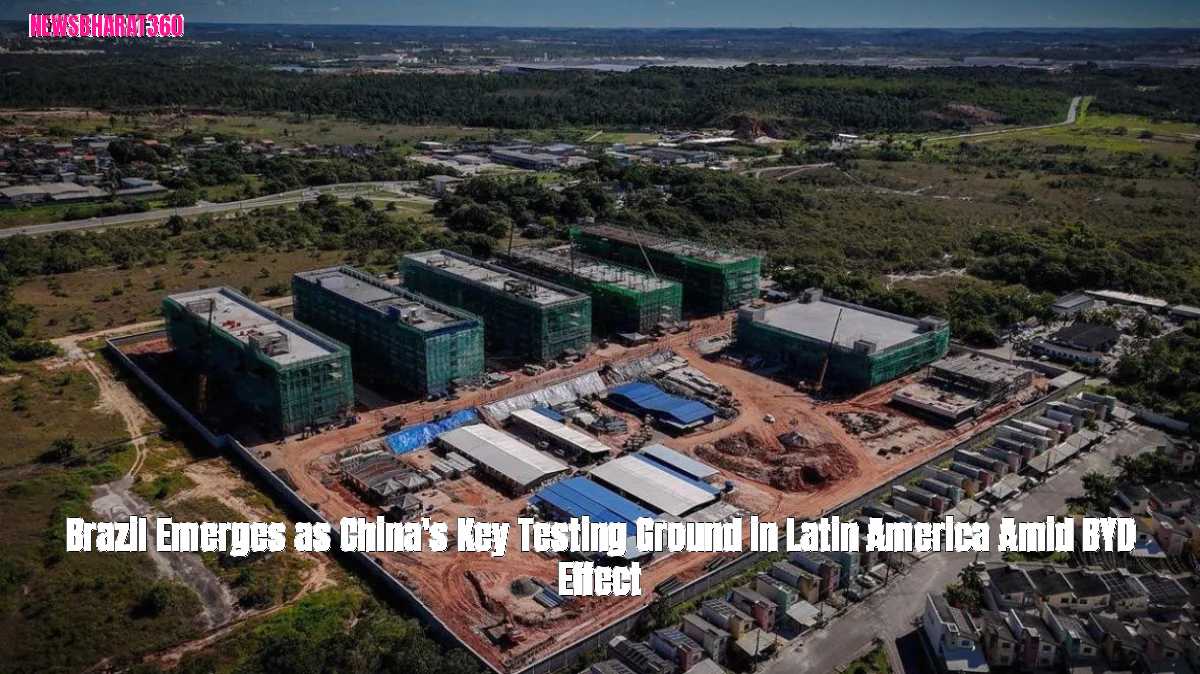
Social media posts have circulated images of a housing complex under construction, allegedly intended to provide accommodations for 10,000 Chinese workers who will be employed at the newly inaugurated BYD factory.
Chinese automaker BYD surpassed Tesla, led by Elon Musk, in 2025 to become the world's largest producer of electric vehicles.
The corporation has selected Camaçari, located within the Salvador metropolitan area, as the site for its largest manufacturing facility in Latin America.
The factory, which is still undergoing construction, officially opened in October 2025. Within a year of its inauguration, over 100,000 vehicles assembled from imported kits were delivered to dealerships nationwide, solidifying the brand's position as one of the top sellers.
Brazil-based production is slated to commence by the end of 2026. The existing plant currently employs 7,618 direct staff members, with approximately 6% or 457 being foreign nationals. Notably, the majority of foreign workers are Chinese.
Chinese laborers are contributing to the ongoing construction efforts within the factory complex and staff housing areas.
Federal Police records indicate that between 2024 and the present, a total of 2,310 residency visas have been granted in the municipalities of Camaçari and Lauro de Freitas, with the majority being temporary in nature.
In the city of Camaçari, home to approximately 300,000 residents, the Chinese community is not visibly concentrated in a specific area. Instead, new arrivals are dispersed among hotels and some residential complexes that are currently unoccupied.
While there is a lack of new restaurants catering to immigrant communities, many employees of BYD, including those from diverse backgrounds, opt to dine within the factory's canteen, which offers a range of international cuisine, featuring both Chinese and Brazilian dishes, or prepare meals at home.
The prevailing view is that these individuals are heavily invested in their work and yield limited personal results.
Cassia Cotia, a real estate agent residing in a residential complex, notes that the lifestyle of Brazilian residents differs significantly from that of Chinese citizens who rent homes in the complex. According to Cotia, Brazilians typically return home, take a shower, and relax on the couch, watching TV, whereas Chinese residents continue working even after arriving home, exhibiting a more reserved demeanor. The complex has more than 60 houses rented to Chinese citizens.
The distinct features of this emerging migratory pattern are gradually becoming apparent.
In the central market of Camaçari, two restaurants have recently displayed posters featuring Chinese characters, advertising their offerings of "yakisoba," a popular Asian dish.
The local community of Jehovah's Witnesses has started conducting meetings in the Mandarin language.
In the northeastern regions of Brazil, where the "forrós" musical genre originated, as well as in other vibrant nightlife areas of the city, a particularly developed form of the genre has emerged, often resulting in performances that gain widespread attention on social media platforms.
A recent social media video has gone viral, depicting a young woman instructing a Chinese man on how to move his hip in a dance-like motion. The accompanying caption suggests a cultural exchange between Brazil and China, implying that Brazil's cultural influence may be spreading to China through a process of cultural assimilation.
A BBC News Brazil team observed a vibrant gathering of locals enjoying beer and pizza on a sidewalk table near Plaza dos 46, a popular evening destination where residents often socialize, take their children to the park, and dine.
Cassia, who formed close bonds with her Chinese clients, has come to appreciate the warmth and freedom of living in Bahia. She has taken on a supportive role, assisting them with everyday tasks, including bill payments and arranging for home repairs, such as hiring an electrician.
A group of individuals communicate via the Chinese social media platform WeChat, utilizing the application's language translation feature to facilitate cross-linguistic exchange. The sender transmits messages in Portuguese, which are then automatically translated and received by the recipients in Mandarin.
China's automotive industry has made significant strides in global leadership, with BYD's establishment in Brazil serving as a notable milestone. The company's Bahia plant in Camaçari holds particular significance, as it occupies the same site previously used by Ford, which ceased operations in 2021.
In the early 20th century, the United States served as the catalyst for the first significant automotive revolution, marked by Henry Ford's pioneering introduction of the mobile assembly line, which facilitated mass production.
Following its initial market dominance, a pioneering American brand held a leading position until it faced increased competition from European and Japanese companies, which subsequently established themselves as major global brands.
Prior to the start of the twenty-first century, China played a relatively minor role in the automotive sector. However, the sector's significant transformation, driven by the shift from combustion-powered vehicles to electric vehicles, presented China with an opportunity to assert its influence.
China has invested significantly more in electrification than the rest of the world, according to Rogélio Golfarb, a seasoned automotive executive with extensive experience in Brazil, having previously held positions at Ford and as president of the Anfavea, and now serving as a consultant.
Government officials recognized the potential for a competitive edge, which they sought to achieve through a comprehensive program that spanned multiple areas, including education and research and development.
BYD is among several electric vehicle manufacturers that have emerged in China over the past two decades, driven by the country's unique approach to state-led economic development, which combines government support with domestic market competition.
China's success in the electric vehicle market can be attributed to a strategic approach led by pioneering companies, which focused on innovation and originality rather than mere imitation. This formula, built on four key pillars, enabled the country to achieve a significant advantage in the global market. The pillars include a pioneering spirit, a commitment to innovation, large-scale production capabilities, and vertical integration, allowing companies to manufacture a wide range of components necessary for producing electric vehicles.
The company's approach diverges significantly from the conventional model employed by traditional manufacturers, who typically rely on a network of suppliers for parts and components.
Chinese electric and hybrid vehicles gained significant competitiveness, thanks to a combination of factors, particularly around the time when the US and European markets became increasingly restrictive to Chinese imports.
Brazil emerged as a prime destination due to its vast size, substantial reserves of raw materials crucial for car battery production, and an abundance of renewable energy resources, coupled with a sizable consumer market.
Brazil has become the world's largest testing ground for Chinese automotive brands, with over 20 Chinese brands currently operating in the country.
Besides BYD, other major players in the market include GWM, which has acquired a Mercedes factory in Rio Grande do Sul, and Geely, which has formed an alliance with Renault in São José dos Pinhais, Paraná state.
Ford's executive stated that the traditional concept of a 'popular car' in Brazil is shifting, with electric vehicles now taking its place.
The top-selling model in the market is the BYD Dolphin, a battery-electric vehicle.
Júlio Bonfim, president of the local trade union of metalworkers, observes that production within the plant has significantly increased its tempo.
The editor notes that BYD has already begun production, in contrast to Ford, which spent two years training staff and manufacturing 12,000 units of the Courier model before transitioning to full production. He likens BYD's swift transition to changing a tire while driving at 180 kilometers per hour.
He notes that labor disputes have escalated at a comparable pace.
BYD is currently facing a significant issue with moral harassment, according to Bonfim, who notes that the number of employee complaints regarding pressure and unfair treatment has increased substantially.
Brazilian leaders' behavior is influenced by cultural perceptions originating from Chinese culture, resulting in a ruthless management style that involves persecuting and harassing workers in a labor context.
The Public Labour Ministry has initiated an investigation into allegations of employment and sexual harassment made by a trade union, but subsequently closed the case due to insufficient evidence.
The BBC News Brazil team encountered difficulties in gaining access to a BYD factory, with efforts spanning two months. Despite these efforts, the company denied the team permission to visit the facility. Additionally, attempts to engage with employees were met with reluctance, as they expressed concerns about potential repercussions from speaking with the press.
BYD maintains a strict policy of non-tolerance for any form of harassment, discrimination, or unlawful conduct.
The organization has established internal channels that enable individuals to submit complaints confidentially and anonymously, and it thoroughly investigates each report, taking necessary actions in response.
The chairman of the metallurgical union drew parallels between the past and present, noting that Ford experienced labor disputes in its early years, primarily centered around wages and working conditions, as well as instances of xenophobia.
The Northeast region, particularly Bahia, has been subject to a widespread stereotype portraying its inhabitants as lazy and only capable of preparing simple dishes, such as acarajé, and sleeping in hammocks.
Ford's experience in Brazil was informed by his prior involvement with the American trade union movement, specifically the United Auto Workers (UAW), as well as his exposure to the Brazilian labor movement in the ABC Paulista region.
Following a series of labor disputes from 2004 to 2007, relations between the company and its employees reportedly experienced a significant improvement, accompanied by enhanced working conditions at the plant.
Ford's production peaked at 250,000 vehicles, but the company was forced to scale back operations in 2013 as the economy began to slow. The situation deteriorated further with the onset of the COVID-19 pandemic, ultimately leading to Ford's decision to cease operations in 2021 and shutter all its manufacturing facilities in the country.
The situation in Bonfim is distinct, largely due to a unique aspect of China - its authoritarian government, which lacks trade union freedoms.
Chinese observers face significant challenges in comprehending the dynamics of the Brazilian trade union movement due to the absence of trade unions in China, resulting in a lack of comparable domestic experience.
A labor union organized a protest in front of a BYD factory in July 2026, resulting in the first factory shutdown. Approximately 2,700 workers returned home in response to a notification issued to two staff leaders, prompting the protest action.
Brazil has strengthened its economic ties with China, with the automotive market being one key sector contributing to this relationship. By 2025, Brazil had become the primary recipient of Chinese investments globally, accounting for 10.9% of the $60 billion in foreign investments, as per data from the Brazil-China Business Council (CEBC).
Brazil's appeal to Chinese capital stems from a combination of factors, according to Tulio Cariello, director of content and research at CEBC. The country boasts a substantial consumer market, a favorable investment climate, and an abundance of clean energy, which aligns with China's decarbonization goals. Additionally, Brazil offers a skilled workforce, further enhancing its attractiveness to Chinese investors.
Brazilian engineers and technical staff have received high praise from Chinese entrepreneurs, according to recent statements.
Between 2023 and 2025, Brazil witnessed a significant surge in the number of work-related residence permits issued to Chinese citizens. This increase, which tripled the previous year's figure of 3,000 to 10,000, is largely attributed to the growing presence of Chinese companies in the country.
Chinese citizens' interest in Brazilian Portuguese is increasing, according to Alice Oliveira, a social scientist who has transitioned to teaching Portuguese to Chinese students. This interest is notable, given her experience as a professor of Portuguese, following her participation in the inaugural 2023 promotion of Mandarin students at the Confucius Institute in Salvador.
A network of cultural centers promoting Chinese language and culture has established a significant presence in Brazil, with 14 centers currently operating nationwide. This development is indicative of a broader initiative aimed at bridging cultural gaps between China and Brazil, transcending mere investment figures.
The strengthening ties between Brazil and China have become a focal point of ideological debate in the country, particularly with China's emergence as a significant global power and the return of Donald Trump to the US presidency.
A false report claiming 10,000 Chinese were invading Camaçari emerged in March of this year, spreading through multiple online profiles.
Brazil has transitioned away from a policy of exclusive alignment with a single superpower, according to Wendel Henrique Baumgartner, a professor at the Federal University of Bahia's Department of Geography.
The official emphasized the need for caution in avoiding a shift from historical dependence on European and later US markets to a new reliance on China.
A professor emphasizes the importance of adopting a strategic approach and engaging with the global community, citing the country's current ability to make informed choices and avoid being swayed by one-sided influences.