
The National Transportation Safety Board (NTSB) plans to issue a preliminary report in about 30 days and a final report — which includes the probable cause — in an approximately 18 months period from the deadly news helicopter crash that occurred on September 15 in Chatsworth, located in the San Fernando Valley, Los Angeles.
In the crash of the Airbus AS-350B2 helicopter died reporter Eliana Moreno and pilot George Marciniw, who provided air coverage for the NBC4 channel and its sister broadcaster in Spanish, Telemundo 52.
A third person died on the ground. It was that the victim was identified by the forensic doctor as Edy Fernando Gutiérrez Mejía, 29, from Cuilapa, Guatemala, who barely had two days to have arrived in the United States. The man planned to pick up a car and take it home to sell it. Now, his family is working to repatriate his remains to Guatemala.
Eliana Moreno and George Marciniw identified as the Reporter/Pilot for NBC4 Los Angeles in the chopper that crashed.Eliana was a seasoned reporter who went by "Eli in the Heli" on Instagram and George was highly experienced, logging more than 14,000 hours in the chopper.? https://t.co/Cp9LUrRNiI pic.twitter.com/vJIJRxl4LY
Two other people who were also on the ground were injured, according to Los Angeles Fire Department (LAFD) battalion chief Rico Gross.
"The video recording of the helicopter's live broadcast is the most important evidence identified so far," NTSB chief investigator Fabián Salazar said at a news conference.
The video, released online, shows how the helicopter’s camera captured the image, then several alarms — apparently indicative of a engine failure — are heard as the helicopter begins to descend. Then you hear reporter Eliana Moreno asking, “Can’t you lift up the flight?” before the image of the video abruptly concludes in a matter of seconds.
The tragic accident of the NewsChopper4 occurred shortly before 7 p.m. by m. The incident occurred between two commercial buildings on Mason Avenue 9151, near Nordhoff Street, in Chatsworth, the LAFD. On Wednesday, the remains of the helicopter were still on the scene of the tragedy.
Salazar that the helicopter (N358TV) suffered considerable damage during the news-gathering flight around 19:00. Moreno and Marciniw had been assigned to cover a fatal traffic accident at the intersection of Nordhoff Street and De Soto Avenue.
In that accident, Bailee Lynn Ríos, 36, violently struck the vehicle she was driving against a Metro bus, causing the death of two people.
The woman, a resident of Simi Valley, was arrested for murder and paid a $4 million bail, according to the Los Angeles Police Department (LAPD).
Eliana Moreno, a 38-year-old air photographer, was born in Orange County and graduated from Chapman University in 2010.
“She was very beautiful. He loved speaking Spanish,” said Esteban Jiménez, a friend of the reporter. Moreno joined Angel City Air's helicopter team in September 2010 and worked for several Southern California media outlets.
According to her Instagram page, she had several chickens and two dogs. she loved riding and had engaged last year.
The news channel that George Marciniw grew up in Southern California and graduated from Burbank High School in 1974.
“He was my instructor; I knew him for several decades. was the best. I still can’t believe what happened to him,” Jiménez, also a pilot, told La Opinión. “He was my friend, and I was about to retire.” Moreno and Marciniw began working together in 2023.
“My thoughts are with all the people affected by the bus and helicopter accidents, and especially with the families and loved ones of Eliana Moreno and pilot George Marciniw, as well as with the whole family of NBC4/Telemundo 52, who regret the loss of members of their team while doing their job,” said Karen Bass, mayor of Los Angeles.
Bass added that she was “deeply grateful to our firefighters, paramedics and police officers who immediately responded to two incredibly difficult scenes to save lives and provide help to those most in need.”
Recognizing that the National Transportation Safety Board will be in charge of the investigation, Bass considered that at this time its focus “is on the victims, their families and loved ones, and in providing them with all possible support as our city faces these two tragedies.”
Before analyzing the cause of the helicopter crash, researcher Salazar noted that experts would gather factual data before analyzing the cause of the tragic event. He explained that an intact copy of the video recording of the live broadcast will be sent to the recording analysis laboratory to conduct a sound spectrum analysis of variations in engine speed and possible pilot communications.
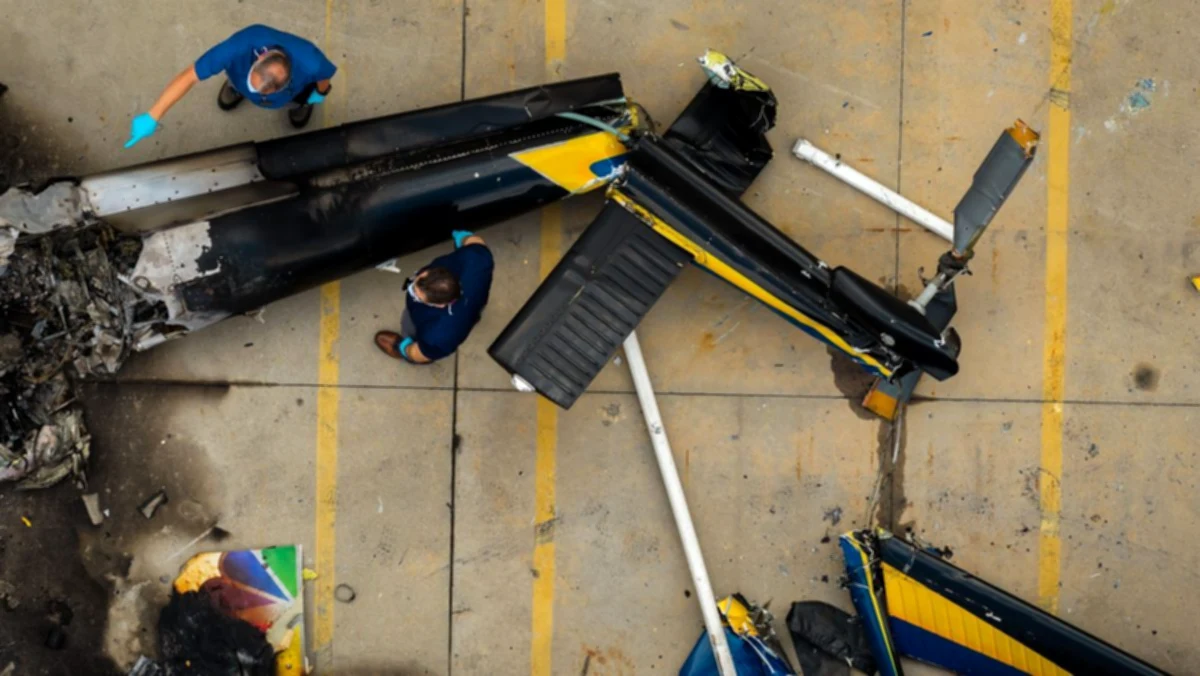
NTSB investigators are collecting data from the remains of the aircraft (despite the post-accident fire), obtaining maintenance records from the aircraft owner, securing security camera recordings and interviewing witnesses.
Salazar said the remains of the helicopter would be transferred to a safe facility for a more thorough examination, and that helicopter cell and engine manufacturers could also carry out detailed examinations of the components, including disassembly to their basic elements.
Among other questions pending the investigation is to determine the altitude of the helicopter and whether it was in stationary flight outside the ground effect. In aviation, the “soil effect” is an aerodynamic phenomenon that occurs when an aircraft or a helicopter flies very close to the earth’s surface, at an altitude smaller than the envelope of its wings, creating a “mattress” of compressed air that increases support and reduces resistance.
“We are thoroughly examining the remains [of the helicopter] to the extent of our possibilities to obtain as much information as possible despite the fact that they suffered a fire after the accident,” Salazar said, who stressed that the helicopter maintenance records are held by the owner of the aircraft and are being handed over to the investigation.”
Questioned by The Opinion regarding the protocols that pilots follow in the midst of an emergency and the way to respond, the researcher Fabián Salazar replied that they are divided into two general categories: those emergencies that require immediate and instinctive action by the pilot, and those that allow him the luxury of having some time to collect information, evaluate it and choose the best option.
“Pilots are being trained to be prepared and react to any of these types of emergencies when they arise,” he said.
Asked about possible rules from the Federal Aviation Administration (FAA) on how media helicopters should operate, such as setting gradual altitudes or minimum distances from the working area, Salazar replied that it was a difficult question to answer.
“We will conduct this investigation of the accident in particular. If we hypothetically find a problem that requires a regulatory solution, we rely on the FAA as part of the research team. So, if we discover a problem that needs to be addressed immediately, they themselves will be discovering it with us in real time.”
And he added: “Now, if the NTSB decides to formulate a security suggestion for a minor change or a security recommendation for a major change, we will bring that recommendation to the most appropriate authority.”