
On a Thursday in May 2025, a dozen journalists were able to enter the Pinewood Studios, west of London, where Marvel was filming the spin-off series of “WandaVision,” which at that time still had no name. It was the 68th day of filming of 105 scheduled days, which had begun on February 24.
That day, in the historic studios where the James Bond saga was born and where “The Fantastic Four” was recently filmed, we could talk to Paul Bettany, who has been playing Vision (and his artificial intelligence J.A.R.V.I.S.) since “Iron Man” (2008). We also talked with the actors Jonathan Sayer and Emily Hampshire, and with the creator and showrunner of the series, Terry Matalas.
In those conversations we discovered the complexity of the new series that will premiere on Disney+ on October 14.
When White Vision kicked off at the climax of “WandaVision,” it left fans of the Marvel Cinematic Universe (UCM) with a profound existential dilemma: what happens to an artificial being who recovers all his data, but remains deprived of his soul?
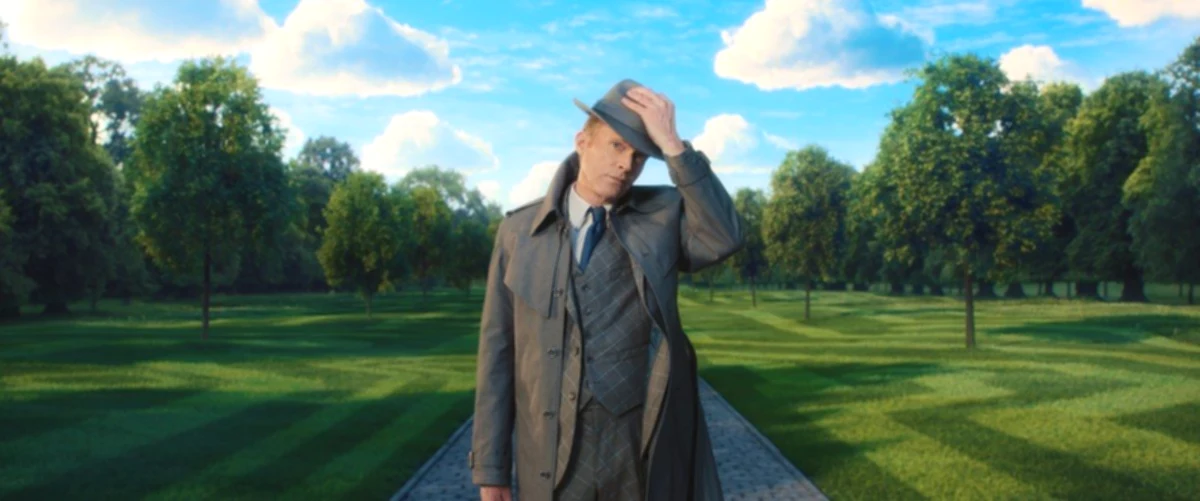
In “VisionQuest,” Matalas and Bettany answer that question by taking the android hero in a radically unexpected direction. Instead of reuniting with the Avengers for cosmic battles, Vision reappears discreetly and goes unnoticed, working in a pub during the day and retreating at night to a surreal psychological sanctuary built within his own processing unit.
It is an internal mental home inhabited by humanized artificial intelligence. So, “VisionQuest” moves away from the usual superhero show to offer an intimate and surprising study of an artificial mind trying to learn to feel again.
Thro much of Vision’s journey at the UCM, his journey reflected the classic archetype of Pinocho: a synthetic android who struggled to become a “true child” through love, grief and domestic coexistence with Wanda Maximoff. “VisionQuest” gives a twist to that paradigm. Having been restored to his historical memory without any of the corresponding emotional attachments, Vision finds himself in a state of affective paralysis.
Reflecting on the evolution of the character, Paul Bettany points out that Vision has left behind his initial innocence of “born yesterday” to dive into a much darker and inquisitive terrain.
“I once heard someone say you can do two things with robots in stories,” Bettany explains. “You can do what Pinocho did, ‘I’m a real kid’ – something we’ve already done – or you can do what Frankenstein did. What I mean is that Frankenstein represents “Who am I, what is my purpose, and why am I created?” For me, that’s also a really interesting part of this, and something that feels very different from the Vision we’ve done before.”
Instead of jumping into heroic action, Vision begins his journey in absolute anonymity, Matalas explains.
“We follow Vision after she has risen... but she is less in contact with her humanity and her past than she would like. So, while you’re in the real world, you’re living a bit in the shadows. It looks human. He doesn’t walk around wearing a coat... In fact, when we meet him, he’s working in a pub,” reveals the showrunner.
This experience of isolation connects to a central emotional theme that Bettany believes connects Vision directly with the audience, especially with those who feel misunderstood.
“Many of the people who come to talk to me are the kids I was when I went to school,” Bettany reflects. “That is, the lonely, the strange, the child who felt he didn’t fit. Vision is always in a state of change, and teenagers are in a state of change, and there is an overwhelming variety of choices they can make about who they are.”
To reconcile its vast database with its absolute lack of emotional resonance, Vision builds the “Mind Space” (Mental Space), a surrealistic New York-style loft-style virtual environment housed entirely inside his head. When Vision enters the pub freezer at night to cool their systems, their consciousness retreats to this mental sanctuary.
To help process human behavior, Vision orders the routines inherited from Tony Stark’s artificial intelligence integrated into his code, to manifest as human avatars.
“He has this place we call the Mind Space, which is literally like a house inside his head,” says Bettany. “There are these complementary artificial intelligences that live with him and that are useful for troubleshooting, and also to help you understand the data you’ve collected during the day.”
This internal home has a section that interprets humanized versions of famous Marvel operating systems:
Actor Jonathan Sayer, who plays U, shares how he and Henry Lewis approached the translation of mechanical extremities to human interpreters.
“Henry and I worked together for a very long time before this, almost always as a comic duo,” Sayer says. “We are overconnected. Very often, the dynamic has been that U goes like two steps behind Dum-E... Probably the two together we equal one.”
Sayer jokes about his intense preparation: “I spent hours in my home just pretending to be a robotic arm!”
Within Vision’s internal family, Sayer describes his roles as the classic “comic-wrappers” who offer absurd solutions while Vision makes serious counterpoints. “We’re offering solutions and trying to help,” Sayer says. “It’s like we’re throwing balls and he’s throwing them out of the field.”
On the visual plane, the Mind Space plateau is designed with subtle imperfections that reflect how artificial intelligence simulates reality.
“Design makes a slide to the way our current version of AI processes things,” says Matalas. “For example, if you look at the ladder from the stairs, you don’t get up completely...it’s beautiful in the way it’s untouched.”
While the lower floors of the Mind Space function as a laboratory on human behavior, the locked room on the upper floor houses the most shocking revelation of the series: Ultron is alive inside Vision’s head.
“VisionQuest” reveals that during the climax of “Avengers: Age of Ultron,” Vision did not completely eradicate its megalomaniac creator. In a secret act of compassion, Vision made a backup of Ultron’s central code and locked it inside his own subconscious.
James Spader returns to play Ultron, appearing in human form within the Mind Space. Closed in Vision’s mental attic and with internet access, Ultron spends his days painting, studying human history and debating philosophy.
Matalas describes the dynamics between Vision and its creator as a complex relationship of “father, son, therapist and psychopath”. Having absorbed centuries of human culture, art and literature, Ultron actually possesses a much wider — though deeply cynical — understanding of humanity than the Vision itself. To understand the human spirit, Vision is forced to seek advice from his worst enemy.
Vision’s quiet mental sanctuary is destroyed when the real world goes out to look for it. The series presents Paladin (Todd Stashwick), a formidable mercenary of dubious morality hired by mysterious forces to track and harvest Vision’s advanced technology.
The resulting persecution forces Vision to form an unexpected alliance with Thomas Shepherd (Ruaridh Mollica), a conflicting and deceitful teenager who is secretly the reincarnated soul of Tommy Maximoff, the son of Vision in “WandaVision.”
As Vision navigates the real world alongside her lost son, the series balances the suspense of risk running with human peculiarities, such as Vision’s astonishing taste for clothes.
“I’m a very superficial human being and I like clothes a lot,” Bettany jokes, admitting her involvement in choosing clothes tailored to her character.
With her philosophical inquiry, family dynamics and psychological intrigue, VisionQuest promises to transform Vision from a stoic superhero into one of the most surprising, vulnerable and fascinating figures in the Marvel Cinematic Universe.