

Mercosur and the EU sign the agreement that creates the world's largest free trade zone: why is it so controversial
The transatlantic pact was signed in the same venue where the South American bloc was born in 1991
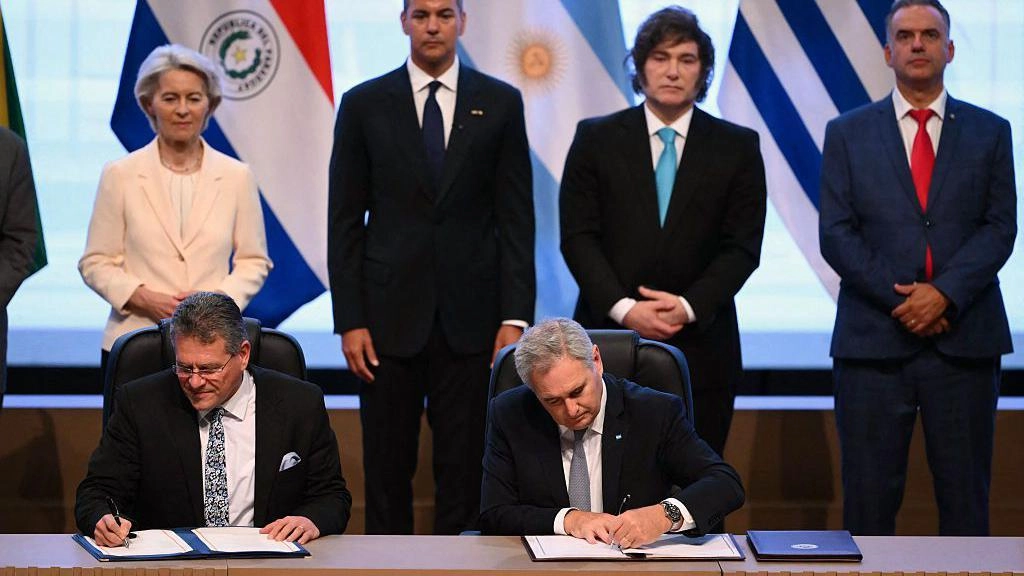

After almost a quarter of a century of negotiations, the Southern Common Market (Mercosur) and the European Union (EU) signed this Saturday the agreement that creates the largest free trade zone in the world.
Almost all the presidents of the South American bloc, except for Brazil's Luiz Inacio Lula da Silva, were present this Saturday at the Jose Asuncion Flores Theater of the Central Bank of Paraguay for the signing of the transatlantic agreement.
The chosen venue could not have been more symbolic, as it was in this same building that Mercosur was founded in 1991, then comprised only of Argentina, Brazil, Paraguay, and Uruguay.
“This is Mercosur's greatest achievement since its creation,” stated Argentine President Javier Milei, who said that his country will continue seeking to establish alliances with the United States, Japan, the United Arab Emirates, and “with all those partners who share a vision of open markets and freedom.”
For his part, Lula da Silva, who excused himself from attending in order to receive part of the European delegation in his country hours earlier, asserted that the pact “is multilateralism's response to isolation.”
The president of European Commission President Ursula von der Leyen said: “We are creating a market of 720 million people… it is the largest trade agreement in the world and this is a very powerful message.” Mercosur and the EU represent around 25% of the world's Gross Domestic Product (GDP). products such as meat, sugar, rice or honey, and reserve the right to intervene if a large price imbalance occurs against local producers.The tariffs that exist on 77% of Mercosur's agricultural exports to the EU will be eliminated within ten years, France 24 reported. In return, EU members will be able to sell industrial machinery, electrical equipment, automobiles, pharmaceuticals, clothing, and other industrial goods in Mercosur, a space that until now has been closed due to high tariffs. These tariffs, which reach 35% for vehicles, will gradually disappear. "This will generate mutual opportunities for employment, income generation, sustainable development, and economic progress," predicted Lula da Silva. However, the Brazilian president's optimism is not shared by some of his new partners. In France, Poland, Hungary, Austria, and Ireland, opposition to the agreement is resounding. Farmers and ranchers are leading the objections to the pact, fearing "unfair competition" because South American agricultural products may be cheaper due to lower labor and environmental costs. Experts agree that there are significant differences in health and animal welfare standards between the Mercosur and European blocs. The EU has strict rules on traceability, pesticides, hormones, and animal welfare. There are concerns that imported products may not meet equivalent standards but will still compete on price. A point that generates rejection among both producers and consumers.
Days before the agreement was signed, farmers in Paris and other European capitals staged massive protests against the agreement.
In 2019, when the deal seemed a done deal, environmental concerns became a major sticking point, preventing negotiations from moving forward ever since.
Francois Rimeu, senior strategist at Credit Mutuel AM, opined that, “while the agreement is very positive for certain European industries, such as the automotive sector, it will be more negative for others, such as agriculture.
It is estimated that once the has been fully implemented, EU exporters will save around US$4.6 billion annually in tariffs, mainly on chemical and pharmaceutical products, General industrial machinery and automobiles.
But for many analysts, the Mercosur agreement is more strategic for the EU than macroeconomic and will help displace Chinese influence in the region.
“The economic and profit agreement implications for listed companies are modest, but the trade agreement strengthens the EU's geopolitical position in South America,” estimated Nenad Dinic, Equity Strategy Research,Julius Baer.
“Strategically, Mercosur would help the EU diversify beyond China as a source of critical minerals, which are vital for the green transition and defense-related supply chains,” stated Max Maton, economist at Oxford Economics.
The pact will allow the EU much better access to the Mercosur countries' abundant critical minerals by eliminating export taxes.
Argentina, Brazil, Paraguay, Uruguay, and Bolivia hold a considerable share of the world's reserves of lithium, graphite, and Nickel.
At a time when trade protectionism seems to be on the rise, five South American countries have chosen to strengthen their ties with Europe and accept that in some industries there will be winners and in others there will be losers. And that is something that can hardly be avoided.
This news has been tken from authentic news syndicates and agencies and only the wordings has been changed keeping the menaing intact. We have not done personal research yet and do not guarantee the complete genuinity and request you to verify from other sources too.