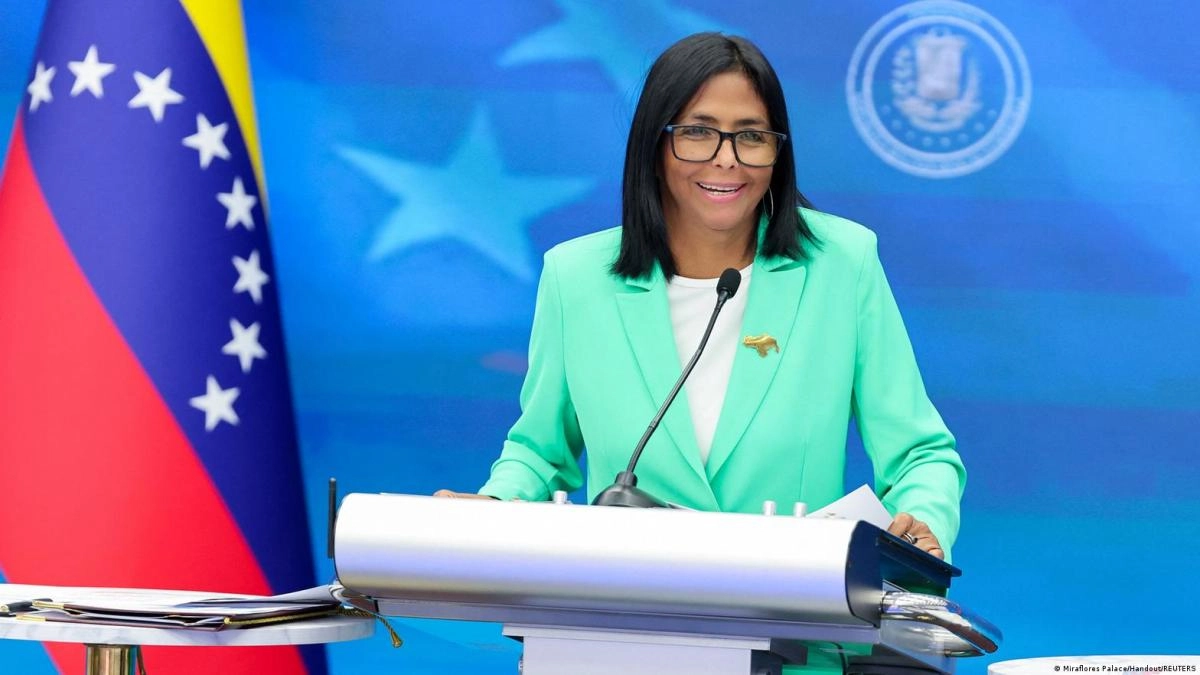

July 2 marks 180 days since Delcy Rodríguez took over as head of the Presidency of the Republic of Venezuela, after the capture and extraction of Nicolás Maduro by United States military forces. This period marks the limit that the Constitution establishes for the exercise of a temporary substitution, designed to avoid a power vacuum in the presidency, not to prolong indefinitely the exercise of the Head of State by an official who was not elected by popular vote.
This is stated by the Academy of Political and Social Sciences in its statement of April 14, 2026, where it warns that “the indefinite extension of the exercise of the office of President of the Republic by a non-elected authority is a violation of the democratic principle and the original legitimacy of the National Executive Branch.”
Beyond the legal controversy over the duration of the interim office, the imminent expiration of the office intensifies the strong questions in the country about Rodríguez's authority, due to his lack of legitimacy to occupy the Presidency of Venezuela, his high co-responsibility in the crisis caused by Chavismo, the deep dissatisfaction with the results of his interim office and the low confidence of the citizens in his conduct of the democratic transition process.
This strong rejection of the figure of Rodríguez has led to a growing demand from academic, union, union, student, political and civil society organizations, who demand an end to the interim term through a new presidential election. These claims reflect the feelings of the general population. According to the Meganalisis survey from April of this year, 87.24 percent of Venezuelans consider that the solution to the country's crisis lies in a presidential election during 2026.
Rodríguez's appointment was made by a president who had usurped the position
The first source of questioning the legitimacy of Delcy Rodríguez lies in the authority that appointed her executive vice president, a position from which her access to the Presidency of the Republic derives.
This is the approach supported by constitutionalist José Ignacio Hernández in his study Is there a transition in Venezuela? According to Hernández, the electoral fraud committed by Maduro in the July 2024 presidential elections dragged his entire government into illegitimacy. Consequently, given that “Maduro was neither president-elect nor in the constitutional exercise of the Presidency, the designation of Delcy Rodríguez as vice president was, likewise, a null and ineffective act, as it was a consequence of the usurpation of functions of the Presidency.”
Rodríguez's indefinite interim term violates the Constitution
The questioning of Rodríguez's legitimacy of origin is further aggravated due to his intention to extend the presidency in charge indefinitely and unconstitutionally. This claim has been described by jurist Hernández as a “violation of the constitutional framework of presidential misconduct, carried out with the purpose of evading the duty to call elections.”
The Venezuelan Constitution contemplates “only” two types of presidential absence: absolute absences and temporary absences. If an absolute failure occurs during the first four years of the period, a new election must be called within the following 30 consecutive days.
In the case of temporary absences, these can extend up to 90 consecutive days. Beyond that period, the National Assembly must declare if there is an absolute fault or, if not, extend the period for up to ninety more days. That is, the maximum duration of a temporary presidency is 180 days. “After the extension expires, the foul becomes permanent,” says Hernández.
Despite this, the National Assembly and the Supreme Court of Justice, controlled by the ruling party, have avoided declaring the absolute absence of Nicolás Maduro, maintaining a situation of indefinition aimed at avoiding the constitutional mandate of calling a new presidential election.
This maneuver has been rejected by recognized constitutionalists and organizations such as the Constitutional Block association of jurists, which, in its statement of April 6, 2026, demanded that the National Assembly declare the absolute absence of the Presidency and the National Electoral Council (CNE) call a new presidential election.
The lack of tangible results increases Rodríguez's illegitimacy
Rodríguez is also questioned about his lack of legitimacy of exercise, that is, the low trust and scarce support of the population, derived from his lack of capacity to offer effective responses to the most serious and urgent problems of Venezuela. This questioning is reinforced by the fact that Rodríguez is identified as one of the main figures who contributed to creating the crisis that the country is experiencing today.
After five months of interim, citizens do not perceive sufficient changes in the conditions that gave rise to the Venezuelan crisis or tangible improvements in their daily lives. The accumulated inflation during the first five months of the year reached 101.97 percent and the interannual inflation was 524.49 percent, according to data from the Central Bank of Venezuela (BCV). In this context, the $190 Minimum Comprehensive Income of public sector workers covers only 29.4 percent of a family food basket that already exceeds $700.
At the same time, the complex humanitarian emergency continues without sufficient attention. Public policy expert Marino González warns that by April of this year, barely 10 percent of the 5 million Venezuelans who required urgent food assistance had been covered. Added to this is the lack of improvement in the deteriorated public services. According to the May 2026 Megaanalysis survey, 81.5 percent of households experienced power outages four or more days per week, with an average duration of 4.73 hours.
The persistence of precarious living conditions has a direct correlation with the increase in social conflict in the country. During the first quarter of 2026, the Venezuelan Observatory of Social Conflict registered 1,926 protests, an increase of 144 percent compared to the same period of the previous year.
The deep discomfort over the lack of improvements helps explain the population's low support for Delcy Rodríguez and her government. According to Latam Pulse, disapproval of the way Rodríguez is leading the government has been growing steadily, going from 44.3 percent in February to 58.7 percent in May. Likewise, the rating of his government as bad or very bad has increased, going from 33.5 percent in February to 48.9 percent in May.
The country does not trust Rodríguez to lead a true democratic transition
The lack of legitimacy of Delcy Rodríguez's exercise is not limited to the poor results of his administration, but extends to his use of political power outside the rule of law. This legitimacy deficit translates into deep citizen distrust towards her figure as the leader of the political transition towards democracy.
In this regard, various organizations and institutions of recognized solvency have been warning about the errors of the transition process. In March, the Washington Office on Latin American Affairs (WOLA) warned about the danger that the country was moving towards an “authoritarian adaptation.” In May, the Venezuelan Human Rights Education-Action Program, Provea, noted that there were “high risks of consolidation of a new authoritarian scheme with international legitimacy.” The European Parliament warned in April about the absence in Venezuela of “significant measures” aimed at a transition to democracy. More recently, Peace Laboratory, in its report on the first five months of the interim, concluded that the changes produced in that period respond more to an “authoritarian recomposition of power” than to the beginning of a verifiable democratic transition.
Among the specific criticisms, the following stand out: there is no electoral schedule or renewal of the CNE, the independence of the Judiciary has not been sought, the structures of repression and political control have not been dismantled and officials accused of human rights violations have even been ratified in strategic positions; and more than 500 political prisoners remain in the country's prisons.
These claims and fears have a strong echo among citizens. The Meganalisis survey from May of this year indicates that 93.8 percent of citizens reject Delcy Rodríguez as the leader of the transition.
As the Peace Laboratory research center concludes, Rodríguez's legitimacy crisis constitutes the most serious obstacle for Venezuela to move towards democracy in a "credible, sustainable and with social support" way. Without recognized authority and without citizen support, any attempt at political normalization under his mandate will lack the necessary legitimacy to compromise the future of the country.