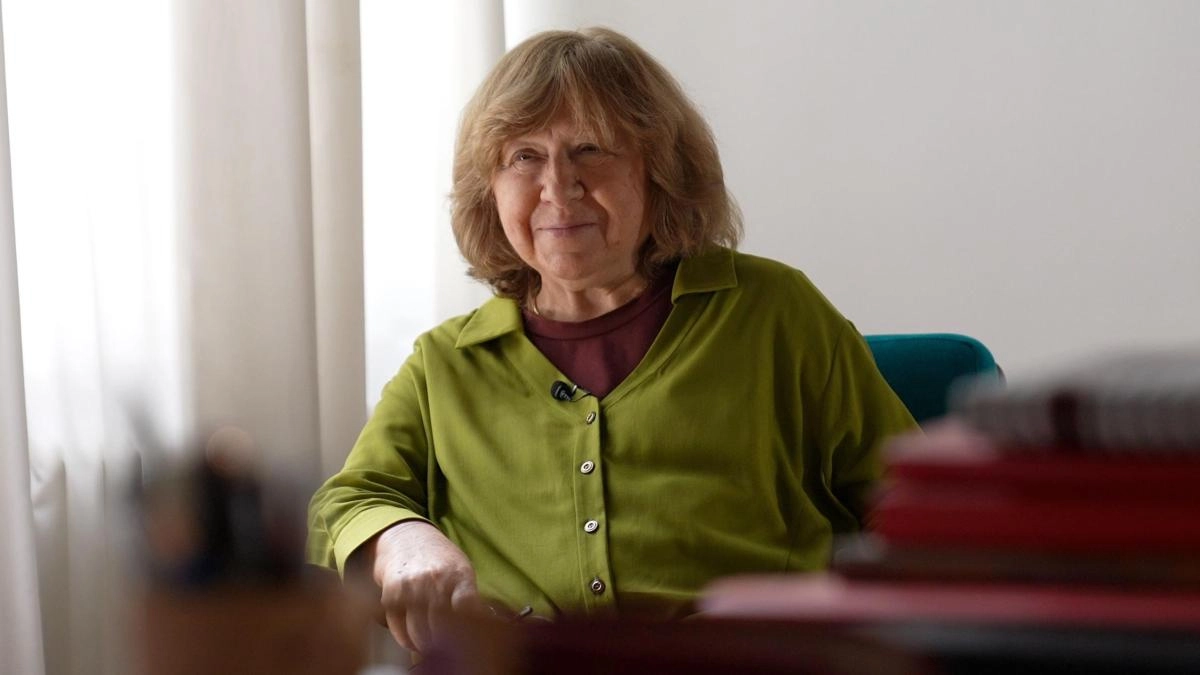

The day after the 2020 elections, which marked the sixth consecutive term of the Belarusian president, Svetlana Alexievich watched as “hundreds of thousands of people” marched outside her apartment in Minsk.
“I thought they would never rise up, but they did. It was perhaps one of the most intense feelings I have ever experienced,” says the author and winner of the 2015 Nobel Prize in Literature.
Part of that feeling was “a naive hope, but hope nonetheless.”
Alexievich joined the protests against elections considered rigged and the Coordination Council tasked with preparing new elections and a peaceful transition of power.
But, little by little, as the weeks passed, the hope faded.
“Now it's clear how romantic we were,” she says.
The protests were brutally suppressed, and the members of the Coordination Council were arrested one by one, until Alexievich, then 72, was the only one who had not yet been detained.
When masked men tried to break into her apartment, several foreign embassies They came to her aid. For two weeks, European diplomats and their wives took turns watching over the house, but finally she had no choice but to leave.
Alexievich recounts that thanks to the German deputy ambassador, Anna Luther, who accompanied her to the airport, she was able to catch a flight to Berlin. She took almost nothing with her, hoping to return soon, but she has now been in the German capital for five years and has little prospect of going home.
Attempt at Utopia
Svetlana Alexievich, 77, has dedicated more than 40 years to documenting the lives of people in the Soviet Union and the independent states that emerged after the dissolution of the communist bloc. She has also documented World War II, the Soviet-Afghan War, and the Chernobyl nuclear disaster.
Her books are titled “Voices of Utopia,” in an ironic reference to the 70-year communist experiment.
“I wanted to describe this attempt at utopia,to show how people experienced it in their hearts and homes," she states.
But the reality Alexievich describes in her books is far from utopian. For this reason, her books were removed from the curriculum in Russia and Belarus. She has also been censored and prosecuted, ultimately leading to her exile.
Internationally, the story is different. Alexievich's books have been translated into 52 languages, published in 55 countries, and earned her the Nobel Prize. Prize in Literature in 2015. In her Berlin apartment, dozens of notes for her next book, which she began writing after the events of 2020, are visible on a large wooden table. For this, she speaks with young people who took to the streets that day and asks them what they wanted and what disappoints them today. They don't always live up to our hopes… Well, now I no longer support revolutions, I don't support bloodshed.” The Human Voice: When the Soviet Union collapsed in the 1990s, “it seemed as if we had all been freed from captivity,” says Alexievich. However, “the red man,” the embodiment of the Soviet regime, did not die with the empire. "He's shooting in Ukraine, he's sitting in the Kremlin. No, he's not dead yet," she adds. In each of her books, Alexievich interviews hundreds of people, artfully combining their testimonies into what she calls “a novel in voices.” "It's an attempt to turn everyday life into literature. I choose works of art from real life," she says, comparing it to the method of sculptor Rodin, who said he started with a block of marble and cut away what he didn't need. “I love the way humans talk,” she said in her 2015 Nobel Prize acceptance speech. "I love the solitary human voice. It is my greatest love and my greatest passion." The reaction to her Nobel Prize in Belarus was “wonderful,” and, she says, in Minsk the champagne ran out and people hugged her in the streets.
Even Alexander Lukashenko, a former collective farm manager who has been the country's president for 31 years, said he would read her books, although she doesn't believe he has.
“She has a different view of the world,” she says.
Early Years
Alexievich remembers growing up in villages inhabited mainly by women, in the aftermath of the devastation of World War II.
Millions of Belarusians died in the war,And millions of those who had fought in Europe were sent to the gulags upon their return.
“Only at weddings were people happy, but those occasions were very rare, because most of the young men had died.”
That is why women are Alexievich's most beloved heroines in her books. Even her first book, “The Unfeminine Face of War” (1985), was about female veterans.
A million Soviet women volunteered to serve as soldiers and medics,but their contribution remained virtually invisible until Alexievich brought it to light in her books.
The stories are terrible and terrifying, but not without humor. For example, one woman told Alexievich that one of the worst things about serving in the army was having to wear men's underwear.
The Permanence of Art
“If they hadn't told their stories and I hadn't recorded them, it would all have disappeared without us even knowing,” she says.
After the perestroika reforms of the 1980s, Alexievich's book became a bestseller, with 2 million copies published in Russian.
But her next book, “Zinky Boys” (1991), generated controversy. Its title referred to the zinc-lined coffins in which the bodies of Soviet soldiers were shipped from Afghanistan.
Alexievich had been in Kabul as a journalist. On that occasion, he found something beautiful in handsome men in uniform and their gleaming weapons. But he disliked war, especially seeing entire villages razed by multiple rocket launchers. The writer says that, for her, it was important to see how far people are capable of going.
“In general, art is immoral, because you spy on other people's pain. It is other people's pain that gives you the opportunity to grow.”
After the book's publication, Alexievich was sued by veterans and mothers of fallen soldiers, who accused her of defamation and desecrating the soldiers' honor.
“The book spoke of the terrible situation into which their sons had been dragged, who had become murderers. And then they came face to face with the truths they feared most.
He fears that Russian attacks on Ukrainian power plants, including those that supply backup power to keep nuclear reactors safe, could cause a new disaster. The 1986 Chernobyl disaster sent radioactive clouds northward, over her home in Minsk. She then spent time in the exclusion zone around the damaged plant, interviewing people who were still living there and sharing their food, despite the risk of contamination. “I couldn't, like Western journalists, listen to all those terrible stories about how a daughter died, was born without arms, without legs, and then, when we were invited to the table, eat a sandwich separately,” she says. Alexievich's book inspired several characters in the popular 2019 TV miniseries “Chernobyl,” including Lyudmila Ignatenko, the wife of one of the first firefighters to die of radiation poisoning. When the series aired, she was upset by the enormous media interest in her life.
“But there's no way to tell a story without intruding on someone's life,” Alexievich says.
And many people want their stories to be known.
The wife of another firefighter interviewed by Alexievich bribed someone to let her into the hospital where her husband was dying, to be with him in his final days. Her pain was only eased, she told Alexievich, when they made love; “then, she was silent for a while.”
To protect the woman from public condemnation, Alexievich gave her a false name. But she called her after the first issue was published to ask why she had done it.
“I didn't want you to get hurt,” Alexievich told her. She replied: "No, I suffered a lot, he suffered a lot. I told the truth, even if it costs me my heart." Despite the dark subject matter, love is a recurring theme in Alexievich's books. "I have always believed that I write about love. I don't collect horrors, I collect demonstrations of the human spirit," she said in 2015. The Nobel Prize judges described her works as "a monument to suffering and courage in our time." This content was created as a co-production between Nobel Prize Outreach and the BBC. Click here to read more stories from BBC News Mundo. Subscribe here to our new newsletter to receive a selection of our best content of the week every Friday. You can also follow us on YouTube, Instagram, TikTok, X, Facebook, and our WhatsApp channel. And remember that you can receive notifications in our app. Download the latest version and activate them.