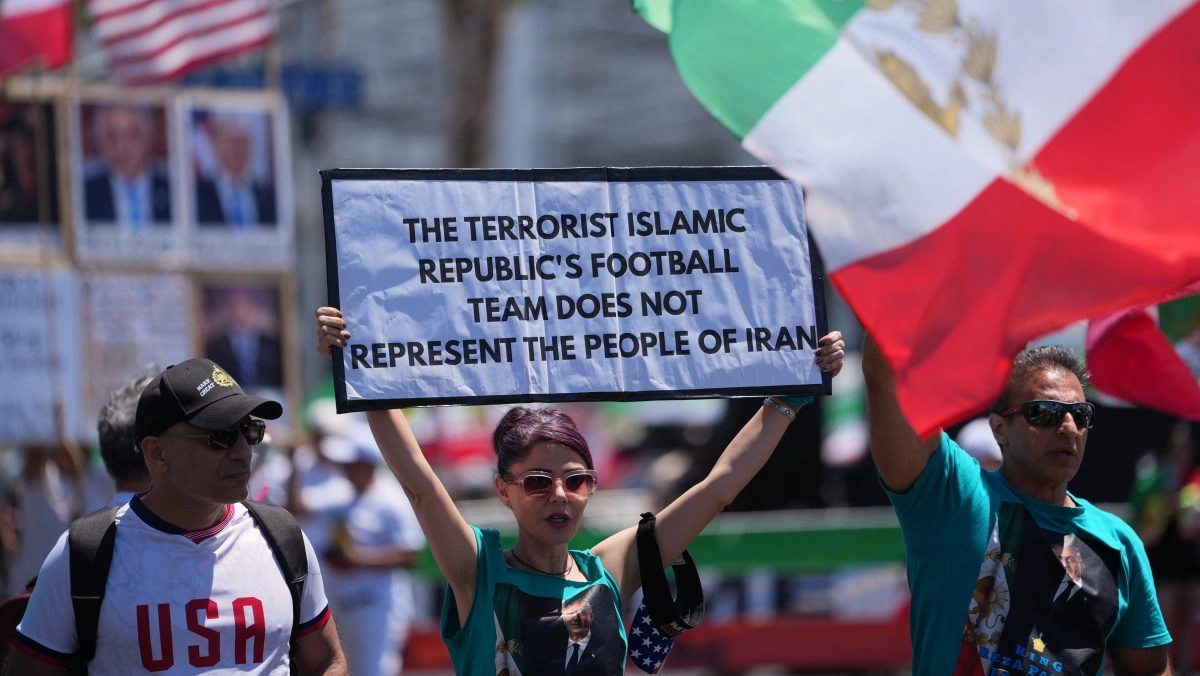

A crowd of Iranians - and their American-born descendants - protested before the 2026 FIFA World Cup match between the Iran and New Zealand national teams on Monday night at SoFi Stadium in Inglewood, where they called for the team's expulsion from the competition because, according to them, "they are not footballers representing their country, nor its royal flag with the lion and the sun, but the terrorist regime of the Islamic Republic of Iran."
The Islamic Republic of Iran has not adopted any new flag. Its official national flag remains the tricolor design (green, white and red) with the emblem of the word "Allah" in the center, which was officially established on July 29, 1980 after the Islamic Revolution and the fall of the Shah, Mohamed Reza Pahlavi.
At the intersection of Pincay Drive and Kareem Ct., in front of the Forum and SoFi Stadium, hundreds of Iranians demonstrated their opposition to the national soccer team, defending their flag with the emblem of the lion and the sun, which FIFA threatened to confiscate in the stadium because it considered its use “politically” inappropriate.
It is worth mentioning that thousands and thousands of Iranians attended Monday's match to support their team despite expressing their rejection of the Islamic regime in power.
“Those soccer players are not our national team,” said Sherry and Abby Aghahanian, originally from Tehran, who raised their “real” flag near the stadium.
The protest arose amid diplomatic advances and the alleged agreement of the United States in its war with Iran for the reopening of the Strait of Hormuz, a conflict led by the United States and Israel, which is fully supported by Iranians in the diaspora.
Tension due to a judge's decision
Tension increased with the lawsuit filed in the Los Angeles County Superior Court over FIFA's ban on flags and t-shirts with the sun and the lion inside the stadium.
Hours before the match, a judge ruled that FIFA can legally prohibit fans from carrying the pre-revolution Iranian “Lion and the Sun” flag into World Cup stadiums. The decision backed FIFA's code of conduct for stadiums, which allows the governing body to ban flags and images deemed provocative or political.
The legal battle filed on behalf of 'Kermanian against FIFA' was filed on June 10 by the Institute for Voices of Liberty (iVOL) and plaintiff Sam Kermanian, one of the most respected figures in the Iranian-American Jewish community and former secretary of the Iranian American Jewish Federation.
iVOL's arguments sought an emergency injunction to prevent the ban at World Cup venues in California, arguing that the flag is a peaceful cultural symbol and that its ban violates free speech protections.
Protesters outside the stadium waved flags of the United States, Israel and Iran, with effigies of Donald Trump, Israeli Prime Minister Benjamin Netanyahu and the late Shah, Mohamed Reza Pahlavi, and called for Iran to regain freedom.
“FIFA did not want to recognize Iran's traditional flag, which protesters say is a cultural and not a political symbol,” said Kate Dehbashi, a member of the Constitutionalist Party of Iran in Los Angeles.
Prior to hearing the judge's decision, she had declared to La Opinión that the FIFA ban would not prosper in the United States, a country where there is supposedly freedom of expression. "The flag is part of our culture. It represented Iran for thousands of years, so they shouldn't ban it," he said.
Inside SoFi Stadium, countless lion and sun flags were displayed and waved proudly by thousands of fans during Monday's game.
“They have been killing people for 47 years”
Although the demonstration outside the stadium was not political, Kate Dehbashi stressed that they do not want the Islamic Republic of Iran.
"They have been killing our people for 47 years. They continue to execute many people in Iran. On January 8 and 9 [2026] they killed tens of thousands of people in the streets; that is why we do not recognize them or love them," Dehbashi said.
He recalled that for 40 years and more frequently during the last five months—after the events of January 8 and 9—“we have been protesting in Los Angeles.”
“The team's players have not given any sign of support to the people of Iran, neither to those who died nor to those who are being executed,” he added. "So as long as they don't show signs of support for the Iranian people, we won't support them either. Unless we see some gesture, like not singing the national anthem on the field, then we would know that it is the team we want to support."
Several members of the Iranian soccer delegation were denied entry visas to the country by the United States Department of State, including this week two members of the press team. "They are terrorists; the head of the Iranian federation is part of the IRGC [Islamic Revolutionary Guard Corps]," the woman said.
His reference was Mehdi Taj, an Iranian sports executive who is currently president of the Football Federation of the Islamic Republic of Iran (FFIRI). Although he does not belong to a traditional political party, he does have deep ties to the state security system and is known for being a former intelligence commander of the Islamic Revolutionary Guard Corps (IRGC).
“Definitely, the flag of the Islamic revolution is not my flag,” declared Tamir Agam, secretary of iVol. “I do not support that regime.”
– And what is your opinion about the war with the United States and Israel? “Very good, very good.”
– Do you support war, even if 168 innocent children die in a school during a bombing? “Sir, there are worse casualties.”
Iranian rejection in California
On Saturday, Iranian-American fans also attended the Qatar-Switzerland game at Levi's Stadium in the Bay Area, where some displayed Lion and Sun flags and “Free Iran” banners.
Contrary to the majority, Hamid Khan, a resident of Los Angeles, explained to La Opinion that, in the historical context of the Iranian flag, many of those who protest would like the Shah's regime and the monarchy to return, and that is why they do not accept the revolutionary changes.
The Iranian Revolution occurred between January 1978 and February 1979, when the monarchy of Shah Reza Pahlavi officially collapsed, who was replaced by Ayatollah Ruhollah Khomeini. Their faces appeared on many of the protesters' banners.
"They [Protestants] had the symbols of the monarchy on the flags, but when the revolution happened, they changed the design and the current revolutionary flag emerged. Many of the people protesting today belong to the next generation of those who fled Iran and are now advocating for the return of royalty and the monarchy, as well as the return of the Shah's son," Khan said.
Data from the Pew Research Center shows that California is home to a huge population of Iranians, between 350,000 and 500,000.
“Everything is very mixed,” said Ario Pourzand, a 17-year-old student, who traveled from the San Francisco Bay Area for the protest, along with his friend Dorian Jarzey, also of Iranian descent. “But, I’m glad we can still be a community.”