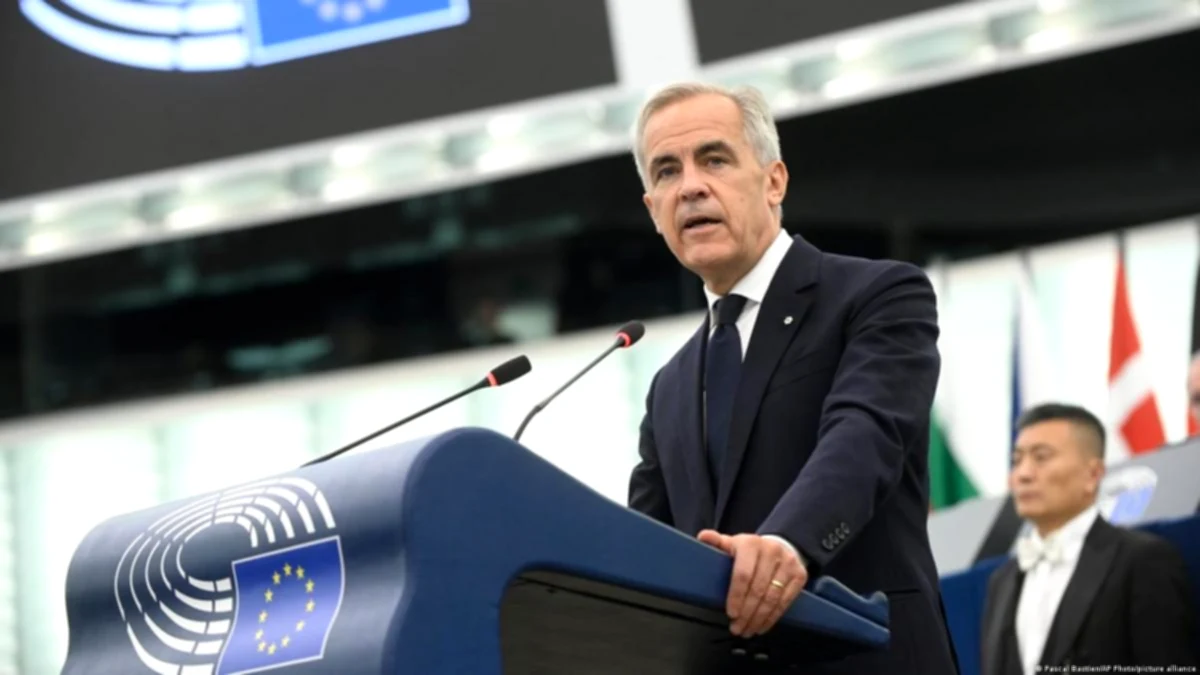

Canadian Prime Minister Mark Carney admitted on Thursday that his administration has examined the possibility, which he considers extremely remote, of a U.S. military action against Canada following repeated statements by President Donald Trump about the possibility of turning the country into the “state 51”.
In an interview published by The New York Times, Carney described this possibility as an “extreme tail risk,” an expression used in risk management for events of very low probability but potentially very serious consequences.
“I think in these positions one has the responsibility to analyze extreme risks,” Carney said. “It’s just risk management.
The Prime Minister avoided explaining what this analysis consisted of.
The statements coincide with reports published in January that the Canadian Armed Forces had developed, for the first time in approximately a century, a theoretical model on how to respond to a hypothetical US invasion.
That exercise, which Canadian officials stressed was not an operational plan, predicted that Canada, in the face of the enormous U.S. military superiority, could lose its main land and sea positions in a matter of days and would later have to resort to an irregular war.
The model looked at embuscades, sabotages, drone attacks and actions by small armed military or civilian units, inspired by tactics used in Afghanistan.
The hypothesis arose after Trump repeatedly proposed to turn Canada into the “51st state” of the United States, although the officials then cited considered an invasion unlikely and highlighted that cooperation between the armies of both countries continued to be positive.
Carney’s statements come amid a sharp deterioration in the relations between Canada and the United States in decades.
Following the suspension of trade talks in August, Washington imposed tariffs of 50% on Canadian goods worth $27.6 billion and Ottawa responded on September 8 with duties of between 15% and 50% on an equivalent volume of U.S. imports.
Despite the deterioration of the bilateral relationship, Carney told The New York Times that he talks “frequently” with Trump and that both have talked on several occasions since trade talks were suspended last month.
“From my perspective, we have a good relationship in the sense that we can pick up the phone and talk to each other about affairs,” Carney said, insisting that there is still the possibility of reaching a mutually beneficial trade agreement.
At the same time, Ottawa is accelerating its strategy to reduce its strategic dependence on the United States, from the Starlink satellite system to the review of the planned purchase of F-35, while seeking to diversify its economic, technological and defense relations with Europe and other partners.