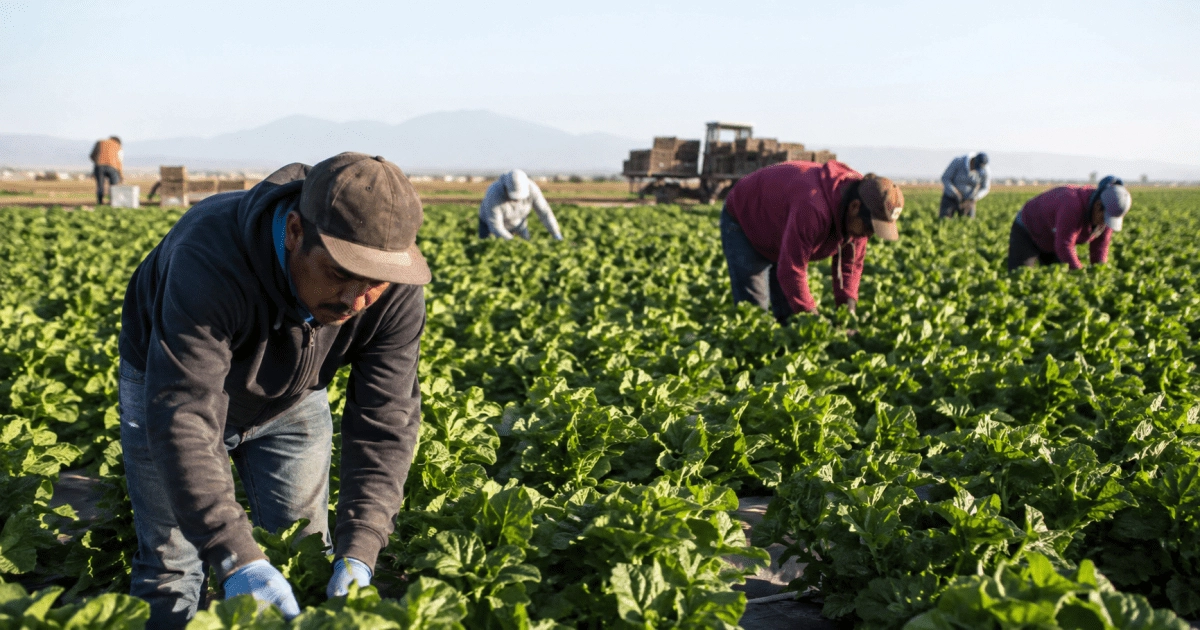

The fear of immigration detention is no longer limited to the workplace. For thousands of farmers in the United States, it also reaches the doctor's office, the supermarket, social networks and family activities.
A report released by the UFW Foundation reveals that 88% of agricultural workers surveyed fear being detained or deported, while 92% say that immigration raids and deportations have affected their employment. The study, titled Under the Sun and Out of the Shadows, gathered responses from 2,250 farmers.
Although the document was published in July 2026, the responses were collected between June 27 and July 11, 2025, during the first months of Donald Trump's second administration.
You can see: What to do with your children if ICE arrests you: key steps for immigrant families
Fear spreads outside of work
One of the most significant conclusions of the report is that the fear of immigration operations is modifying basic activities of daily life.
61% of participants stated that they reduced their shopping trips. Another 29% said they did not seek medical attention for fear of being arrested, while 21% acknowledged they began using social media more cautiously.
The main concern, however, is family. 90% fear being separated from their loved ones due to deportation. Furthermore, 43% consider that, if they had to leave the country, they might not be able to return to the United States.
These responses show that the consequences of the operations are not limited to possible arrests. According to the UFW Foundation, fear can also lead workers to delay medical care, reduce community participation and avoid public places.
Most have been in the United States for more than a decade
The report notes that many of the participants have formed deep roots in the communities where they live and work.
80% have been residing in the United States for more than 10 years and 41% have been living in the United States for more than 20 years. In terms of employment, 84% reported having worked in American agriculture for at least a decade.
These data help explain why family separation appears as the main concern. Many of the workers have children, partners and other relatives in the United States, while some have not returned to their countries of origin for years or decades.
Faced with the possibility of immigration reform that would allow them to obtain legal status, 87% said that one of their first actions would be to visit relatives who live outside the United States and whom they have not been able to see for years.
You can see: The industries where ICE usually raids workplaces the most
What protection do agricultural workers demand?
When asked what conditions would lead them to continue working in the field over the next five years, 76% chose protections against detention and deportation.
66% asked for living wages, 53% indicated they want a path to legal status or citizenship and 50% demanded jobs with benefits, including health coverage. Participants could choose more than one answer.
The UFW Foundation maintains that immigration regularization would allow workers with years of experience to be retained, offer greater stability to families and reduce the fear that currently makes it difficult to report labor abuses or unsafe conditions.
You can see: Shortage of workers due to ICE raids makes housing more expensive in South Texas
How representative is the survey
The results must be interpreted with some limitations. This is not a national probability survey designed to represent all farmworkers in the United States.
The UFW Foundation distributed the questionnaire through its own text message program and received responses primarily from California, although workers from 15 other states, including Florida, Georgia, Michigan, New York, Arizona and Washington, also participated.
To protect participants, the organization did not directly ask about their immigration status, address, names of family members, or daily routines. Instead, it used indirect questions to identify the experiences of those who might be in an irregular situation. It was also not required to answer all the questions, so the number of participants varies slightly between the different results.
The study, therefore, primarily reflects the experiences of workers linked to the UFW Foundation's communication and assistance programs. However, it offers one of the broadest recent samples of how immigration policies are being perceived within agricultural communities.
You can see: How to locate a family member detained by ICE step by step
Where can they seek guidance?
The UFW Foundation offers information on immigration rights, family preparedness plans and legal service providers for farmworkers and immigrants.
The organization publishes these resources in Spanish and also answers questions at 1-877-881-8281. The assistance available is case-by-case and is not a substitute for the individual evaluation of a licensed immigration attorney.