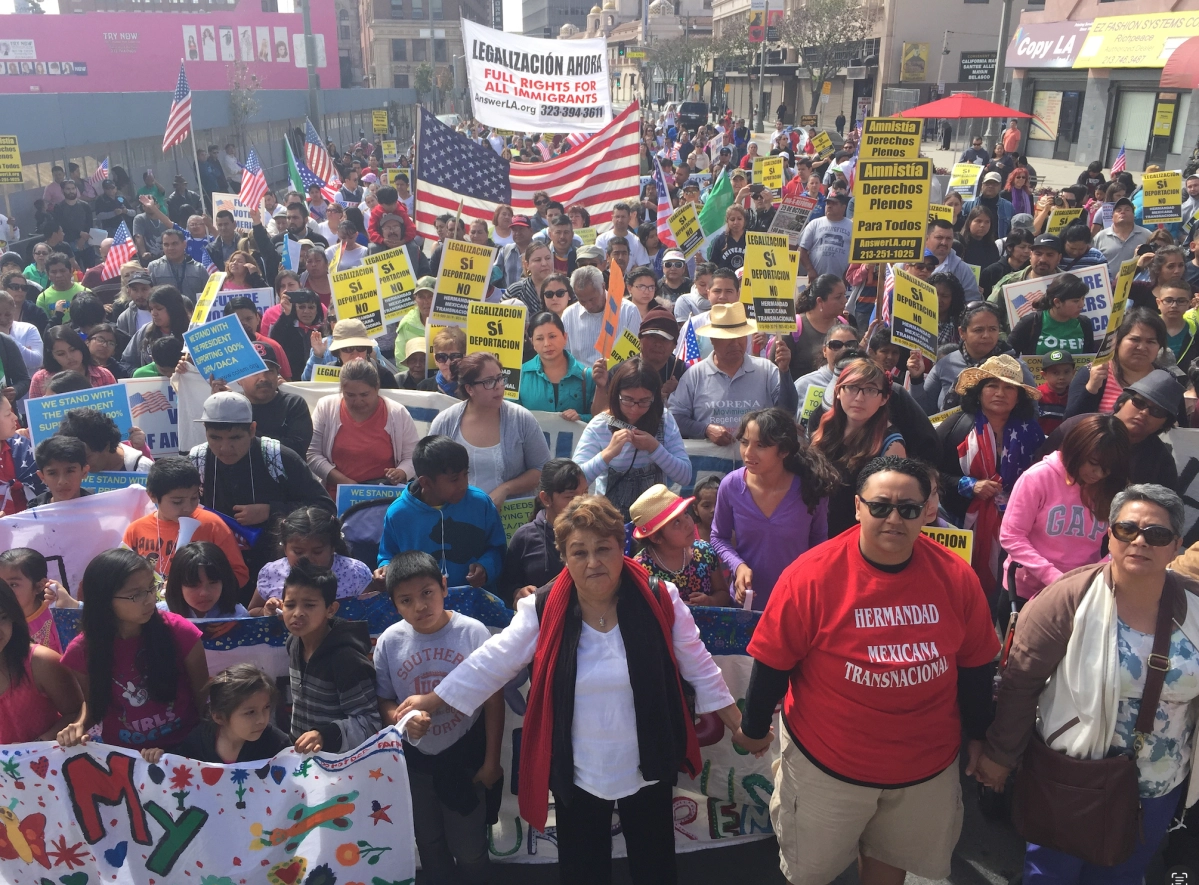

Gloria Saucedo, a symbol of the leadership of the Latino people of California, has died. And, as with great figures, they don't bury her: they sow her seeds, because her fruits and her teachings will transcend the barrier of cycles. A native of Jalisco and an immigrant in Los Angeles since her youth, she passed away in the early morning of December 31st. She was an example of social struggle and a pillar of the organization Hermandad Mexicana Nacional, Inc. (HMN), founded by the legendary Alberto “Bert” Corona 74 years ago. She was born on a national holiday: May 5, 1950, in the community of Michoacanejo, Jalisco. At the time of her unexpected passing, Gloria was 75 years and 8 months old. She lived her first 35 years in various places in Mexico and the last 40 in Los Angeles County. For the first five years of her life, she grew up in the town where she was born in the state of Jalisco. Later, her parents took her to El Paso, Texas, where she spent the next two years until, at the age of seven, she returned to her birthplace to live with her grandmother for two years. When she was nine, she moved to Tijuana, Baja California, where she attended elementary and middle school, graduating from high school in 1968. That same year, she returned to Guadalajara, Jalisco, where she earned her medical degree in 1974. The following year, she completed her social service in Ciudad Obregon, Sonora. With 25 years of experience, she worked in her field of medicine at the Tijuana Red Cross and taught anatomy and pharmacology at the Autonomous University of Baja California (UABC). Later, she established a medical practice, a job she pursued for twelve years. Gloria Saucedo often shared with trusted individuals how she earned $22 an hour at the time, but after the peso devaluation, she began to be paid in pesos, and consequently, in 1987, she moved with her parents to the San Fernando Valley in Los Angeles County. In late 1988, at one of the schools her children attended, she met the pro-immigrant leader, Bert Corona. who immediately invited her to collaborate with his organization: the National Mexican Brotherhood. Gloria Saucedo accepted the offer and immediately joined the work. The following year, she organized and structured English and UScivics classes, which were mandatory for obtaining permanent residency. Under this program, immigrant workers were required to attend classes in English, history, and civics, and to complete at least a 40-hour course. Gloria Saucedo carried out all this work in the city of Pacoima, California. By 1996, after seven years of community work with excellent results, Bert Corona appointed her as director of the Hank Lacayo Community Center for Youth and Families—National Mexican Brotherhood, Inc. This community center is located in the city of Van Nuys, California. In 2005, Gloria founded and became the executive director of the Transnational Mexican Brotherhood. She held this position until 2019, when she assumed the executive directorship of the Grupo Mexico organization. In 2003, she founded and organized groups of the Transnational Mexican Brotherhood in the cities of Oxnard, CA, and Las Vegas, Nevada. In 2005, she opened another community center in San Diego, California. For the past 30 years, she has organized and mobilized workers to oppose racist and fascist proposals such as Prop. 187 by the Republican governor of California, Pete Wilson. and against federal legislative bill HR 4437, known as the Sessenbrenner Act.
She worked to pass legislation in favor of Family Unity and to grant citizenship to immigrant veterans after their death.
In addition, she was involved and essential in the work that allowed the Federal Congress to pass the Violence Against Women Act, known as VAWA. Thanks to this law, thousands of women who have suffered abuse and domestic violence can apply for and obtain legal immigration status.
Gloria Saucedo also made it possible for banks to allow undocumented immigrant workers to open accounts; She confronted unscrupulous landlords to prevent them from evicting low-income people, many of whom were immigrants. Her decades of community work left a legacy of activism based on a total commitment to justice for all, especially for undocumented immigrants. Her efforts to convince federal authorities to grant late amnesty to undocumented workers were essential. Who were illegally excluded from legalizing their status during the period the immigration amnesty law was in effect. Thanks to her efforts, thousands of these workers obtained temporary work permits and later permanent legal status. The activist and community leader fought against the privatization of public education and supported Democratic candidates, especially those of Latino origin, who won in the polls and now hold important positions as public servants. She always supported the campaigns of workers' organizations to ensure they had the protection of a union and the respective collective bargaining agreements. She was also known for her advocacy on behalf of farmworkers, hotel workers, and workers in many other industries.Gloria Saucedo confronted and consistently fought against white supremacist racists from Nazi organizations such as the Minutemen, the John Birch Society, and all manner of far-right paramilitary groups that, over the past 30 years, have proliferated across the nation and attempted to return Trump to the White House through a coup attempt at the Capitol on January 6, 2021. Saucedo sacrificed her time and her family, traveling on weekends with priests and activists to the California desert to deliver water jugs and assist undocumented immigrants who, out of necessity, were forced to cross dangerous terrain and risk their lives in search of a better future for their families. The Latina leader lobbied for unconditional amnesty for undocumented workers in Washington, DC to make possible the law that granted driver's licenses to undocumented immigrants in Sacramento; she led countless marches and gave speeches in support of immigrants. We would need to write a book to describe his extensive work and historical significance. Many of the achievements that contribute to a better daily life for the Latino community in the United States are owed to this activist and Latina leader. Thank you, Gloria Saucedo. At this moment, she is among the great leaders who gave their lives for the well-being of the Spanish-speaking people in the United States. Her energy and example inspire us to continue the fight for justice and the rights of our community. With her guidance and that of other historical Latino leaders, we will continue working to strengthen our voice and achieve the equality we all deserve. Gloria Saucedo, the indispensable fighter… present! Alicia Flores is the executive director of The Hank Lacayo Youth and Family Center. Juan Jose Gutierrez is the executive director of the Full Rights for Immigrants Coalition.