

How Pix works, the Brazilian payment system that Trump sees as a threat
The Pix tool was developed by central bank technicians and quickly became popular throughout Brazil

A digital payment system created in 2020 grew very strongly in Brazil.
Its name is Pix and it is on the phones of millions of Brazilians, clearly visible in the apps of banks and other financial intermediation institutions, to pay for any purchase in a store or transfer money to a family member or friend instantly.
But, unlike other similar systems in the world, Brazil's is state-run; It was created and is operated by the central bank of that country.
Pix has been such a disruptive public solution that it was rejected by US President Donald Trump, who consequently imposed high tariffs on Brazil.
The US government weeks ago concluded a commercial investigation initiated against Brazil a year ago and identified Pix as one of its targets.
“Brazil has unfairly harmed American companies that operate in electronic payment services,” states the document published in early June.
Among them are Visa and Mastercard, mainly.
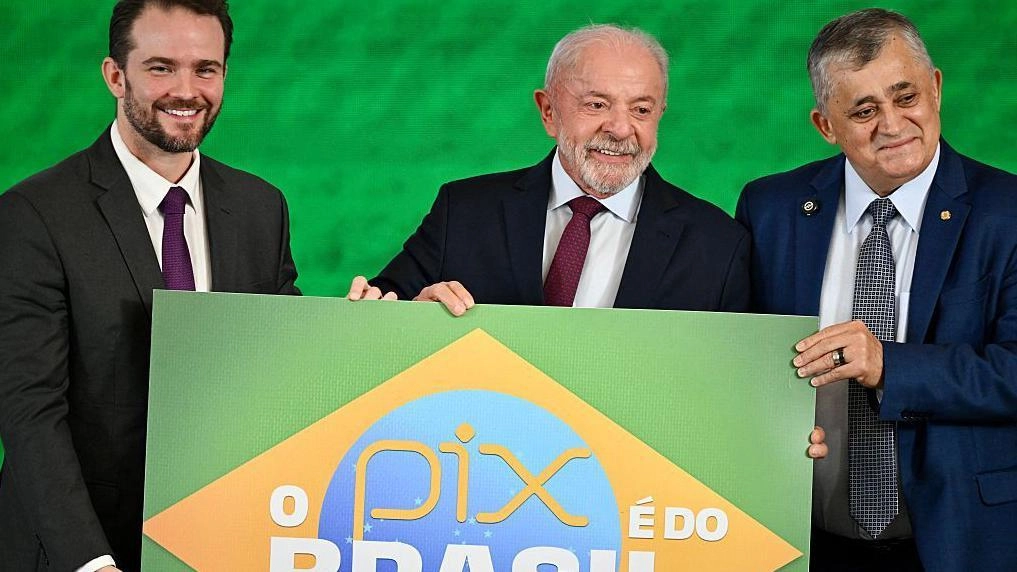
The next day, Brazil's president, Luiz Inácio Lula da Silva, appeared with a banner during an event that read: “Pix is from Brazil.”
“The American president, in an impulsive act—since we were negotiating after my visit to President Trump—announced an increase in the tax on Brazilian products to 25%, based on a lie,” declared Lula, presidential candidate in the October elections, referring to the Brazilian payments system.
Lula said he responded: “Hey, Trump, hey, instead of being afraid of Pix, make Pix work in the United States.”
The fight for Pix is not just international. A day later, senator and presidential candidate Flávio Bolsonaro, Lula's main opponent in the upcoming elections, displayed a poster at an event that said: “Pix is from Brazil and from Bolsonaro.”
He also posted a photo with the same message on his Instagram.
What is Pix?
Pix is an instant payment system created by technicians from the Central Bank of Brazil that allows you to transfer money between accounts in seconds, at any time.
It is characterized by its speed and security, and is used from each person's cell phone linked to checking, savings or prepaid accounts.
To pay, the user has several ways, such as entering into an app a number that identifies the third party's account within the entire Brazilian banking system, or typing a password, which can be a number or a username, something that in other countries is known as an "alias."
But there is an easier way: scan a QR code with your phone's camera.
This code can be static from the business, and then the user has to enter the amount to pay, or it can be a dynamic code, which is used only for that transaction and already has the purchase price incorporated.
The latter is the most common option of all in Brazil, according to official data.
When the payment is completed, the system gives confirmation to both parties.
Pix does not charge extra fees to the buyer, and charges the merchant commissions of 0.22% on average.
Debit cards such as Visa or Mastercard charge merchants fees of more than 1%, while credit cards charge 2.2% in Brazil, according to a report from the Bank for International Settlements cited by Reuters.
According to a Goldman Sachs client report, Pix's growth "may limit the use of credit and prepaid cards."
The system has become popular in Brazil and has impressive figures.
Pix has 176 million users—equivalent to 80% of the Brazilian population—and most of them use it frequently, according to data from that country's central bank as of July 2026.
Each month it registers more than 7,000 million transactions for almost 3.4 trillion reais (about US$660 million), according to the average for the first half of this year.
That means that payments are for everyday purchases of low amounts: US$9 on average.
Pix is the second most used payment method among Brazilians, measured by the total amount of transactions, and is only surpassed by traditional interbank transfers.
How did it come about?
According to a 2022 central bank report on Pix, the first mention of “solutions that enable low-cost, real-time and seamless retail payments” came in 2014.
However, the development of Pix by central bank technicians did not begin until May 2018, when a working group was established with the goal of “contributing to the construction of a competitive, efficient, secure and inclusive instant payments ecosystem.”
The name Pix was not yet in use at that time.
But some of the fundamentals of the system were already defined.
“The centralized settlement infrastructure will be operated by the Central Bank of Brazil and will be available 24 hours a day, seven days a week, every day of the year,” the government said then.
“The transactions will be settled one by one, at the moment the infrastructure accepts the settlement order,” he added.
The Working Group for Instant Payments of May 2018 was, according to the central bank, “the first step towards the development of instant payments in Brazil.”
This group was open to anyone interested in the topic and received contributions from more than 130 participants.
In December 2018, the central bank set out the fundamental requirements for Pix.
There, the central bank officially positioned itself as the leader of the system development and implementation process, and in October 2019 the development of the technological infrastructure began.
Approximately 31 months passed between the creation of a specific working group and the launch of the system.
The Pix brand was launched in February 2020.
According to the central bank, the brand “is based on technology, transaction and pixel, and represents the overcoming of the limits of the financial system, communication between market agents and the strength of the pixel.”
One year after the start of the development of the technological infrastructure, in October 2020, the registration of keys by the first users began.
On November 3, the system began operations on a restricted basis, and on November 16 it began to function fully.
Impact
In Brazil, the way Pix was structured benefited domestic companies, especially digital banks and fintechs.
“Leveraging the Pix model,” they developed innovation and grew, even expanding to other markets.
Nowadays it is possible to pay in other South American countries with Pix, and also for people from neighboring countries to pay in Brazil with this system.
This ended up turning the country into an international benchmark.
“Brazil is well known today for its ‘neobanks’ [digital banks] and for its internal ecosystem of financial innovation,” researcher Polina Kempinsky told BBC News Brazil.
Nobel economics laureate Paul Krugman praised Pix for being almost instantaneous and having low transaction costs, and suggested that Brazil may have invented the future of money with this system.
“Other nations can learn from Brazil's success in developing a digital payment system,” Krugman wrote.
And he stated that the Brazilian payments system is “achieving what cryptocurrency advocates falsely claimed could be achieved with blockchain: low transaction costs and financial inclusion.”
“Compare the 93% of Brazilians using Pix with the 2%, yes, 2% of Americans who used cryptocurrency to buy something or make a payment in 2024,” the economist said in 2025.
"Oh, and using Pix doesn't incentivize kidnapping and torturing people until they hand over their encryption keys. So, will we have a system similar to Pix in the United States? No. Or at least not for a long time," Krugman estimated.
Nobel economics laureate Joseph Stiglitz told BBC News Brazil that Washington “doesn't like the idea of Brazil having its own payments system, independent of Visa and Mastercard,” and is effectively defending the interests of American companies by including Pix on the list of reasons to tax Brazilian exports.
In turn, Pix has made some big American tech companies uncomfortable, said Bruna Martins dos Santos, policy and advocacy manager at Witness, an international nonprofit organization focused on technology and human rights.
"We are talking about a technological competition, where the United States intends to appropriate any type of technology that can offer some type of innovation and that is not managed within the country itself or that is not under US control," he said.
What the United States says about Pix
In the conclusion of the investigation based on Section 301 of the Trade Act of 1974 — a legal instrument that allows Washington to investigate foreign practices considered unfair or discriminatory against American companies and products — the US government accuses Pix of unfairly harming American companies.
The investigation indicates that the Central Bank of Brazil should not be the one that has the tool and at the same time regulates the market.
“The dual role of the Central Bank of Brazil as regulator and owner/operator of Pix generates a conflict of interest, in the absence of adequate procedural safeguards,” he points out.
“The bank has acted as a regulator to harm American electronic payment service providers and favor Pix,” he alleges.
“For example, the Central Bank requires the use of Pix for financial institutions with more than 500,000 accounts and requires that Pix be displayed on the main application screen of participating institutions with no less prominence than any other payment or transfer functionality.”
In addition, the US criticizes the central bank for requiring that Pix be offered to clients without charging them commissions.
According to the investigation's conclusions, Brazilian authorities are forcing US companies to promote their Brazilian competitor (Pix) without receiving compensation for it, which constitutes a “burden or restriction on US trade.”
“Brazil's actions, policies and practices related to the preferential treatment granted to Pix are unfair and discriminatory,” he denounces.
“It is unfair to require competitors to offer benefits to Pix—such as availability, visibility, and fee caps—and Brazil discriminates against U.S. electronic payment service providers by granting such benefits only to its own national leader.”
As a result of the investigation, which also included access to the ethanol market and problems related to corruption and deforestation, the United States imposed tariffs of 25% on Brazilian products, in addition to the 12.5% it imposed on most countries.
The Brazilian government repudiated the announced decision and in a statement said that “it will go down in the history of relations between Brazil and the United States as a regrettable milestone.”
Lula's government announced that it will respond with reciprocity and, in addition, will take the case to the World Trade Organization (WTO).
Meanwhile, the Brazilian Federation of Banks (Febraban) defended Pix from criticism from the US government.
In a statement, the entity stated that the investigation's conclusions were based on "incomplete information" about the objectives and operation of the system.
“Pix is a payment infrastructure, not a commercial product, which favors competition and the correct functioning of the payment system,” said Febraban.
The organization noted that Pix contributes to financial inclusion by reducing costs and expanding access to digital payment methods.
Brazilian diplomat Roberto Azevêdo, former director of the WTO and consultant, downplayed the effects that the Trump administration could have on the system.
“Pix is not under any threat,” Azevêdo said in an interview with BBC News Brazil.
However, he said, the only relevant doubt that Americans raise is that the central bank plays as a competitor and regulator at the same time.
This news has been tken from authentic news syndicates and agencies and only the wordings has been changed keeping the menaing intact. We have not done personal research yet and do not guarantee the complete genuinity and request you to verify from other sources too.