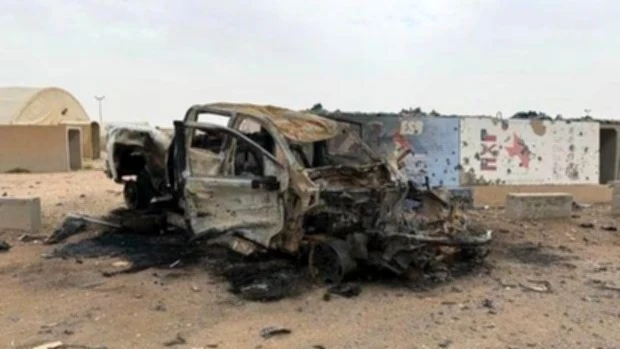

Photographs broadcast by CBS, a partner of the BBC in the United States, show widespread damage to various U.S. facilities in the Middle East as a result of Iranian attacks.
The images, provided by active military personnel, show a sectioned radar, crushed trailers and heavily damaged buildings.
The images, which are not dated, were taken at U.S. bases and facilities in Saudi Arabia and Kuwait.
A member of the military, whose identity was not disclosed by CBS, said: “These are significant damage to our bases that have not been communicated to the American public.”
“We are standing there, with our eyes closed, receiving beats in the face,” he said.
The White House referred to the BBC the U.S. Central Command (Centcom), which did not immediately respond to a request for comment.
The photographs, which have not been independently verified by the BBC, were released a day after a Pentagon control body report confirmed that hundreds of U.S. buildings and bases structures in the Middle East had been damaged or destroyed by Iran.
One of the photos shows a Boeing E-3 Sentry destroyed at the Prince Sultan Air Base in Saudi Arabia.
Although the photo has no date, BBC Verify had already confirmed in March the existence of a similar image, apparently of the same radar plane.
The Boeing E-3 AWACS are used to detect and track potential long-range targets and provide early warnings of potential threats.
A U.S. official told Reuters that 12 U.S. personnel had been wounded, two of them seriously, in an Iranian attack on the air base.
Two dateless images, allegedly taken at Camp Buehring, Kuwait, show crushed trailers and a large structure similar to a carp reduced to jirons, as smoke rises from the site.
Another image shows a four-story building damaged by an Iranian attack at Camp Arifjan, also in Kuwait.
In March, damage to the facilities, including satellite communications equipment, was, although it is unclear whether this image corresponds to the same attack.
Brian Katulis, a former national security official who worked in both Democratic and Republican administrations, said the visible damage on the images demonstrated that “the United States had not properly prepared its defenses.”
“And there is solid evidence that U.S. adversaries, such as China and Russia, could have helped Iran select targets,” added Katulis, currently senior researcher at the Middle East Institute.
“The Trump administration has done nothing to address these vulnerabilities.”
The images were released shortly after a Pentagon control body report revealed that Iranian attacks “harmed and destroyed hundreds of buildings and structures on U.S. bases in Kuwait, Bahrain, Qatar, the United Arab Emirates, Saudi Arabia, Iraq, Oman and Jordan during the conflict.”
It also notes that equipment losses amounted to $3.7 billion.
In total, the United States had spent $33.4 billion on the war until June 29, according to the report.
In the months following the start of the war, “dozen U.S. aircraft were destroyed or damaged,” the report continues.
The document lists several of the affected aircraft, including five on-flight refuelling aircraft that were damaged or destroyed on land in Saudi Arabia by Iranian ammunition.
An independent report from the Congressional Budget Office (CBO) notes that the E-3 aircraft is no longer manufactured and would have to be replaced by a more modern equivalent: the E-7.
The CBO indicated that the cost of a single E-3 aircraft is $500 million and that the estimated total cost of equipment lost in combat, including aircraft, drones and a high-altitude area defense system (THAAD), amounts to $1.9 billion.
The agency said its analysis is subject to “uncertainty” as the Defense Department failed to respond to its requests for information, forcing it to rely on government databases and public reports.
Moreover, according to the report, it is unclear the scope of the repairs and reconstruction tasks the U.S. military plans to carry out.
Brian Katulis, of the Middle East Institute, noted that while “these costs demonstrate how the Trump administration wasted valuable military resources without obtaining significant results in return,” the biggest damage affected the general military preparation of the United States.
“The United States had to divert military resources from Asia to the Middle East, leaving the country and its Asian partners more exposed and vulnerable to China,” he said.
He added that “in addition, the depletion of U.S. ammunition makes Russia more willing to survey the vulnerabilities of NATO allies and to continue its aggressive war against Ukraine.”
Although the United States has the financial resources to cope with equipment losses, it is already facing budgetary problems and may not be able to replace the missing material as quickly as necessary to prepare for possible conflict outbreaks in the Middle East or elsewhere in the world, he added.
Over the months, public and political pressure on the White House has increased to end the conflict with Iran, which began on February 28 when the United States and Israel launched joint attacks against the country.
Since the beginning of the war, Iran has repeatedly attacked U.S. bases and allied countries in the Gulf, as well as Israel.
On Tuesday, the U.S. House of Representatives He voted for the third time in favour of ending the war with Iran, approving a measure that would force President Donald Trump to end U.S. military action unless it has the permission of Congress.
The move came forward with the support of several Republicans, in which it could be the last House vote on this matter before the midterm elections in November.
Its approval faces an uncertain path, as the U.S. Senate has not indicated whether it will address the issue.
That same day, Republican Congressman Thomas Massie announced an initiative to prosecute Defense Secretary Pete Hegseth, as new details emerged about the cost of the war with Iran for the United States.
The Trump administration backed Hegseth, and U.S. Attorney General Todd Blanche told the press that he was doing “a phenomenal job.”