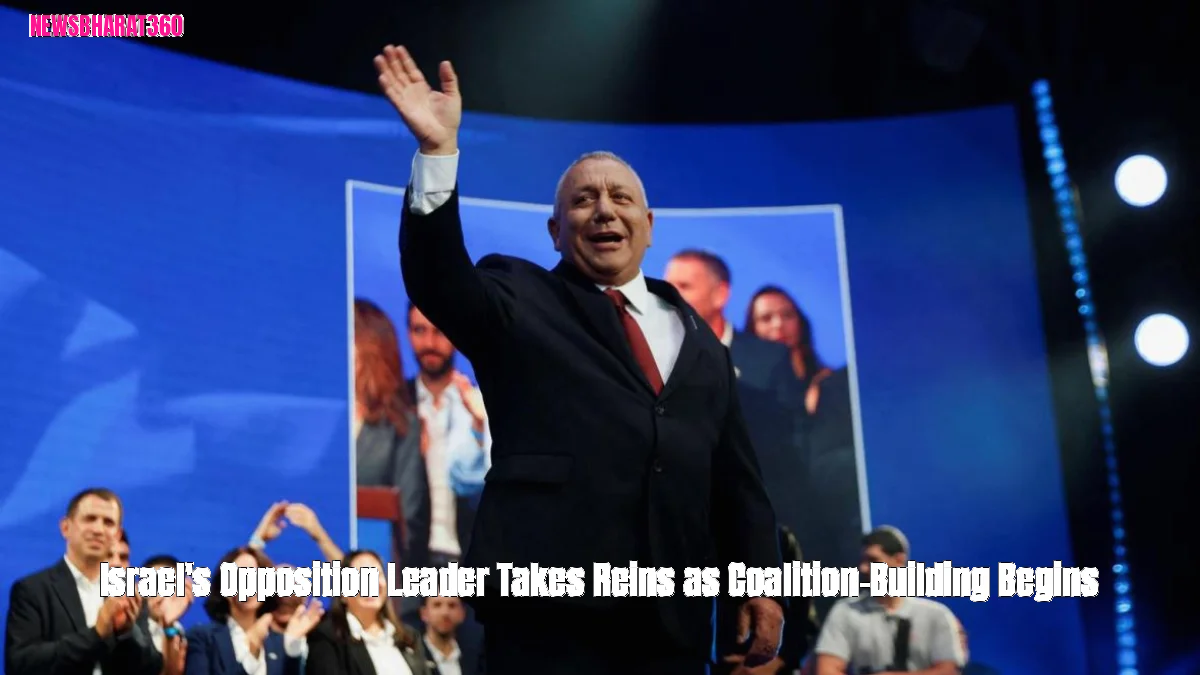

Israeli opposition leader Gadi Eisenkot has urged the formation of a national emergency government, following his designation by President Isaac Herzog as the candidate tasked with attempting to establish a new government following the October 27 election, which poses a potential challenge to the continued tenure of Prime Minister Benjamin Netanyahu.
Israeli President Isaac Herzog has designated opposition leader Gadi Eisenkot to form a new government following the country's legislative elections in late October, marking the end of a two-decade period of shifting power.
In the aftermath of the Gaza war, Israel's first post-conflict elections failed to yield a clear majority for either Prime Minister Netanyahu's coalition or the Eisenkot bloc.
The opposition leader, a newly appointed military chief, has garnered significant backing from Arab parties and has taken a notable step towards forming an alliance with ultra-Orthodox Jewish factions, a potential partnership that could provide a governing majority.
Following extensive consultations with all relevant parties throughout the week, Israeli President Isaac Herzog announced on Saturday that he would initially task former Chief of General Staff Gadi Eisenkot with the mission of forming a government.
A formal ceremony to confirm the official appointment is scheduled to take place on Sunday at the presidential residence in Jerusalem, according to a statement from President Herzog's cabinet.
Israeli former Chief of Staff Gadi Eisenkot has stated that the country's time of need has arrived, necessitating the establishment of a national emergency government, and he is committed to taking all necessary actions to propel the nation forward.
Israeli Defense Minister Eisenkot conducted consultations with various parties on Wednesday and Thursday, resulting in a total of 67 recommendations against Prime Minister Netanyahu's candidacy. This number surpassed the 46 recommendations initially obtained by Netanyahu, following the decision of the United Torah Judaism party, which holds seven seats in the coalition and has historically supported Netanyahu, to decline recommending him for the position.
The Israeli Arab parties were among the formations selected by the former head of the General Staff, a choice that has raised concerns among certain sectors of the opposition bloc, who are hesitant to align themselves with these parties.
Following the elections, President-elect Isaac Herzog had advocated for the formation of a national unity government that would comprise Jewish Israelis from across the political spectrum.
Israeli Prime Minister Benjamin Netanyahu has advocated for the formation of a unity government, however, opposition parties remain steadfast in their insistence that his resignation should precede any potential coalition efforts.
Israel's longest-serving prime minister has held office for nearly two decades, marking a significant milestone in the country's history.
A former official faces potential imprisonment if his dismissal is confirmed, as he is currently under investigation for multiple corruption charges and is also the target of an arrest warrant issued by the International Criminal Court related to alleged war crimes in Gaza.
Israeli Prime Minister Netanyahu has criticized the opposition for exploring a potential alliance with Israeli Arabs, who are descendants of Palestinians who chose to remain in Israel following its establishment in 1948.
Hours prior to his announcement, Israeli Prime Minister-designate Benjamin Herzog referred to the Arab parties as Islamist, stating that a coalition with them would lead to the erosion of the State of Israel from within.
Following the development, Yashar, led by former military chief Eisenkot, called on Netanyahu's allies and members of the Likud party to establish a unity government with Eisenkot at its helm.
Tensions have arisen within the opposition bloc due to its alliance with Arab parties, with more conservative elements expressing discontent over the government's reliance on these formations.
Following his appointment, General Eisenkot will have a 28-day window to secure the necessary 61 votes to achieve a governing majority.
Israel is poised to potentially head to new elections if no party achieves success in the current political climate. The country has experienced a tumultuous period, having held five elections between 2019 and 2022 due to ongoing political gridlock.