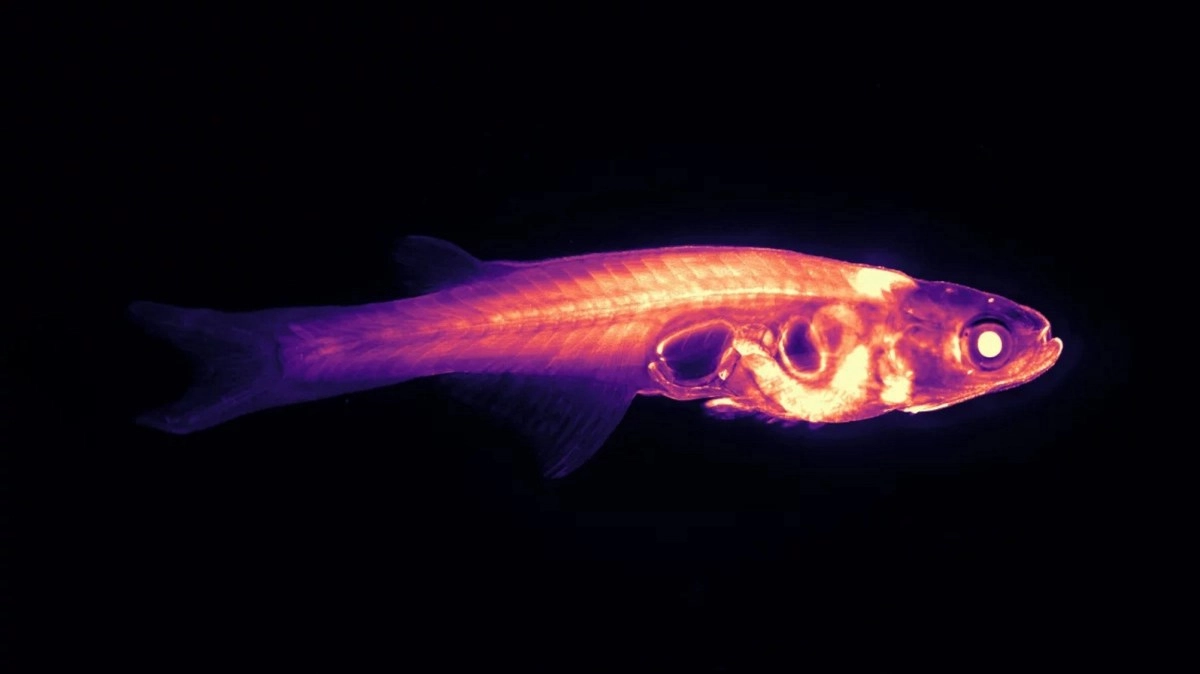

Researchers at the Janelia campus of the Howard Hughes Medical Institute, one of the most important in the world in the area of ​​neuroscience, have launched an innovative project focused on the Danionella fish. This small transparent fish will be used to understand the relationship between the brain and complex behaviors such as social interaction.
It is announced that the research will be expanded significantly, tripling the space allocated to fish. Danionella is distinguished by its lack of an upper skull and its transparent skin, which makes it easy to study its brain in real time.
Although less known than other models such as zebrafish, the identification of Danionella as a separate species in 2021 has allowed an increase in its use in laboratories. This fish promises to offer new insights into brain function.
The lack of the upper skull (or “skull roof”) is a characteristic that has made this fish a gold model for neurophysiology research, mainly because it allows us to observe the functioning brain in a living animal without the need for invasive surgery.
A transparent fish that makes the task easier
Gerry Rubin, founding executive director and head of biology at Janelia, explains that a transparent fish makes it easier to examine how physical processes, such as the activation of a neuron, can give rise to things like memory, experiences and decision making, reports National Public Radio (NPR).
But he notes that, by studying parts of an animal's brain, they will have to deal with three times more neurons than in fruit flies.
“If you really want to understand how the brain works as a whole, you need to see all the neurons firing at the same time,” Rubin says. “This is going to generate so much data that we are going to need something like artificial intelligence to analyze it,” he adds.
Scientific challenges and objectives
Scientists at Janelia, near Washington, D.C., face the challenge of addressing the fundamental question of the brain-behavior relationship. The goal is to observe all active neurons at once, a goal that requires advanced tools.
It's time for Janelia to take on a bold new challenge, says HHMI President Erin O'Shea, one that could help solve one of biology's fundamental mysteries.
Janelia's strategy not only seeks to accumulate data, but also to create tools that facilitate the study of Danionella in more natural contexts. This involves solving engineering challenges to study freely moving fish, thereby improving understanding of their social and cognitive behaviors. The research promises significant advances in neuroscience in the next decade.
You may also be interested in:
· Early use of social networks can lead to experimentation with substances, experts warn · Cannabis use is increasing among older adults, we tell you why · Gene that promotes rapid growth and early reproduction is discovered, but increases the risk of aging and cancer