
Early Wednesday morning, residents of Kfar Aza in the Israeli-Gaza border region began to move towards the kibbutz's central arsenal.
A Hamas-led attack occurred at a kibbutz, where the community's defensive arsenal is housed, resulting in the deaths of seven out of 14 members of the kibbutz's civilian defense unit on October 7, 2023, shortly after 7:00 a.m. local time.
At least 64 individuals lost their lives, and 19 others were taken hostage in a tragic incident that occurred in the community.
Concerns are now being raised about the extent of responsibility for Israel's security shortcomings, with questions emerging about potential additional parties who may have contributed to the situation.
Inbar Goldstein, whose brother and niece were killed and four other family members were taken hostage in the Kfar Aza attack, urged her country to accept responsibility for the incident.
On October 7, Israel experienced its deadliest attack in its 75-year history, dating back to its establishment in 1948.
A deadly attack occurred in southern Israel, resulting in the loss of approximately 1,200 lives, after armed individuals breached the border fence and launched a violent assault on local communities.
A further 251 individuals were taken captive and transported to Gaza.
Despite the passage of three years since Israel's most significant security breach, an independent state-led inquiry into the circumstances surrounding the incident remains outstanding.
Prime Minister Benjamin Netanyahu, who was in office during a significant security failure, is once again campaigning on a promise to provide robust and uncompromising protection for Israel against its adversaries.
The investigation into the attack's origins has been neglected, with the issue dating back beyond October 7. According to Goldstein, this lack of inquiry is symptomatic of a broader pattern of abandonment that has unfolded over time.
Israel is grappling with multiple concerns surrounding the recent attack, including the responsibility of Hamas and the circumstances that led to a perceived intelligence failure. Questions are being raised about the information shared with military and political leaders in the days preceding the attack, as well as the level of knowledge possessed by Prime Minister Netanyahu.
In the preceding months, troops stationed along the Gaza border had alerted their commanders to potential preparations for an assault, citing concerns that may have foreshadowed an imminent attack.
A soldier lost his life in an attack on his base in Nahal Oz, adjacent to Kfar Aza, where armed men had stormed the facility, resulting in the deaths of 14 other members of his unit.
Uncle Elad Levy expressed concerns, noting that several questions remain unanswered regarding the circumstances surrounding the incident. Specifically, he inquired whether the Egyptian government had alerted Israeli Prime Minister Netanyahu to potential threats, and if the United Arab Emirates had also issued any warnings. Levy also emphasized the need for a thorough investigation into events not only on the day of the incident, but also in the preceding year and the five years prior.
He emphasized that transparency is essential, warning that failure to investigate these incidents will only lead to recurring instances.
Over the past three years, a significant increase has been observed in warnings issued to Netanyahu, both by his own security officials and by neighboring countries in the region.
In September, extracts from a new book were published in the Israeli newspaper Haaretz, revealing that the UAE leader had made a phone call to Israeli Prime Minister Netanyahu approximately ten days prior to the attack, warning him of Hamas' intentions to carry out a large-scale operation.
Benjamin Netanyahu's office has denied the allegations, labeling them as completely false and has stated its intention to pursue a lawsuit against the publication.
A Likud party member, Amir Ohana, recently expressed criticism on social media, stating that it is unacceptable to imply former Israeli Prime Minister Netanyahu was aware of the attack, given that only a small group of individuals, including former Hamas leader in Gaza Yahya Sinwar, were informed of the plan.
According to Ohana, the Israeli prime minister has demonstrated unwavering determination in transforming the Middle East, refusing to abandon his efforts despite mounting pressure from both within and outside Israel to reconsider his stance.
Israeli Prime Minister Benjamin Netanyahu has shifted the blame for the October 7 attacks to his own security officials, alleging that they deliberately chose not to alert him in the hours leading up to the incident, reportedly out of concern that he would order a large-scale mobilization of the Israeli Defense Forces, potentially exacerbating the situation.
The Israeli official emphasized the need for caution in alerting the prime minister and mobilizing the Israeli Defense Forces, stating that such drastic measures should not be taken lightly.
The individual implied that if he had been alerted, Israel's defense would have been more effective, potentially preventing the attacks.
Journalist and author Yaacov Katz has highlighted concerns about Hamas' increasing activity in the hours leading up to a recent attack.
In his book "While Israel Slept," the author details the pivotal moments leading up to a critical event, including early morning phone calls between high-ranking military officials and intelligence leaders, as well as the abrupt recall of senior commanders who were on leave at the time. Additionally, the deployment of an elite intelligence unit to the border marked a significant escalation of the situation.
Sources indicated that the military was anticipating a small-scale and contained incursion of Hamas fighters in the most severe scenarios.
It is unclear why Prime Minister Netanyahu would authorize a large-scale preemptive strike by the Israeli Defense Forces, given that all security officials had advised him that such an outcome was unlikely.
Netanyahu is also under scrutiny for his perceived failure to anticipate and respond to the unfolding situation.
The speaker praised the individual's significant role as prime minister, emphasizing their profound impact on the field of politics.
The doctrine of containment has been a cornerstone of policy, with its effects evident in the most recent soldier stationed at the Gaza border guard tower. This approach has involved keeping Hamas in power while separating the Palestinians, thereby preventing the establishment of a Palestinian state.
Under the leadership of former Israeli Prime Minister Netanyahu, a policy of containment was implemented in Gaza, with the Israeli government permitting Qatar to deliver hundreds of millions of dollars in aid to the region over several years.
Israeli Prime Minister Netanyahu denied allegations he sought to bolster Hamas, stating such claims were entirely false, in an interview with a German publication a month following the October 7 attacks.
The official clarified that the funds were allocated to mitigate a potential humanitarian crisis, rather than to strengthen Hamas.
Following the attack, then-FDI Chief of Staff Lieutenant General Herzi Halevi publicly expressed regret over the inability to protect civilians, stating that the weight of responsibility had been a persistent burden for him.
Following the resignation of Halevi, a series of high-ranking military officials were subsequently relieved of their duties, including several military commanders. Additionally, the head of Israeli interior intelligence tendered their resignation.
Israeli Prime Minister Benjamin Netanyahu has rejected claims of personal involvement in the attacks.
On October 7, Colonel Richard Hecht served as the international spokesman for the Israeli Defense Forces. He attributed his resignation, which occurred six months later, to the reluctance of political leaders, including then-Prime Minister Netanyahu, to accept responsibility.
A significant issue hindering the relationship between the political summit and the military is the lack of accountability within the FDI. This is a major contributing factor to the strained relationship.
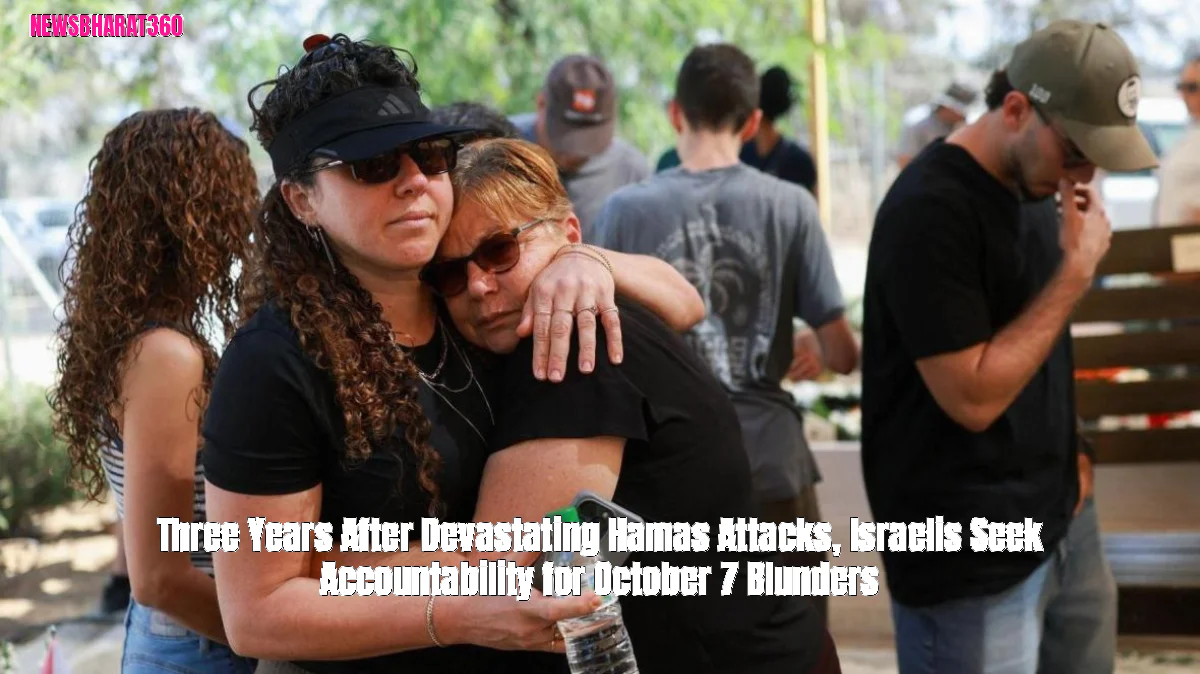
A father of one of the victims from the October 7 incident addressed the prime minister during a commemorative ceremony held in Jerusalem on Monday.
The grieving father expressed his outrage and sense of betrayal, stating that the authorities had failed to safeguard his child and the other victims who lost their lives.
Following a three-year period since the attacks, there is a growing demand for accountability. Activists have petitioned the Israeli Supreme Court to compel the government to establish a state commission of inquiry.
Yizhar Shai, a former opposition minister and politician, was involved in a significant campaign. Tragically, his youngest son, Yaron, who was a soldier at the time, lost his life on October 7.
A protest participant in Tel Aviv expressed concern about the upcoming elections, stating that as of last week, the situation was being navigated with limited information.
The prime minister has yet to provide a thorough and detailed account of the situation under sworn testimony, where he would be subject to rigorous questioning and be required to address all pertinent issues.
Israeli Prime Minister Benjamin Netanyahu has consistently rejected a state investigation ordered by the Israeli Supreme Court, citing concerns that the country's judicial system would be biased against him.
Prior to the election process, the government presented an alternative proposal, a national commission of inquiry, which would be composed of members selected by the country's political parties.
The Israeli government stated it was unable to pass legislation outlining its plans for an investigation prior to the conclusion of the parliamentary session in July, despite having previously passed a series of laws.
Efforts to secure comments from members of the Likud party, with which the individual is affiliated, have been unsuccessful thus far. A request has also been extended to the party to address criticisms leveled against it, with a response pending.
Netanyahu's refusal to acknowledge his role in a contentious matter has taken on electoral significance as he gears up for a re-election campaign set to conclude later this month.
A video game called Sleepy Bibi, a reference to Prime Minister Netanyahu's nickname, has been released by a team affiliated with his main political opponent, Gadi Eisenkot. The game's objective is for players to assist the prime minister in avoiding accountability by sidestepping warnings of an impending attack, ultimately allowing him to retire to bed safely and healthily.
Israeli Prime Minister Benjamin Netanyahu has long referred to himself as the country's chief authority on security, a title he has maintained despite presiding over the most significant security failure in Israel's history.
In the past three years, he has concentrated on launching military campaigns against Israel's adversaries, including Hamas, Hezbollah, and Iran.
Recent polling data indicates a highly competitive election landscape, with the October 7 attacks emerging as a pivotal issue influencing the voting decisions of many citizens.
Yaakov Katz describes the aftermath of October 7 as a complex and multifaceted phenomenon, with both positive and negative consequences.
The individual emphasized that while there have been instances of failure and mistakes that contributed to the Hamas invasion, it is also essential to consider the positive impact of Netanyahu's leadership, which has led to significant transformations in the Middle East and enhanced Israel's security.
The Israelis will be taking this perspective with them as they cast their votes.
Tensions stemming from recent attacks continue to cast a divisive influence over Israel's upcoming elections, with the country's citizens increasingly aligning along partisan lines.
Supporters of the Israeli leader believe that his continued presence is crucial to maintaining the country's security.
The country's leaders are facing criticism that their focus on maintaining power may compromise Israel's security and stability.
This article was initially composed in English and has been translated using an artificial intelligence tool. Prior to publication, a BBC reporter reviewed the text to ensure accuracy. For more information on our use of translation technology, please visit our website.