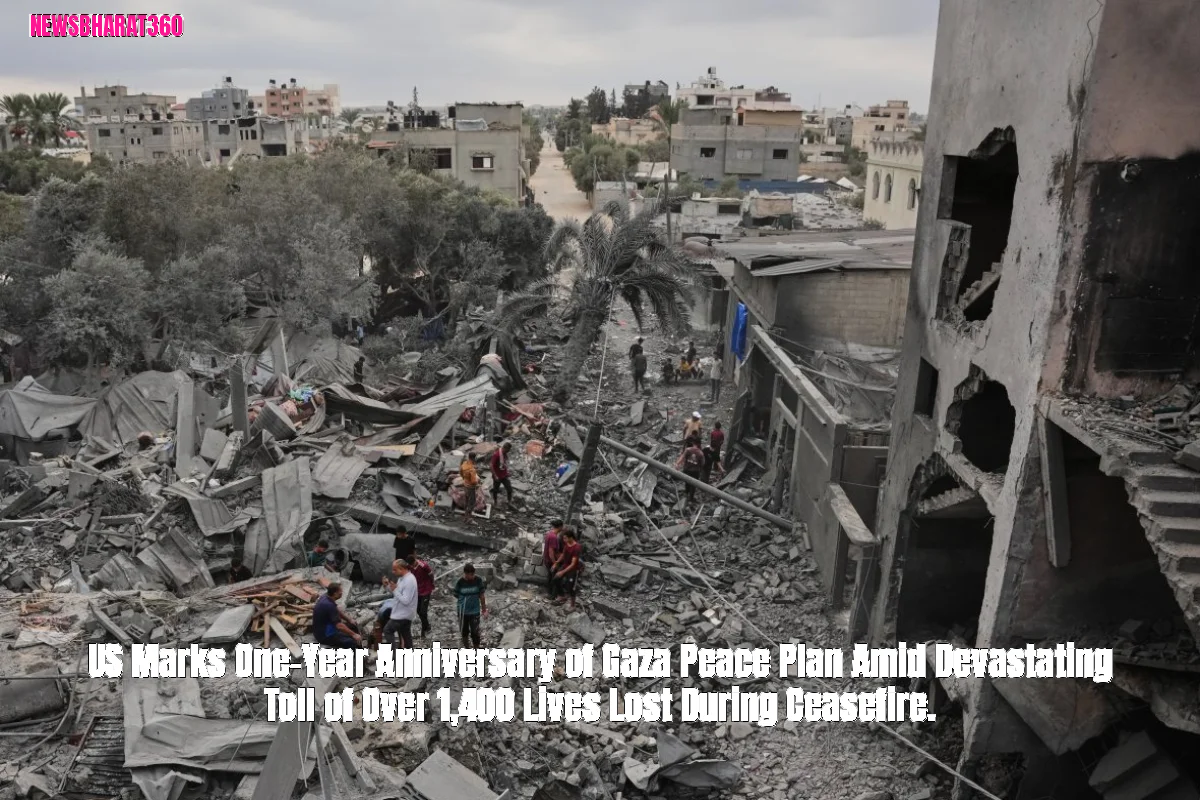

US President Donald Trump has maintained his stance in support of the strategy implemented to bring an end to the conflict between Israel and Hamas, despite ongoing attacks and a lack of progress in rebuilding Palestinian infrastructure.
The United States government marked the one-year anniversary of its peace initiative for the Gaza Strip, citing the establishment of a lasting ceasefire as a key achievement despite the loss of over 1,400 Palestinian lives since the truce took effect.
US State Department spokesman Tommy Pigott credited President Donald Trump's diplomatic efforts with facilitating a series of developments that have set the stage for a new phase in Gaza, following two years of conflict.
Key outcomes of the agreement include the repatriation of all Israeli hostages, both living and deceased, the establishment of a Peace Board, and the formation of a Palestinian technocratic government.
The official stated that the measure has led to an increase in humanitarian aid and a decrease in Hamas's ability to redirect supplies, although specific data to quantify this reduction was not provided.
The State Department acknowledged that the recent accomplishments mark the start of a larger process, while also acknowledging the challenges that remain to be overcome in order to solidify the agreement reached in October 2025.
Contrary to the positive developments in Washington, international organizations issued a stark warning. The Office of the United Nations High Commissioner for Human Rights issued a statement on October 12, highlighting that Israeli military actions persisted throughout the first year of the agreement, resulting in additional casualties and displacements.
The Gaza Ministry of Health reported that at least 1,493 Palestinians have been killed and 5,299 wounded as of October 12, based on available data. Since the conflict began on October 7, 2023, the total number of fatalities has surpassed 74,382.
The United Nations has recorded attacks occurring both within and beyond the designated "yellow line," which marks the boundary between Israeli military positions and other areas following the recent agreement. The organization has also issued a warning regarding potential breaches of international humanitarian law.
Israel claimed its military operations targeted Hamas militants and other armed groups, asserting they had breached a ceasefire agreement. However, Hamas countered by attributing the breakdown in the peace process to Israeli actions.
On October 9, 2025, Israel and Hamas initiated the first phase of a 20-point plan, a key component of a broader agreement. Subsequently, an international conference was convened in Sharm el-Sheikh, Egypt, four days later.
The initial agreement facilitated the release of Israeli hostages and the liberation of hundreds of Palestinian prisoners and detainees. Nevertheless, subsequent undertakings, including the disarmament of Hamas, the withdrawal of Israeli military forces and the deployment of an international stabilization force, have yielded limited progress.
Israel maintained control over roughly two-thirds of the Gaza Strip, with the Palestinian technocratic government, established in January 2026, yet to establish a presence in the territory to assume its responsibilities.
The reconstruction effort encountered significant economic challenges. A preliminary $2.45 billion program was unveiled by the Peace Council, falling short of the estimated $71.4 billion required over the next decade, according to international agencies.
The anniversary of a significant event highlighted two contrasting perspectives: Washington's assessment of diplomatic success, marked by the release of hostages and a decrease in large-scale military operations, and the concerns of humanitarian organizations, which emphasized ongoing violence and displacement affecting the Palestinian population.