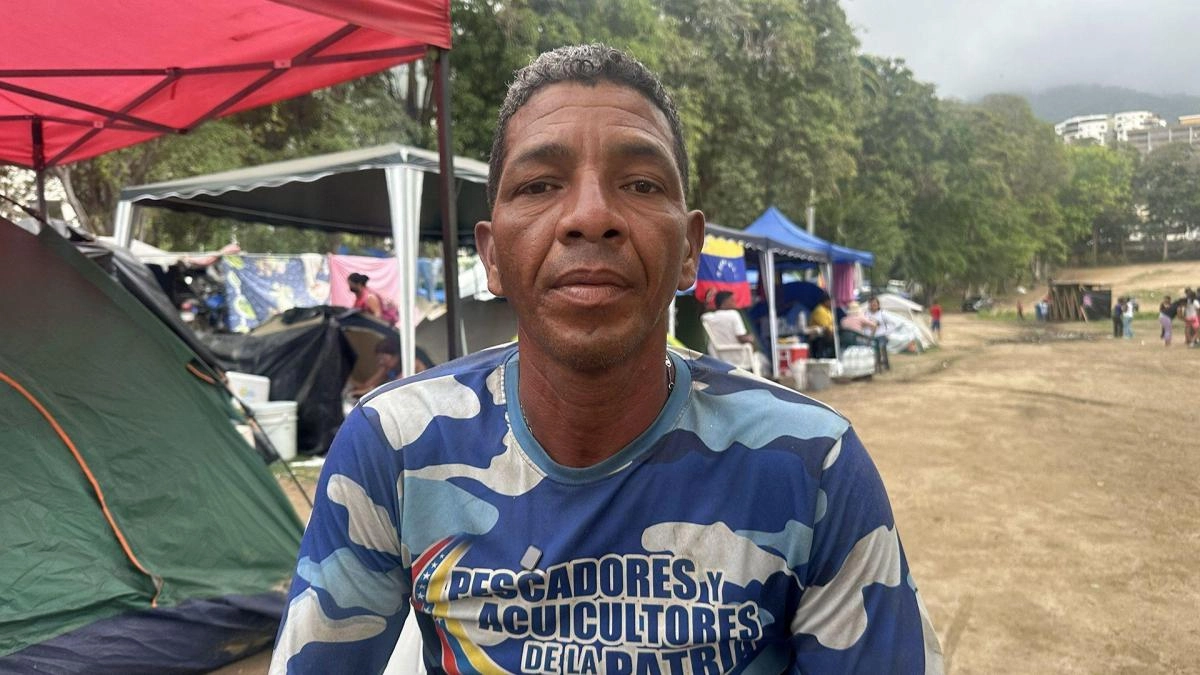

The worst day of Víctor Calderón's life, exactly a month ago, occurred while he was at sea.
When two powerful earthquakes devastated the northern coast of Venezuela, the 49-year-old fisherman had been on a boat for 18 days, and was informed by radio that the building where he lived with his family had collapsed.
When he returned to shore, he found that 26 members of his family were missing.
Among them are his sisters, nephews, great-nephews and nine cousins. Their ages ranged from 2 to 70-something years old.
“It's a terrible, terrible thing,” he says, struggling to find the words.
“I haven't cried for them yet, not until I find the last ones missing,” he adds stoically.
Víctor's entire family lived in a public housing complex known as OPPE 26 located in Caraballeda, the town in the state of La Guaira that is considered ground zero of the tragedy.
Fortunately, his daughter and granddaughter survived. His family, now very small, lives in a tent on a golf course.
“This is heartbreaking”
A month after the disaster, many like Víctor continue searching and finding their loved ones.
According to a count updated almost daily by the government, more than 5,300 people have been confirmed dead. More than 16,500 were injured in the earthquakes.
The government has not specified how many people remain missing, but the number is estimated to be in the tens of thousands.
In the evening, as the sun began to set, three bodies were recovered at OPPE26 from among the rebar and rubble, including that of an 11-year-old girl.
His father, sobbing uncontrollably, was finally able to mourn his loss after the end of his desperate month-long search.
The rescuers stopped working or prayed while the girl's body was delicately removed wrapped in a black plastic tarp; his father's howls pierced the air and drowned out the sound of the heavy machinery working nearby.
“This is heartbreaking,” says Magin Hernández, a member of another search team, between sobs. “For the rescuers, the families, the friends – it's really devastating.”
Was there negligence?
For most survivors and victims' families, the devastating pain is also combined with a deep and growing sense of anger toward authorities.
The resentment is palpable. Almost everyone I spoke to in the housing complex in Caraballeda asks the same questions:
How could ten of the twelve housing blocks collapse? Were the construction plans defective, resources spared, or inappropriate materials used? Is there evidence of negligence?
I posed some of those questions to the Minister of Public Works, Juan José Ramírez, during his visit to the site.
He insisted that the buildings were in good condition, adding that no nation could have coped with the magnitude of the disaster.
“It was not a single earthquake, but two almost simultaneous ones, both moving in different directions,” the minister argued.
“Around us you can see that both public and private buildings have been demolished,” he said, pointing across the street to other destroyed apartment blocks.
“The earthquake made no distinction between the two.”
A lonely search
In one of the demolished private buildings in the coastal town of Catia La Mar, an unusual rescue took place eight days after the earthquakes.
From beneath the concrete slabs, a security guard, Hernán Gil, was rescued alive from an underground parking lot.
The scenes of jubilation briefly lifted Venezuela's spirits.
Today, Laura Barrios continues searching in the same building for her brother-in-law, whose body remains trapped in the same parking lot.
Most of the international teams that were mobilized to help Gil have already returned home, and even the excavator that was removing the unstable debris was sent elsewhere.
The news that Laura's family has returned to searching on their own came a day after the bodies of her sister-in-law and the children, ages 10 and 3, were found huddled together in their room.
“The other day was Children's Day in Venezuela,” Laura says between sobs. "But we don't have children to celebrate. Ours are gone."
She is furious with the authorities for their slow reaction.
He says that the news that heavy machinery is being removed when his family still needs it has taken away his desire to fight.
“What more can we say that this rubble doesn't already tell us?” he asks, contemplating the devastation around us.
"Lost t-shirts, unused cutlery, dishes, toys. Entire lives, gone in just 39 seconds."
Uncertainty and hope
In line for a hot meal at World Central Kitchen, one of the US-based humanitarian agencies operating in Catia La Mar, people show characteristic Venezuelan good humor in the face of greater adversity than most have ever known.
While people need food and bottled water, they also appreciate a smile or a hug, gestures of human kindness and camaraderie.
Meanwhile, they return to the cheap nylon tents, pitched on the sidewalk, that will be their temporary homes for the foreseeable future.
This week, the Delcy Rodríguez government donated 200 homes to affected families.
However, the total need could be a hundred times greater. Reconstruction will take years and billions of dollars in investment; The World Bank has estimated that the two earthquakes caused $19.6 billion in damage.
Rodríguez was sworn in as interim president in January, days after U.S. forces detained Venezuelan leader Nicolás Maduro and took him to New York to stand trial on “narcoterrorism” charges.
While it has the backing of President Donald Trump's administration, it is Washington that controls Venezuela's oil industry, the oil-rich country's main source of income, so it is far from clear how reconstruction will unfold.
Many of those living in tents resided on Playa Pirata, a small stretch of beach that was packed with visitors during the holiday when the earthquakes occurred.
They watched in desperation as their homes collapsed before their eyes and ran to their apartments to try to save family members and pets trapped inside.
Theirs are just a few of the thousands of horror stories that Venezuelans still struggle to understand and that have left an indelible mark on a nation ill-prepared to face them.
This article was originally written in English and we used an artificial intelligence tool to translate it. A BBC journalist reviewed the text before publication. Learn more about how we use AI.
Download the new BBC World Service app. Choose BBC News Mundo and receive news alerts, documentaries and analysis, all in one place. Important: The new app is not available in the United Kingdom or the United States.