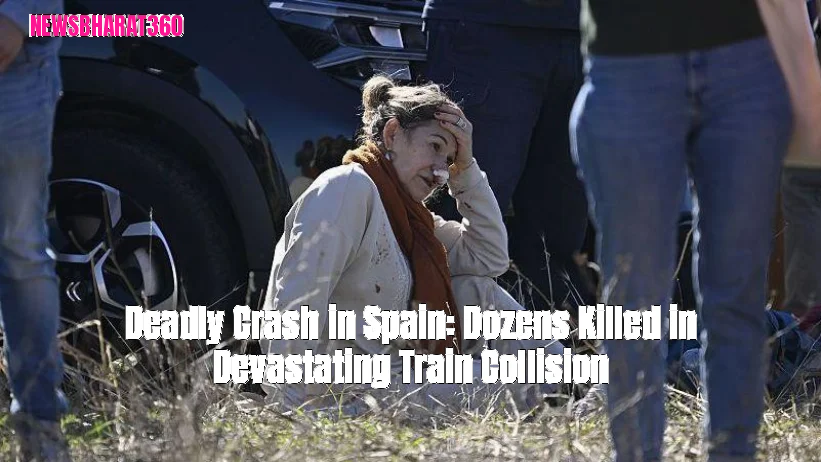

A high-speed train collision occurred on Wednesday morning in the vicinity of Urda, a town located south of Madrid.
A collision occurred between an AVE train, operated by the state-owned railway company, which was traveling from Madrid to Seville, and an Iryo train, a private service, heading in the opposite direction.
A plane crash occurred approximately 140 kilometers south of Madrid, near the town of Urda in the province of Toledo, at around 8:54 local time.
The death toll from the accident has increased to at least 68, according to regional government sources cited in Spanish media reports.
The death toll from the recent tragedy remains a disproportionate figure, evoking deep sorrow for the affected families. The region's president, Emiliano García-Page, expressed his condolences and acknowledged that the recovery efforts are ongoing, with a focus on dismantling and removing the remaining clusters from the wagons, as firefighters anticipate the discovery of additional bodies.
The latest incident marks the most severe railway disaster in Spain since a fatal accident occurred in July 2013, resulting in the loss of 80 lives when a high-speed train derailed in a curve near Santiago de Compostela, in the northwest region of the country.
Emergency responders are engaged in a time-sensitive operation to provide aid to those injured and conduct a thorough search for any remaining survivors.
Renfe has temporarily halted train services connecting Madrid, Ciudad Real, and Andalucía.
A high-speed train traveling from Madrid to southern Spain collided with another train that appeared to be stationary on the tracks.
At least two vehicles collided with a terraplen as a result of the incident.
According to RTVE, citing the Ministry of Transport, a Renfe train was involved in a collision, striking the train operated by Iryo.
Spain's national railway company, Renfe, operates as a state-owned entity, in contrast to Iryo, a privately owned high-speed rail service provider.
Train service on this line remains temporarily halted due to ongoing disruptions.
A 17-year-old passenger, Eduarda, described the scene at the accident site as chaotic, stating she witnessed victims trapped beneath the trains.
A witness described the chaotic scene, recounting that he was seated with his two kittens nearby when a sudden, severe braking occurred, causing him to be propelled forward in his chair. As people began to evacuate the area, the witness observed numerous individuals crying and noted that bodies of those killed by the trains were visible throughout the scene.
Eyewitnesses described a chaotic and terrifying scene as many individuals were unable to escape the unfolding disaster.
The underlying factors responsible for the sudden event are still unclear.
Spanish media outlets have cited government sources suggesting that a potential human mistake involving signaling procedures may have contributed to the accident.
A high-speed train reportedly collided with a stationary train that was halted on the tracks.
At least 500 individuals were reportedly on board the two trains involved in the collision.
Data from Adif, obtained through Esther Padilla, a spokesperson for the Government of Castile-La Mancha, indicates that at the time of the collision, a total of 544 individuals were present in both convoys.
A train operated by Iryo, identified as service 6076, was transporting 147 passengers at the time of the incident, consisting of 146 adults and one infant.
A train operated by Renfe's high-speed service 2080 carried a total of 397 passengers.
Spanish Prime Minister Pedro Sánchez announced on social media that emergency responders are actively working in the affected area to provide assistance and guarantee the safety of those impacted, in close collaboration with relevant local authorities.
The individual stated that the serious rail accident in Toledo was a pivotal event in his life.
The judicial authorities are actively investigating the circumstances surrounding the incident, with the goal of determining its causes, origins, and motivations. They are committed to uncovering the truth and identifying any potential shortcomings or failures in the security system, and will take decisive action if any negligence or lapses are found.
The Minister of Transport, Óscar Puente, attributed the cause of the accident to a malfunction at the control center during a press conference.
A communication failure affecting three computers in the LZB control system at the Urta station occurred at approximately 8:30 p.m., resulting in a 63-kilometre stretch of the railway system being left without LZB security, prompting the automatic halt of all trains operating in that section.
The decision to resume circulation was made by the control center, which also determined the timing of the resumption of the march. However, the reasoning behind this decision remains unclear and appears to be unexplained from our perspective.
On that occasion, the AVE train accelerated to a speed at which it was unable to halt in time. Approximately 25 kilometers later, it collided with the stationary Iryo train.
The minister emphasized that he does not assign responsibility for the facts and instead, the investigation should draw its own conclusions.
Emergency response teams from the Civil Guard, local firefighters in Toledo and Ciudad Real, Civil Protection volunteers, and medical personnel from the Health Service of Castilla-La Mancha have been deployed to the affected area.
The Madrid government has mobilized public hospitals in La Paz, Getafe and 12 de Octubre to provide medical care to those injured in the rail accident, according to official reports.
A recent train accident in the province of Toledo, Spain, marks the third railway incident to occur in the country within the past year.
A devastating train collision occurred on January 18 in Andalusia, resulting in 45 fatalities and over 100 people sustaining injuries.
A fatal accident occurred in Catalonia when a driver, who was in a vehicle involved in a practice session, lost his life. The nearby train, in which he was traveling, collided with a wall that had collapsed onto the road.