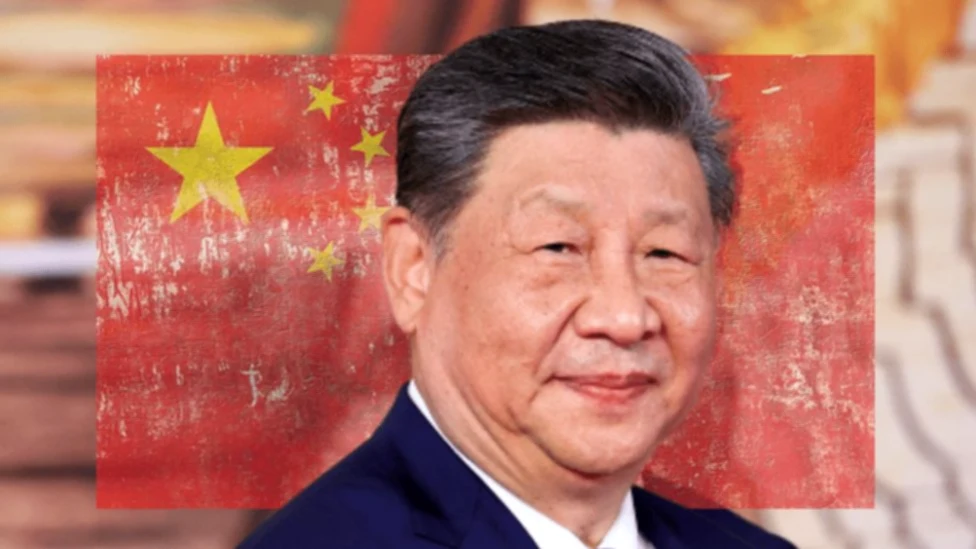

Chinese President Xi Jinping will arrive in Washington on Wednesday, which will be his first visit to the United States in 11 years.
But his first contact with that country came long before he became China’s most powerful leader in generations.
Four decades ago, Xi was an official from a northern Chinese county and visited the Middle West of the United States during a study trip.
He then spent several days in Iowa learning about agriculture, visiting farms and staying with a local family.
Chinese state media highlighted his stay at that home and his friendship with Terry Branstad, then governor of Iowa and later ambassador of Washington in China during the presidency of Donald Trump, to highlight Xi’s personal ties with the United States.
Today, the relationship between the United States and China has little to do with that of then. It is now marked by competition between the two nations for global influence, mutual tariffs, technological controls, and military rivalry.
In his 14 years at the head of China, he has transformed the Communist Party and the country’s role in the world.
Xi’s history began with privileges.
Born in Beijing in 1953, he was the sixth son of Xi Zhongxun, a Communist revolutionary who contributed to the founding of the People's Republic of China. His father became a Communist Party leader and deputy prime minister.
During his childhood, Xi attended elite schools and many privileges that were beyond the reach of most Chinese families.
But the situation turned upside down when politics turned against his family.
At the beginning of the 1960s, his father was accused of being part of a supposed “anti-party faction” and ended up being sent to the countryside to work in a factory, in addition to being expelled from the Communist Party.
As the son of a person considered “counter-revolutionary,” Xi was forcibly sent to a re-education program.
Responding to the call of then-leader Mao Zedong for young people to go to the countryside and learn from the peasants, Xi, at the age of 15, was moved to a rural area along with millions of students from the cities.
Describing that experience in a 2004 interview, he recalled: “Everyone on the train was crying. I was the only one who smiled. If I had not come out of there, I would have cried. If I had stayed, I don’t even know if I would be alive.”
He ended up in the remote village of Liangjiahe, in the western Chinese province of Shaanxi, where he lived for seven years in a yaodong, a house excavated on the slope of a hill, where he did agricultural tasks, transported debris and digged shells.
“The shortened vegetables became my favorite food,” she said about that stage. “I still remember them today with affection.”
According to him, at first he was “stunned” by the hard work and suffered hunger and flea bites, although he found some relief in the smoking breaks before lunch.
At the age of 22, Xi left the field to study chemical engineering at Tsinghua University, one of China’s most prestigious academic institutions.
After graduating, he worked as a local official far from Beijing, in the coastal provinces of Fujian and Zhejiang, which became some of the country's most prosperous regions after the economic opening of the 1980s.
His father's political rehabilitation after Mao's death helped Xi access positions in the central government and the Armed Forces, beginning to weave relations within the Communist Party.
Many of those officials would then go into their closest circle of trust.
Xi married in 1979 his first wife, Ke Lingling, daughter of a former Chinese ambassador to the United Kingdom.
Then, a common friend introduced him to his current wife, Peng Liyuan, an Army folk music singer who was already a well-known figure in China thanks to her performances at the Lunar New Year’s TV shows, followed each year by millions of spectators.
For many Chinese during the 1980s and 1990s, Peng was more recognized than the provincial official she married.
Peng has frequently accompanied Xi on his overseas trips, breaking with the discrete image traditionallyined by the Chinese first ladies.
Her only daughter, Xi Mingze, was born in 1992. little is known about her, except that she studied at Harvard University in the United States.
In 2007, after a brief period as Shanghai’s highest leader, Xi joined the Standing Committee of the Political Bureau, China’s main decision-making body.
And, five years later, he succeeded Hu Jintao as leader of the Communist Party.
As the country’s highest leader, Xi transformed the economic and political system in ways that only a few had imagined.
Over its 14 years in power, China has shown itself increasingly confident of itself.
At the international level, Xi expanded China’s global presence through projects such as the Belt and Road Initiative, while presenting Beijing as a defender of the so-called Global South.
At the same time, relations with many democracies became more tense, with rising disputes in the South China Sea, increased pressure on Taiwan and increasing competition with the United States.
However, Xi’s legacy is also marked by greater political control within China.
Under his leadership, the country has placed much more emphasis on security and political stability, applying repressive measures in regions such as Xinjiang, Tibet and Hong Kong. According to his supporters, this has restored order. For its critics, they have significantly restricted civil liberties.
Xi also promoted a political doctrine that bears his name, “Xi Jinping’s Thinking on Socialism with Chinese Characteristics for a New Era,” something that his two predecessors failed to incorporate in the same way into the Communist Party’s ideological structure.
In addition, he removed from the Constitution the limit of presidential terms, which allows him to remain in office beyond two terms.
Although Chinese state media often present him as a serious figure, Xi has also occasionally shown a more distracted facet.
The president has talked about his passion for football, even joking with a Thai prime minister about the poor results of the Chinese men's national team.
In addition, he shared a beer with former British prime minister David Cameron and came to joke with a South Korean president about the convenience of checking whether Xiaomi phones made in China had any “backdoor” before accepting them as a gift.
Xi’s relations with foreign leaders have gone through different stages, reflecting the changing priorities of China’s foreign policy.
No foreign leader has a closer relationship with him than Russian President Vladimir Putin. Since Xi came to power, the two have met more than 40 times, and the Chinese leader has even come to describe Putin as their “nearest confidant.”
The relationship with Donald Trump is more complicated.
Although Trump launched a trade war with China during his first term, he has often spoken in praiseful terms about Xi, whom he has called a friend and whose political strength he has highlighted on several occasions.
With India’s prime minister, Narendra Modi, Xi initially sought intense personal diplomacy.
The two sides held informal meetings aimed at highlighting cooperation between the two Asian powers. However, the 2020 border clashes brought bilateral relations to their lowest point in decades.
Unlike other leaders known for their personal charisma or improvisational ability, Xi rarely puts individual relations ahead of state interests.
When he arrives this week in Washington DC, Xi will no longer be the curious local official who visited the Iowa farms four decades ago, but one of the most influential political figures of the 21st century.