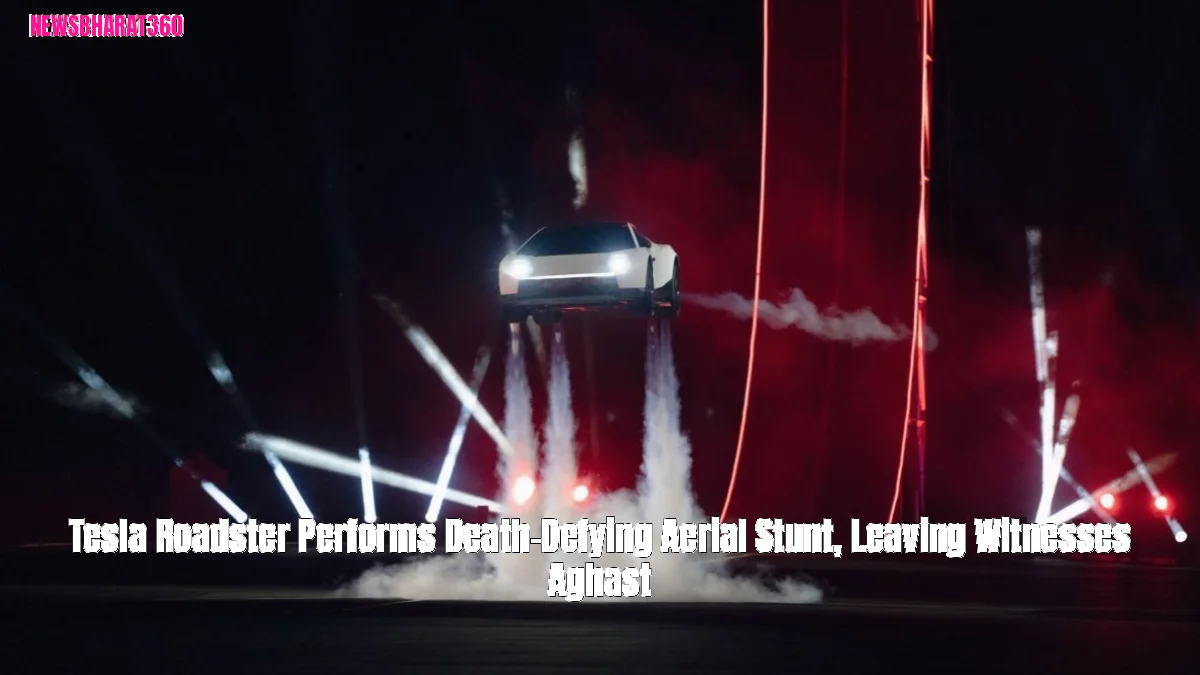

Tesla showcased its new Roadster electric sports car in an unconventional demonstration, highlighting the vehicle's capabilities through a series of impressive maneuvers reminiscent of a science fiction film. The display featured the car executing aerial turns and leaping over other vehicles, effectively conveying the Roadster's advanced performance. However, the presentation raised several unanswered questions regarding the car's capabilities and features.
Porsche has unveiled a new concept, the Mission S, which is positioned as a high-performance sports car surpassing the capabilities of the iconic 911 model.
A highly anticipated model made its latest appearance in McGregor, Texas, under the leadership of Elon Musk, marking a significant milestone in the vehicle's long development process. The model's initial unveiling took place in 2017, but subsequent production timelines have been repeatedly pushed back. The company now indicates that it plans to bring the model into production by 2028.
Chinese electric vehicle manufacturer BYD has filed a patent for a system designed to refrigerate immersion batteries, a technology aimed at improving battery performance and lifespan. The innovative cooling system is expected to enhance the efficiency and reliability of BYD's battery-powered vehicles. The patent filing marks a significant development in the company's efforts to advance its battery technology.
The design of the sports car has undergone modifications from its original prototype, but the true showstopper is the advanced technology employed to execute its high-performance capabilities. Tesla aims to differentiate its vehicle not only through exceptional acceleration but also by pushing the boundaries of what is possible in a conventional automobile.
SpaceX's Tesla Roadster, an empty car, was launched into space on February 6, 2018, aboard the Falcon Heavy rocket during a historic demonstration test.
The Tesla Roadster's demonstration commenced with a controlled descent down a massive ramp, secured by a suction system until it broke free and transitioned into a mid-air rotation using cold gas thrusters. The vehicle successfully landed on its wheels before executing a series of impressive jumps over several of the company's vehicles, culminating in a second aerial maneuver.
Elon Musk expressed caution prior to the demonstration, acknowledging that a successful outcome was not assured, despite his confidence in the event's progression.
Elon Musk showcased the vehicle's capabilities, highlighting its ability to fly like a rocket. Nevertheless, it is unclear which aspects of the demonstrations will be feasible to integrate into a production-ready model suitable for public roads.
Tesla's vice president of engineering, Lars Moravy, has highlighted a notable feature of the company's suction ventilation system, which can produce up to 2G of force. This technology is expected to enhance the vehicle's performance on the track by adding an additional load.
A key component of the system is the propulsor set, which utilizes advanced technology from SpaceX. This innovative system consists of 10 towers and relies on 250 kilograms of compressed gas for operation. Furthermore, the propulsor set is designed to recycle its air supply, enabling it to replenish its capacity without requiring external charging.
Tesla's upcoming Roadster is expected to deliver exceptional performance capabilities, including 2G side acceleration in curved sections. The vehicle is also targeting impressive straight-line acceleration, with the company having achieved a 0-96 km/h time of 0.81 seconds in testing. Further enhancements to this result are anticipated in the production version.
A high-performance vehicle has achieved a top speed of over 370 km/h, with developers aiming to reach approximately 616 km/h, roughly half the speed of sound. For context, a 2017 prototype demonstrated rapid acceleration, accelerating from 0 to 96 km/h in 1.9 seconds.
Elon Musk's latest electric vehicle, the Roadster, will be offered in three distinct configurations. The Performance model will feature the advanced suction system, providing a high level of acceleration. The Thrust edition will be a limited release variant, catering to drivers seeking even more extreme performance capabilities. The top-of-the-line Rocket configuration will be reserved for select customers, featuring a full suite of 10 propellers.
Tesla requires a non-refundable deposit of $50,000 for all versions, which must be paid within a 10-day timeframe following the initial booking.
Key details regarding the vehicle remain unclear, with the company yet to disclose its final price and autonomy capabilities, crucial factors for potential buyers. Additionally, the regulatory status of the systems enabling its advanced maneuvers remains uncertain, with the need for approval to operate on public roads still unaddressed.
Elon Musk has acknowledged that certain features of the vehicle may not be compliant with regulations in all countries. This concern is particularly warranted given the car's capabilities, which include navigating obstacles and executing aerial maneuvers with the aid of propellers.