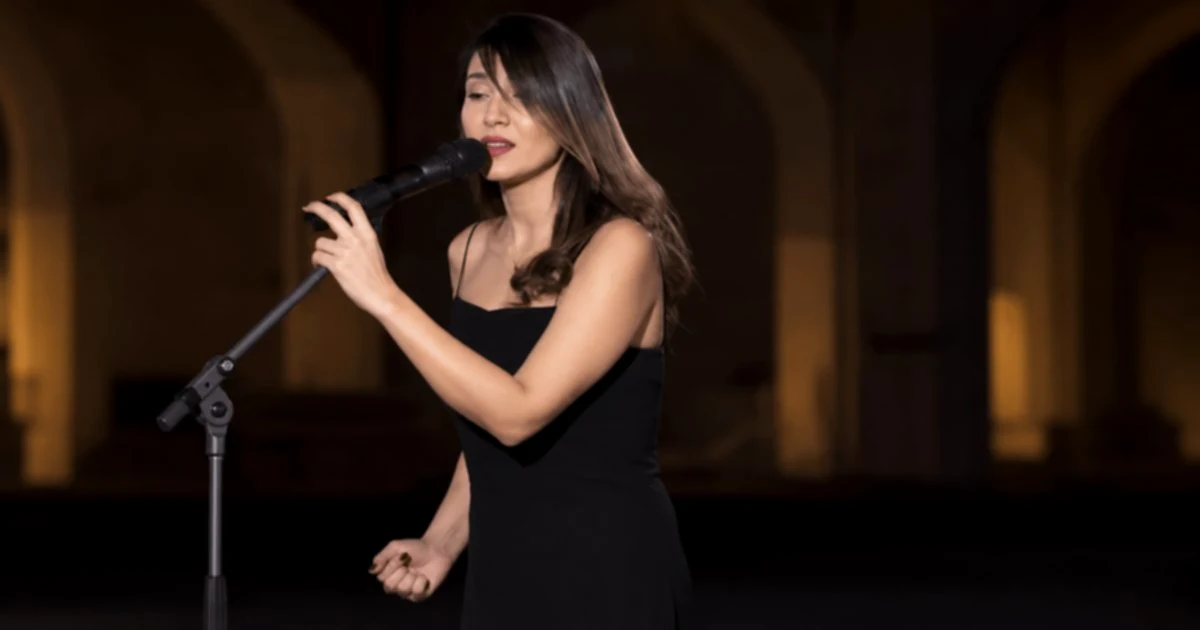

A voice, an empty stage and a black dress were enough to turn an internet-streamed concert into a court case that now shakes Iran again.
The 29-year-old singer Parastoo Ahmadi faces a sentence of 74 beats, plus two years without being able to travel abroad or develop artistic activities, after an appeal court rejected the appeal filed by her defense. The sentence was firm and enforceable, although it was not yet when and where the corporal punishment would be applied.
The case has once again crossed the Iranian borders in recent days. Iranian-American journalist and activist Masih Alinejad launched a call on social media aimed at singers, musicians and figures with access to a stage: she asked them to sing for Ahmadi and help keep her story visible as she faces the ban on exercising her profession.
It all started on December 11, 2024. Ahmadi organized a non-audience concert at a former Iranian caravanserai and aired it on YouTube. She appeared with open hair, without the mandatory hiyab, and sang as a soloist accompanied by male musicians. The video became viral quickly: in just one day it had accumulated 500,000 views on YouTube and millions of views on other platforms.
Before starting, the singer explained that she wanted to sing for the people she loved and presented that performance without spectators as an “imaginary concert.”
The judicial authorities then opened a case against her and her team arguing that the presentation did not respect the country’s legal and cultural norms.
Months later, a Qom court convicted them for considering that they had harmed “public decency” by publishing content judgmentally qualified as “vulgar and immoral” on the internet.
You can see: How is Iran’s theocratic regime and why its power structures seem to remain intact
The judgment has already surpassed the appeal. The head of a chamber of the Qom Court of Appeals rejected the arguments submitted by Ahmadi and seven members of his team. Another member initially convicted did not appeal, according to The National.
The sentence stipulates 74 beats, two years of ban on leaving Iran and two years of non-participation in artistic or audiovisual activities. Iran International, citing the Iranian newspaper Ham-Mihan, said the ruling was declared definitive and enforceable.
In Iran, women are legally obliged to cover their hair in public and there are also restrictions for acting as solo singers in front of mixed audiences.
The confirmation of the verdict gave rise to a new international campaign. On September 27, Masih Alinejad broadcasted a video of Ahmadi singing and asked well-known figures of the music and the show to use their own platforms to amplify their case.
for one minute. That’s all it takes to listen to this beautiful voice. Parastoo Ahmadi, one of Iran’s most beloved singers, hasly been sentenced to 74 lashes simply for singing. Her musicians and production team face the same punishment. In the ? pic.twitter.com/vuCXoKMBCO
His message poses a simple action: listen to Parastoo, share her story and let artists with access to a stage or a microphone “be Parastoo’s voice” and sing for her until she can sing again. The post began to circulate widely on X over the weekend.
Alinejad is an Iranian-American journalist and activist known internationally for her campaigns against the compulsory use of hijab and in defense of the rights of Iranian women. In recent years, she has also been the subject of alleged plots to kidnap or murder her in the United States; several accused have been prosecuted by U.S. justice.
The corporal punishment used by Iranian justice has been repeatedly challenged by international human rights organizations.
Human Rights Watch noted in its 2026 global report that Iranian authorities continue to impose punishments such as beating and amputating, practices that, according to the organization, constitute torture in accordance with international law.
Amnesty International has also specifically denounced the use of beatings against artists and activists. In March 2025, for example, Iranian singer Mehdi Yarrahi received 74 beats for a song related to the “Woman, Life, Freedom” protests.
The call began to add voices from the media world. French journalist and columnist Marika Bret publicly called for Parastoo Ahmadi to “be the voice,” while Sophia Aram, one of France Inter’s most famous columnists, spread the case with the message “Say her name Parastoo Ahmadi.”
Say her name Parastoo Ahmadi https://t.co/GbsOQggRgp
Claudio Savoia, editor of the Argentine newspaper Clarín and columnist on the TN channel.
A woman is sentenced to 74 beats, two years without being able to develop audiovisual activities and two years without leaving Iran. Parastoo Ahmadi is 29 years old. His “crime” was singing without hiyab and spreading that concert. The Justice ? pic.twitter.com/FxNwx9bmKK
German journalist Sebastian Gierke, editor of Politics for the Süddeutsche Zeitung, had previously amplified the complaints over the conviction.
In the case of Parastoo Ahmadi, the date on which the sentence could be executed is not yet known. But the judicial confirmation again turned that concert in front of an inexisting audience into a story followed far beyond Iran.
And the new campaign seeks just that: that while Ahmadi has a ban on singing, other voices keep his own circulating.