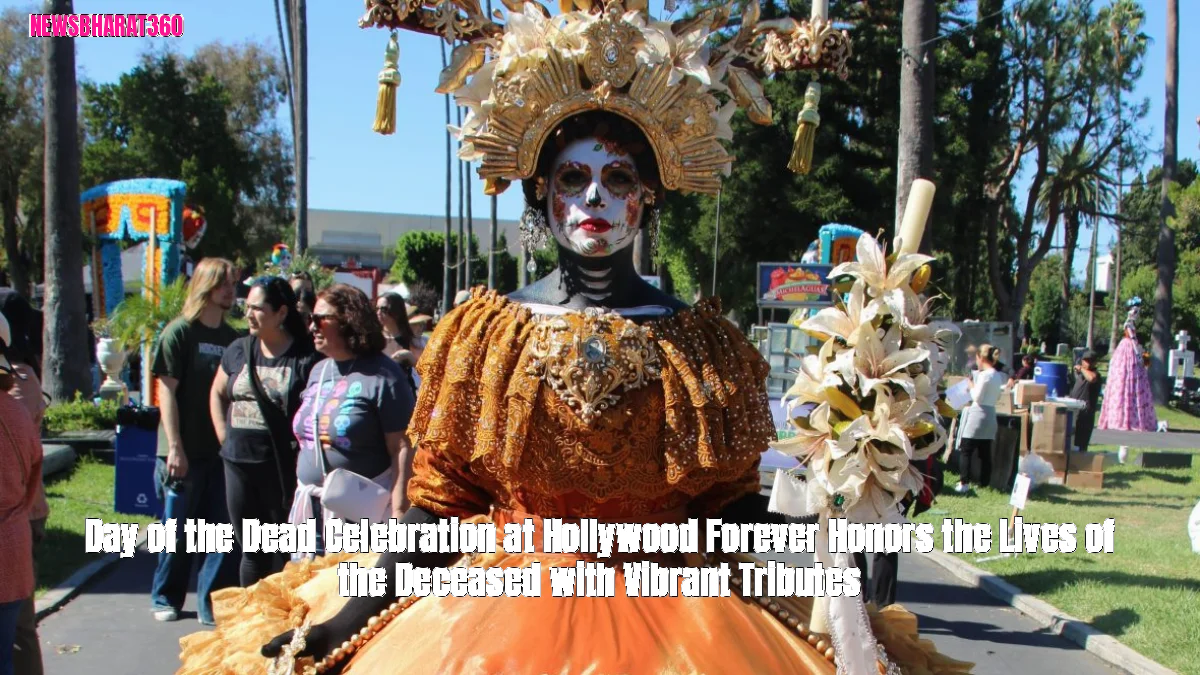

Thousands of people of Mexican descent and individuals from diverse backgrounds gathered at the Hollywood Forever cemetery to commemorate the 27th anniversary of the Day of the Dead festival amidst a vibrant display of traditional symbols, including cempasúchil flowers, ofrendas, and iconic catrinas and catrines.
The Festival of Life, intended to authentically honor and preserve the ancient tradition of the Day of the Dead, has instead revealed a lack of understanding about the true significance of this significant holiday.
Paola Pratt views this experience as a chance to reconnect with her heritage and explore her family's history. She is taking the opportunity to learn more about her ancestry and share this knowledge with her husband Clayton, including preparing an altar for the first time.
Mexico uniquely observes the Day of the Dead, a holiday honoring and commemorating deceased loved ones, based on the ancestral belief that their spirits briefly return to the earthly realm to reunite with their families. Official celebrations take place on November 1 and 2, but festivities often commence several days in advance.
The origins of the celebration are rooted in the pre-Hispanic cultures of Mexico, including the Mayans, Zapotecs, and Mixtecs, who viewed death as a natural transition rather than an end. According to their mythology, the soul embarked on a journey to the underworld, known as Mictlán, a term derived from the náhuatl words "mikki" meaning "dead" and "tlan" signifying "place of death" or "where death abounds". In these cultures, Mictlantecuhtli was revered as the deity of death, often accompanied by his wife Mictecacíhuatl.
Javier "Xico" Garza, leader of the Aztec dance group, stated that he directs his blessings to the four cardinal directions and invokes Mother Earth with copal during the performance at the entrance of the Hollywood Forever Cemetery.
The origin of the term copal is derived from the náhuatl language, where copalli translates to incense. According to Garza, in pre-Hispanic culture, reverence for nature and the cosmos was deeply intertwined with medicinal practices, underscoring the significance of honoring ancestors and the deceased for Mexican and Latin American immigrants.
Traditional healing practices among Mexico's indigenous communities have utilized copal bark, often prepared as smoke or infused in breast-like vessels, to alleviate a range of health issues, including headaches, coughs, bronchitis, and general illnesses.
Many Mexicans who migrate to the United States often experience a loss of their cultural identity, a phenomenon attributed to their desire to assimilate into American society.
The Day of the Dead is a celebration centered on the joyous reunion with deceased loved ones, transcending the traditional notion of mourning or sadness.
José Romero, who has been honoring his late brother Víctor Hugo with a seven-year memorial, expressed his sentiments. Víctor Hugo passed away at 52 due to stomach cancer, and is also remembered by his sisters Patricia Pichardo and Laura Díaz.
A memorial altar dedicated to Victor featured a prominent display of a photograph, a pathway of cempasúchil flowers, and a garden of roses and various plants. The altar also included an assortment of food items, including bananas, chilies, apples, buñuelos, and dead bread, as well as several sports trophies.
A brother has found solace in the rose garden at St. George's hospital, which was established in memory of Jude of Fullerton. The garden serves as a poignant reminder of his life, evoking feelings of peace and happiness in those who remember him.
Participating in the Day of the Dead holds a profound significance for him, serving not only as a way to honor his brother's memory but also as a therapeutic experience that nourishes his own emotional well-being.
A key figure in Mexico's Day of the Dead celebrations is La Catrina, a stylized representation of a female skull, often depicted in elegant attire.
Mexican illustrator José Guadalupe Posada created the Calavera Garbancera between 1910 and 1912 as a satirical commentary. The artwork targeted individuals of indigenous descent who sought to adopt European customs, thereby rejecting their own cultural heritage.
In 1937, renowned muralist Diego Rivera reimagined the skeletal figure in his iconic mural 'Dream of a Sunday Afternoon in the Alameda Central', depicting it fully clothed in a refined gown and christening it La Catrina.
Francisco Parra Aguirre, a young Mexican from Ayutla, Jalisco, created the character of La Catrina, which embodies Mexico's unique cultural connection with death, characterized by acceptance, respect, and festive undertones.
The essence of human existence lies in the balance between making the most of life and leaving a lasting legacy, ultimately extending the duration of one's existence through meaningful experiences and cherished memories.
Parra Aguirre, a supermarket employee in Bakersfield, California, expressed a perspective on mortality, stating that one does not need to fear death. This sentiment stems from his admiration for Mexican culture and a deep respect for the traditions of his ancestors, which inspired his choice to dress in a lugubre character.
A Mexican immigrant residing in the United States for 16 years expressed his deep connection to his country's heritage, stating that he always carries its traditions with him wherever he goes. He shared his passion for sharing Mexico's culture and traditions, which motivated him to adopt the iconic character of the Divine Catrina as part of his attire.
A prominent feature of Francisco's costume was a large heart, which housed a dije, and within it, a small black and white photograph was discreetly placed.
A person emphasized the significance of living life to its fullest and leaving a lasting legacy, suggesting that this approach can extend the duration of one's existence.
Perla Torres, project manager for the Los Angeles-based Undocumented Migration Project, emphasized the importance of acknowledging the lives of deceased migrants not only as a way to pay tribute but also to underscore their inherent humanity and keep their memories alive.
As of October 2026, a total of 4,517 migrant deaths have been documented in the Arizona border zone since 1981 by the Pima County Forensic Doctor's Office and collaborating organizations, including Humane Borders. Among these, a range of 1,639 to 1,641 individuals remain unidentified, as reported by Humane Borders.
A memorial was created on the altar, featuring photographs of identified migrants, while below, lists of those still missing were displayed, bearing the names of individuals whose relatives continue to search for them.
The Divine Catrina
Memorial Services Held to Honor Migrants Who Lost Their Lives A poignant tribute was paid to the countless migrants who have perished during their perilous journeys in search of a better life. The somber occasion served as a poignant reminder of the devastating consequences of human trafficking and the unrelenting pursuit of hope and opportunity. The memorial services, held on a specific date, brought together families, friends, and community leaders to honor the memories of those who have fallen victim to the treacherous routes taken by migrants. The event aimed to raise awareness about the plight of migrants and to advocate for improved safety measures and more humane treatment. According to reports, thousands of migrants have lost their lives in recent years while attempting to cross borders in search of a safer and more prosperous future. The memorial services served as a powerful reminder of the need for increased support and protection for these vulnerable individuals. The ceremony included various tributes, including a moment of silence, candlelight vigils, and heartfelt speeches from dignitaries and community leaders. The event also featured exhibits and displays showcasing the stories and struggles of migrants, highlighting the importance of empathy and understanding. The memorial services served as a powerful call to action, urging governments, organizations, and individuals to work together to address the root causes of migration and to provide more effective support to those in need. By honoring the memories of those who have lost their lives, the event aimed to inspire a new era of compassion and cooperation in addressing the complex issue of migration.
A visitor from Ayutla, Jalisco, emphasized the significance of making the most of one's existence, stating that the key to a longer life lies in living life to the fullest and leaving a lasting impact through cherished memories.