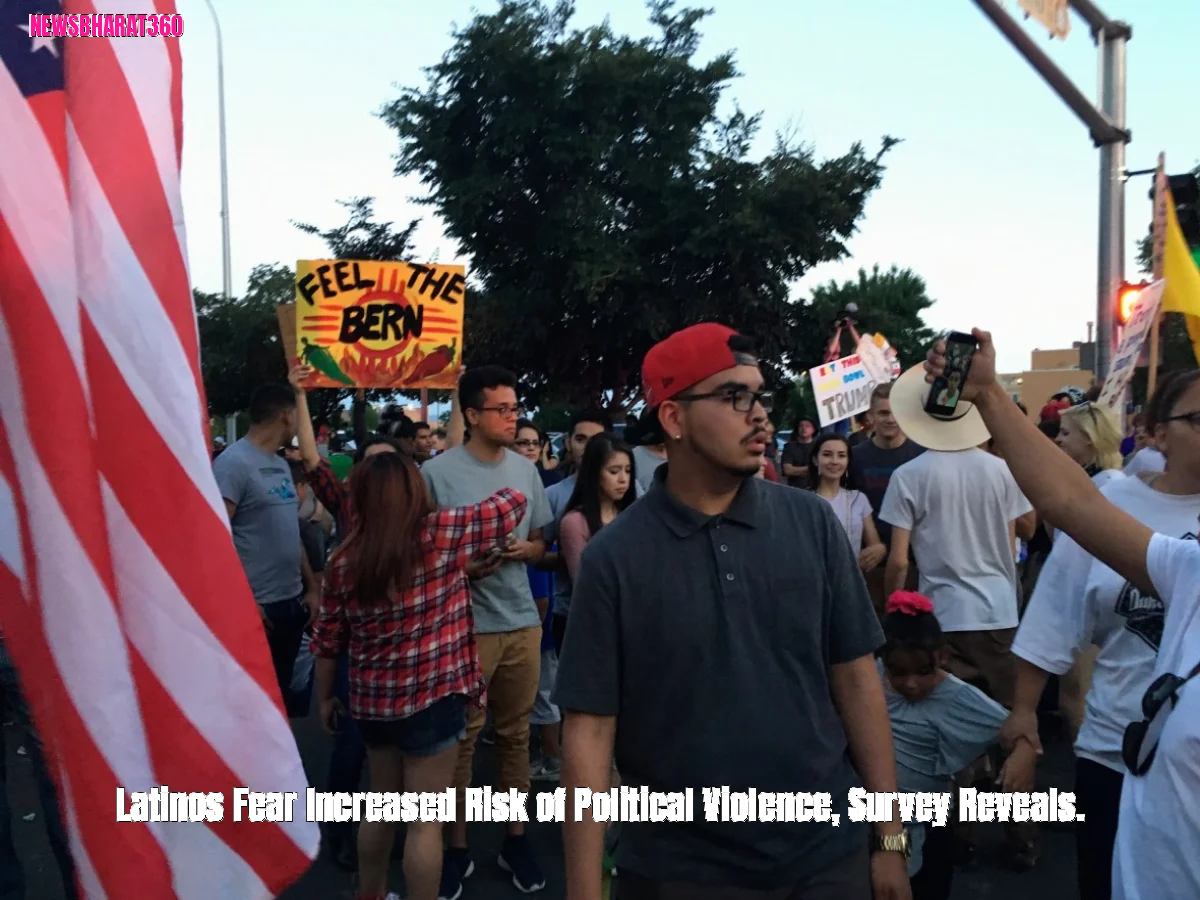

A recent My Code survey indicates that nearly 60% of Hispanic voters in the US who are concerned about political violence believe their community is more susceptible to such aggression than other groups, ahead of the November midterm elections.
A recent study conducted by the Intelligence Center of My Code, as part of its Culture 360 Political Tracker, has released data from Wave 15. This study, which began analyzing the attitudes, priorities, media consumption, and political participation of U.S. voters aged 18 to 64 in 2022, provides valuable insights into the demographic.
A recent survey assessed levels of concern regarding political violence in the United States, dividing the inquiry into two stages. Initially, participants were asked to express their degree of concern, with 53% of Hispanic respondents indicating "very" or "extremely" high levels of concern. Comparable levels of concern were observed among other demographic groups, including 54% of Americans of Asian origin (AANHPI), 49% of African Americans, and 54% of non-Hispanic voters.
A notable disparity emerged in the responses to a follow-up question regarding perceived risks of political violence within one's community. Specifically, 60% of Hispanic respondents indicated they believed their community was at a higher risk, the highest percentage among the groups analyzed. In contrast, 52% of African American respondents, 46% of Asian American and Native Hawaiian/Pacific Islander (AANHPI) respondents, and 38% of non-multicultural voters shared this concern.
According to the survey results, six out of 10 Hispanics perceive a risk of political violence within their community, but this does not necessarily indicate that they have been victims of such violence or are at a proven risk of experiencing it. The survey aims to gauge the perceived vulnerability of this population, a crucial distinction that helps to contextualize the findings of the My Code study.
A second survey conducted within the same study reveals a notable disparity between respondents' sense of national identity and their perception of security.
A recent survey found that a significant majority of Hispanic individuals expressed pride in their American identity, with 78% of respondents indicating a strong sense of patriotism. This proportion surpassed that of other analyzed communities, including non-multicultural voters, African Americans, and Asian Americans and Native Hawaiians and Pacific Islanders, who reported lower levels of American pride, with 75%, 72%, and 72% respectively.
A six-point disparity exists between four distinct groups in terms of national pride. Nevertheless, a significant divide emerges when considering perceptions of community risk in the context of political violence, with a 22-point gap observed between Hispanic and non-multicultural voters, with 60% of the former and 38% of the latter expressing concern.
The study emphasizes that patriotism and national pride should not be conflated with endorsement of the government, its institutions, or the country's current trajectory.
Respondents' feelings of vulnerability are also evident when they are asked about the level of security they believe they have when expressing their political views.
A significant proportion, approximately one-third, of voters across various communities expressed decreased confidence in discussing politics online compared to 2024. The underlying reasons for this perceived loss of security differ among distinct groups.
Hispanic individuals expressed concerns about potential repercussions, with 50% citing fear of retaliation or becoming targets of attacks, and 46% hesitating to express themselves due to uncertainty about what could be considered acceptable speech. Meanwhile, Asian Americans and Native Hawaiian Pacific Islanders (AANHPI) reported the highest level of concern, with 65% indicating fear of retaliation or attacks.
According to federal data, there is a notable distinction in the patterns of hate crimes, with a separate trend observed for incidents motivated by anti-Hispanic or Latino bias compared to hate crimes in general.
According to the FBI, law enforcement agencies reported a total of 10,881 hate crimes in 2025, marking a decrease from the 11,679 incidents recorded in the previous year, 2024.
According to Justice Department statistics, a majority of victims of incidents driven by a single type of prejudice were targeted due to their race, ethnic origin, or descent, accounting for 55.6% of such cases.
According to an analysis by the Arab American Institute based on FBI data, incidents motivated by prejudice against Hispanics or Latinos reached a record high in 2025. The data revealed a 16% increase in such incidents, with 1,002 reported in 2025, compared to 862 in the previous year.
According to recent data, a notable spike in violent crimes was observed in 2025, with a record number of aggravated assaults reported. Additionally, homicides also experienced a notable increase. In contrast, reported hate crimes declined in the same year.
The data on hate crimes and political violence must be viewed with careful consideration. These two categories are distinct, and an increase in hate crimes does not necessarily indicate a heightened risk of political violence for Latinos. The FBI classifies a hate crime as any offense driven by prejudice against characteristics such as ethnicity, religion, disability, sexual orientation, gender, or gender identity.
The context surrounding the concerns raised by My Code provides a broader perspective, but it does not provide conclusive evidence that the threats are specifically directed at the Hispanic community.
A recent online study was conducted among a diverse group of 3,219 eligible U.S. voters aged 18 to 64 from May 27 to July 8, 2026. The sample consisted of 651 Hispanic, 650 African American, 628 Asian American and Native Hawaiian/Pacific Islander, and 1,243 non-multicultural participants.