
Per at another point in history, a U.S. president who spoke before the United Nations of using his “unparalleled military power” to defend his interests in Latin America, or of winning a “bot” in one of his countries, would have generated rejection from left and right governments in the region alike.
But the American president who says those things today is Donald Trump, and throughout Latin America several exponents of a new right rule who, far from criticizing him, align with him in the eyes of the world.
That political reality has been shaped this week in New York, in the framework of the UN General Assembly, where Trump presented the active US muscle. In the hemisphere as an achievement of its own, while facing growing challenges elsewhere.
For example, he cited in his speech to the UN on Tuesday the military attack he ordered in Venezuela to arrest President Nicolás Maduro in January and the control that the US had over Venezuela. It was obtained from the vast oil reserves of that country, because “the winner has the bot.”
“Our actions in Venezuela are proof that the U.S. It will no longer allow the threats against America to solidify anywhere in the Western Hemisphere," he said. “And, if necessary, we will use our unparalleled military power to safeguard the vital national interests of the United States.”
Then, Trump listened to praise from Latin American presidents the rest of the day.
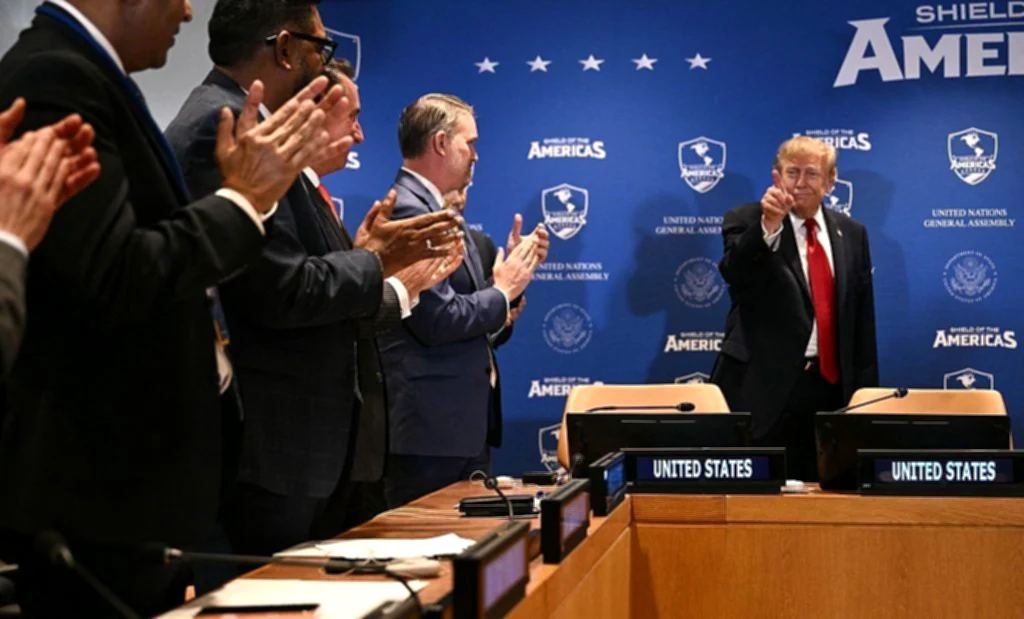
“Let me congratulate him, because I think he has broken a world record: I don’t think there is a U.S. president who would meet more times with presidents of the Western Hemisphere,” Paraguayan President Santiago Peña told Trump at a United States Shield meeting on Tuesday in New York.
The affinity of Latin American rulers to the U.S. is mostly manifested in security issues, but there are indications that it is extending to other areas.
The Shield of the Americas emerged in March as a Washington coalition with politically close regional governments against organized crime, although Trump himself commented on Tuesday to his members that “maybe they don’t know” how important this group he leads is.
Chile, headed since March by right-wing José Antonio Kast, joined the alliance of 15 countries, which declared their will to impose “sanctions and other measures” against groups Trump has designated as narco-terrorists in Latin America.
In addition to the United States. The declaration was approved by the governments of Argentina, Bolivia, Colombia, Costa Rica, the Dominican Republic, Ecuador, El Salvador, Guyana, Honduras, Panama, Paraguay, Peru and Trinidad and Tobago.
“Organized crime does not respect borders, so we are very happy to join this coalition. We applaud his leadership and his initiative, President Trump,” said during the meeting Keiko Fujimori, who assumed the presidency of Peru in July and also recently joined the group.
“The only way to stop crime is to be tough,” Trump replied, “they have to be very tough, maybe they don’t like it, but they have to be: that’s going to stop it quickly.”
President of the United States. It has ordered its own military forces bombings that since last year killed more than 220 people on ships allegedly trafficking drugs in waters in the Caribbean and Pacific, without showing clear evidence of this.
A UN special rapporteur on human rights said in a report on Monday that those U.S. attacks “violate international law” and “plausibly constitute crimes against humanity.”
The author of the report, Ben Saul, also pointed out that the Shield of the Americas “promotes a highly-centric security response without explicit commitments to human rights and international law, nor with addressing the deep causes of organized crime, such as poverty, corruption and the weakness of the state.”
These are criticisms also raised by other experts, but they were crushed during the meeting between the US and its Latin American allies on Tuesday.
Instead, Trump referred to the drug trafficking organizations and suggested to the group’s presidents: “Tell us and we get them out. Or take them out yourself; that’s what I like even more. But if you can’t, we’ll do it for you.”
At that moment, laughter was heard from the people in the room.
During his first term, Trump threatened in 2017 with a military intervention in the Venezuela crisis, but that generated widespread rejection even from his allies in the region.
“Neither Colombia nor Latin America, from the south of the Grande River to Patagonia, could agree. America is a continent of peace,” said Colombian President Juan Manuel Santos after meeting with the US vice president. This is Mike Pence.
Other conservative governments that were critical of Maduro’s socialist regime in Venezuela, such as those in Mexico and Peru, also opposed Trump’s option.
Some analysts attributed those reactions to the sequences left by the long history of US interventions in Latin America, direct or hidden, which in several cases caused violence and serious abuses.
But in recent years they have come to power in countries in the political region of a new right, more radical than the traditional and with promises of applying hard hand against a crime that troubles societies.
Trump said on Tuesday to his Latin American allies that “there has been a big change in their countries, a big turn to the right,” and cheered that he had supported some of them in the elections.
“Everyone I supported won. As you know, we have just achieved a great victory in Colombia,” he said in reference to the June triumph of Abelardo de la Espriella, who sent his vice president José Manuel Restrepo to New York.
Trump’s biggest regional contrast at this UN assembly so far has been President Luiz Inácio Lula da Silva, who argued that “Brazil does not fit in anyone’s backyard.”
Weeks before the October elections in which a right-wing Trump sympathizer, Flávio Bolsonaro, will contest him for the Brazilian presidency, Lula warned at the largest forum of global diplomacy about the return of “external interference in electoral processes.”
“In Latin America and the Caribbean, geographical proximity to the world’s largest military power is inevitable. Especially in the context of a rise in hegemonic temptations,” said Lula, one of the few left-wing leaders currently in South America.
Brazil is outside of the Shield of the Americas, but among the criminal groups this alliance wants to sanction there are two from that country: the Red Command and the First Command Capital.
When Washington designated both organizations as terrorists in May, Lula’s administration saw the move with restraint as it understood it could open the door to U.S. military intervention. in Brazilian territory.
While the Shield of the Americas has security issues as its axis, Trump also mentioned to his members the “enormous natural wealth” of their countries and asked them to avoid “that hostile external powers seize it.”
“The resources of the Americas must always belong to the peoples of the Americas, and the U.S. is willing to work with you to this goal,” he said.
U.S. Secretary of State Marco Rubio said the alliance offers the opportunity “to collaborate in the economic and diplomatic fields to speak with one voice, unanimously, on topics that unite them.”
And one of those topics could be artificial intelligence.
In fact, the Argentine president, Javier Milei, defended before the UN assembly on Wednesday Trump’s stance as opposed to regulating this technology in the face of growing warnings that it poses serious risks to humanity.
“Artificial intelligence or superintelligence, as President Donald Trump says, can multiply our productivity to orders of magnitude that we still don’t know,” Milei said.
He added that the West must lead the development of this technology to make it in line with “liberal fundamental values.”
“In that,” he said, “we fully share President Trump’s vision.”