How Sweden turned the right of access to nature into a tourism strategy
The Allemansratten allows the responsible use of uncultivated land and today supports one of Visit Sweden's most ambitious campaigns
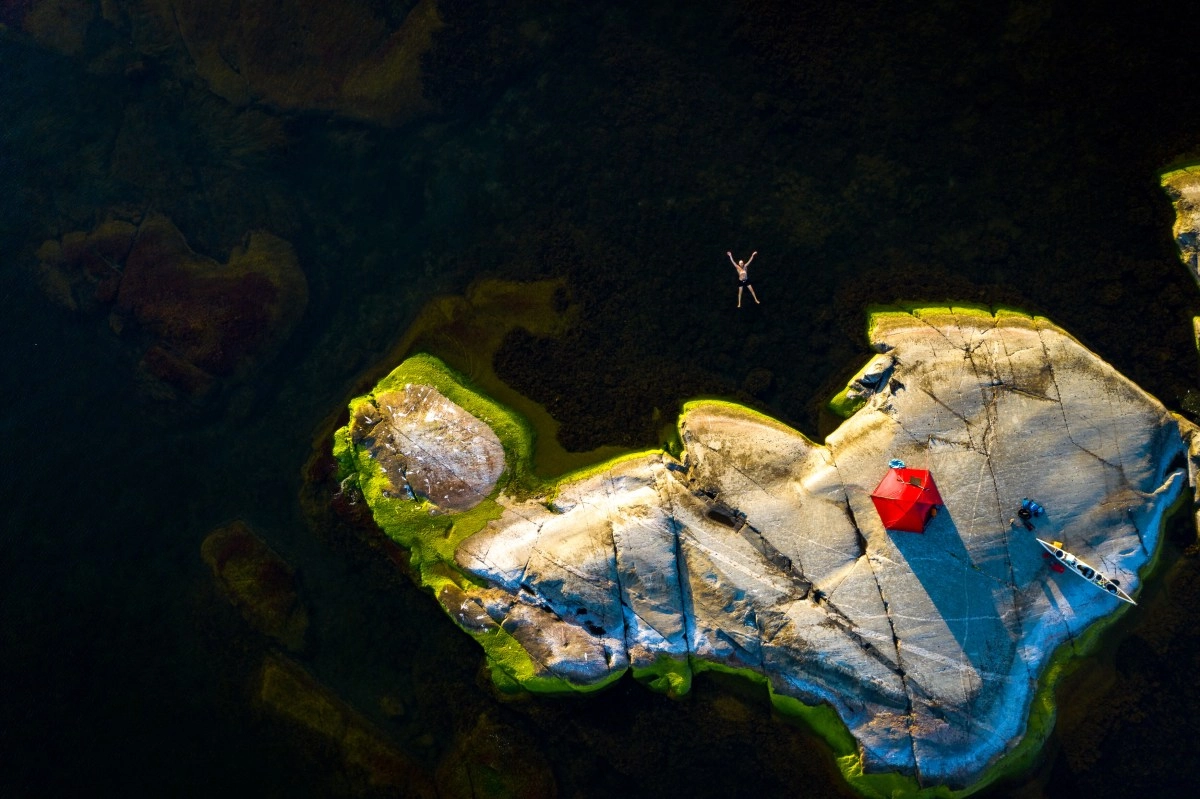
In Sweden, a person can reach an uninhabited island by kayak, pitch a tent among the pine trees, carefully light a campfire, swim in the lake at dawn, pick wild blueberries for breakfast, and stay for a night or two without asking anyone's permission. You can do it on an island that belongs to the state, in a forest that belongs to a logging company, on the shore of a lake surrounded by vacation homes whose owners are inside having dinner. You can do it because a constitutional principle allows it. It's called Allemansratten. Literally translated: the right of all. It has been protected by the Swedish Constitution since 1994, although the practice dates back centuries. It recognizes public access to uncultivated land (including private property) and certain recreational uses of the land: walking, camping for one or two nights, swimming, boating, and gathering wild fruits. The condition can be summed up in four words: inte stora, inte forstora. Do not disturb, do not destroy. In various parts of the world, access to land and visitor stays are managed in increasingly visible ways. Disputes over access to beaches in Malibu have been in court for decades. In several national parks in the United States, the entrance fee per vehicle exceeds $35. In the Mexican Caribbean, the boundary between public beach and resort property has become blurred. Or in Barcelona, ??for example, tourist taxes reach 11 euros per night, while in Venice and Rome, fees have begun to be charged for visiting the historic center and some monuments like the Trevi Fountain. Although these phenomena have different origins (legal battles, conservation fees, de facto privatization, charges for urban congestion), they point in the same direction: access to the landscape, its use, and its preservation are increasingly mediated by money, regulations, or management conflicts. The Allemansratten operates from an opposite premise: nature belongs to those who care for it, not to those who can pay for access. And at this moment,That premise has become the most valuable asset in tourism marketing for the entire Nordic region.
Skotbadan used to be a tool
Among Sweden's 267,570 islands is one called Skotbadan, in the archipelago north of Stockholm. It's a low-lying stretch of rock in open saltwater, treeless, shaped by the wind and sea. For generations, it served as an anchor for herring nets. It functioned as a working tool, part of the Baltic fishing infrastructure. The fishermen used it and then left.
Today, Skotbadan is one of five islands that Visit Sweden, the Swedish government's tourism marketing company, offers for free stewardship to international travelers for a year. The other four cover Sweden's geography from south to north: Marsten, on the west coast near Falkenberg, an exposed rock next to a beach where locals swim in the cold water year-round as part of their routine. Tjuvholmen, on Lake Vanern, surrounded by pine trees with sea eagles visible from the shore and a 12th-century castle on the horizon. Medbadan, near Umea, shaped by the last ice age, with waters where the summer sun barely sets. And Storberget, off Nynashamn south of Stockholm, light granite facing the open sea where the wind dictates the experience. Each island was selected from an inventory of some 1,700 state islands known as kronoholmar, crown islands, administered by Statens fastighetsverk, the government agency that manages one-seventh of Sweden's total land area. The five islands lack electricity, running water, and permanent shelter. A few months ago, Josefin Haraldsson, the US representative for Visit Sweden, told me about a campaign they were about to launch. “Sweden is giving away five islands,” she said. At the time, I didn't know about Allemansratten. I started investigating and discovered a principle that no one in Sweden needs explaining. To understand the strategy behind the campaign, I interviewed Susanne Andersson, CEO of Visit Sweden. What the contest is giving away and what already existed: The campaign is called “Your Swedish Island” and requires a one-minute vertical video. Applications close on April 17. Winners will be announced in June. The prize includes a custodianship certificate, a 12-month usage agreement, and a travel voucher for two people worth about $1,900. Everything else is the winner's responsibility. In the first seven days, without any advertising investment, the campaign received 600 applications from 40 countries, according to Andersson. Billionaires are excluded by self-declaration; according to the rules, the Swedish threshold is equivalent to about $95 million. International coverage focused on the mechanics of the contest and the exclusion of millionaires.What almost no media outlet reported is what Andersson said quite matter-of-factly during the interview: “What you earn is really little more than the Allemansratten, and you have to comply with what the Allemansratten stipulates, but you have the opportunity to keep it for longer.” This is a statement that deserves a second look. The CEO of a government-owned tourism marketing company has just described her global campaign as a temporary extension of a right that already exists permanently for Swedish citizens. Everything that “Your Swedish Island” grants (access to the territory, permission to camp, the possibility of swimming and collecting) is something that the Swedish Parliament already grants without time limit to anyone who arrives independently on any of the country's 267,570 islands. Andersson offered a personal example to illustrate the scope of the right: “Even though I live right on the seafront here, I can't just go down to the beach and say the beach is mine. Because it isn't. That's how it works in Sweden.” I was recently in the Sea of ??Cortez, off the coast of La Paz, and slept on an island for the first time. It was glamping on Espiritu Santo Island: 30 people including staff, 15 travelers. In the middle of the night, I looked at the stars and thought, also about the Swedish islands. That's when I understood what kind of luxury the campaign was referring to: the kind that costs a small fortune in Espirito Santo but is guaranteed by the constitution in Sweden. The Nordic countries share versions of this principle, with nuances that illuminate how each society calibrates the relationship between the individual and the land. The Swedish Allemansratten has limits on distance from dwellings, environmental conservation, and respect for agricultural use, but it is the most comprehensive in the region. In Norway, the Allemansratten requires a distance of 150 meters from inhabited dwellings and prohibits campfires between April and September. In Finland, the Jokamiehenoikeus prevents lighting a fire without the landowner's permission. Scotland codified a responsible access right in 2003, limited to non-motorized recreation.
Three campaigns, one underlying argument
“Your Swedish Island” is the third phase of an arc that Visit Sweden has built under the concept of luxury of a different nature.
The first campaign, “Sweden (not Switzerland)” (2023), used humor to address a documented problem: half of all adults in the United States confuse Sweden with Switzerland. The second, “The Swedish Prescription” (2025), presented Sweden as the first country where doctors can prescribe medicine, with the support of the Karolinska Institute and healthcare professionals in four countries. I saw the presentation of that campaign on a panel at the International Media Marketplace in New York, where Josefin Haraldsson presented it to a room of tourism professionals. The reaction was immediate: applause,Phones snapping photos of the screen and conversations in the hallways after the presentation. The campaign generated more than 1,200 articles in media outlets across 30 countries and won the industry's global award in the tourism category. The third organization took the Allemansratten's premise and wrapped it in a contest with viral potential. The organization operates with a few dozen employees and an estimated budget of tens of millions of dollars a year. Despite these limitations, the United States is already Stockholm's number one international market and the third largest for the country as a whole. Last summer, the number of international visitors grew by 15%. This year, SAS, one of the largest airlines in Scandinavia, opened a direct route between Stockholm and Miami, adding to the existing connections from Los Angeles, New York, Boston, San Francisco, and other US cities. When the conversation turned to who is traveling and who might be, Andersson revealed that Visit Sweden has been reviewing data on Hispanic travelers in the United States. “Research from the U.S. travel industry shows that Hispanic travelers tend to value multigenerational travel, nature experiences, and those motivations align very well with what Sweden offers,” he said. Their website is available in English, German, French, and Dutch. Adding Spanish is something they are considering; the obstacle, according to Andersson, is budgetary.
Finland translates happiness into an invitation
400 kilometers east of Stockholm, across the Baltic Sea, Finland is offering its own take on the same phenomenon. “Chill Like a Finn,” launched this week, invites travelers from anywhere in the world to apply with a companion for a free seven-day stay in Finnish Lakeland, Europe’s largest lake district, with more than 188,000 lakes: waterside cabins, a traditional sauna, forest walks, and, according to the official statement, “perhaps most importantly: putting your phone away for a while.” The concept is reminiscent of the Swedish one. But the philosophies differ. Finland believes its way of life can be taught; Sweden believes its landscape speaks for itself. Finland has been refining this approach for years. In 2019, “Rent a Finn” offered foreigners free stays with a Finnish “guide to happiness” and generated more than 1.3 billion impressions in 149 countries on a minimal budget. By 2025, it had recorded 7.2 million foreign overnight stays, an all-time record. Visit Finland designed these formats because its marketing resources were a fraction of those of its neighbors; creativity made up the difference. Andersson acknowledged this regional dynamic during the interview: “It’s not a bad thing if someone travels to Denmark or Norway or Finland instead of Sweden.”What we try to do as a Nordic bloc is that, when someone travels so far, they stay longer and see the differences between the countries.”
The pressure coming from the south
Spain received 94 million tourists in 2024, almost double its population. A YouGov poll found that 32% of Spaniards believe their region receives too many international tourists; in Catalonia, the figure rises to 48%. In Sweden, the percentage is 5%, with nine out of ten Stockholm residents declaring themselves welcoming to visitors.
Anti-tourism protests in Spain during 2024 and 2025 spread from Barcelona to Palma de Mallorca, Ibiza, the Canary Islands, and the coast of Malaga, with slogans such as “Your vacation, my misery.” Barcelona is seeking to eliminate 10,000 tourist rental licenses by 2028. Amsterdam is limiting Airbnb to 30 nights and has launched a campaign titled “Stay Away.” The year 2024 It was confirmed as the hottest in European history. The very destinations that built their economies by inviting the world to visit them have spent the last two years looking for ways to ask for the opposite. That heat is pushing travelers north. Nordic bookings for the summer of 2025 grew 263% year-on-year, according to Virtuoso. SAS reported a 20-25% increase in ticket sales. Intrepid Travel recorded a 50% increase in bookings to Iceland, Estonia, and Scandinavia for July and August, while its bookings to Southern Europe in those same months fell 15%. The industry dubbed the phenomenon the "coolcation," a term that accurately describes something any family in Seville or Rome understands without needing an Anglicism: when the thermometer climbs above 40 degrees for weeks on end, an 18-degree lake in Finland ceases to be an alternative destination and becomes common sense. Sweden operates from the opposite end of that pressure. "Swedish tourism accounts for only between 2.7 and 1 “2.9% of GDP,” Andersson stated. “If you look at the hotels we already have built, there are between 4 and 4.5 empty beds every night.” Half of the country’s accommodation capacity, a density of 25 people per square kilometer compared to the European average of 117, remains unused year-round. Andersson downplayed the existing friction: “It’s not really a tourism problem. It’s more a problem of Swedes who live near tourist areas,” referring to residents who discovered new areas during lockdowns and generated local friction.
The Limits of Abundance
Norway, despite sharing the Nordic narrative of open nature, has already announced a 3% tourist tax for areas under pressure starting in 2026. Innovation Norway suspended a campaign in September 2024 promoting its right of access among foreign tourists, after regional operators warned about unregulated camping and environmental damage.Iceland went from a marginal destination to a ratio of six tourists for every resident in less than a decade. Nordic abundance has precedents of depletion. The Allemansratten (the Icelandic National Park) only works as long as there's space. Skotbadan, the island that for generations served as a place to lay herring nets, now appears on a campaign website with coordinates, an aerial photograph, and an application form. That luxury of enjoying space and living in harmony with nature is the soul of the message with which Sweden invites travelers to discover it.
This news has been tken from authentic news syndicates and agencies and only the wordings has been changed keeping the menaing intact. We have not done personal research yet and do not guarantee the complete genuinity and request you to verify from other sources too.