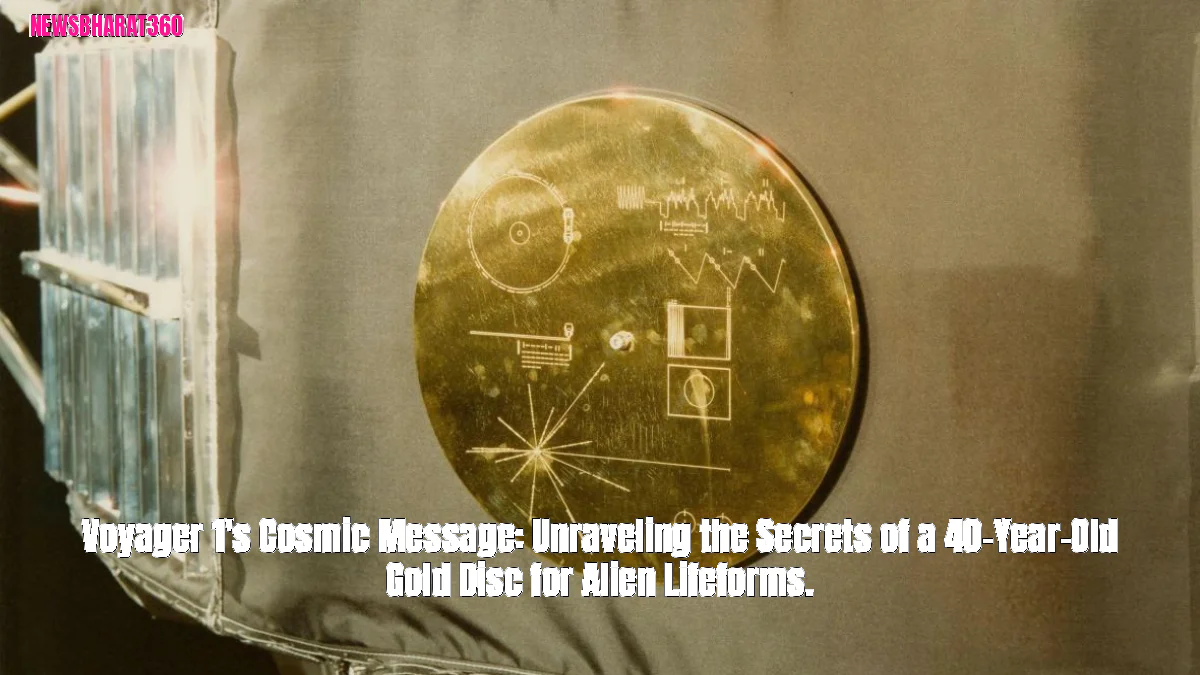

A cosmic transmission has been sent into the vast expanse of outer space, serving as an intergalactic introduction to humanity and providing instructions for any extraterrestrial civilization that may be able to decipher its contents.
The data is inscribed on two gold-plated records, analogous to early acetate music discs, which are attached to the Voyager 1 and 2 spacecraft launched by NASA in the 1970s.
Voyager 1, a space probe, achieved a significant milestone on Wednesday, marking a 50-year journey to become the farthest human-made object in space. It has now reached a distance equivalent to one light day from Earth.
The discs are engineered to endure for approximately one billion years, ensuring their contents will persist in traversing the cosmos, unaffected by human presence or the fate of our planet.
The decipherability of the disks by a hypothetical species, should it encounter them in the future, remains a subject of uncertainty.
Launched in the 1970s, the Voyager spacecraft embarked on a groundbreaking mission to become the first human-made object to venture beyond the boundaries of the Solar System.
According to Priyamvada Natarajan, a professor of astronomy and physics at Yale University in the U.S., overcoming the technological limitations of the time was a significant hurdle in interstellar travel. Specifically, the lack of a powerful rocket capable of escaping the solar system was a major obstacle, as the available rockets were unable to achieve the necessary speeds to break free from the Sun's gravitational pull.
Two postgraduate students, Michael Minovitch and Gary Flandro, discovered a solution to the problem by utilizing the gravitational influence of planets to harness energy from their orbits.
The probes would gain momentum through gravitational assistance, eliminating the requirement for additional propellant.
For a single planet to escape the Sun's gravitational pull, it would require the collective momentum of multiple planets in the Solar System to achieve sufficient velocity.
A rare celestial occurrence was required to facilitate the event.
According to Natarajan, a rare celestial alignment occurs approximately every 175 years, enabling effective gravitational assistance. This alignment allowed Voyager to transition from the gravitational influence of one planet to that of the next.
Astronomers Carl Sagan and Frank Drake recognized the potential of this mission as a pivotal moment in their research, enabling them to explore the possibility of establishing communication with extraterrestrial life.
The design director of the Golden Record project, Jon Lomberg, revealed to the BBC that a small team entrusted him with a significant responsibility: to craft a message for potential extraterrestrial life.
The individual overseeing the project described the challenging circumstances, citing a short timeframe of only a few weeks, a nonexistent budget, and a severely understaffed team.
NASA has previously attempted to establish contact with intelligent extraterrestrial life through various means, including the transmission of radiomagnetic signals. Additionally, a prior mission, the Pioneer spacecraft, carried a metallic plaque featuring engravings, as part of its payload.
Ann Druyan, a science documentary writer and ex-wife of Carl Sagan, stated to the BBC that the gold discs accompanying the Pioneer spacecraft held significant potential for information transmission. The discs, she noted, offered a more efficient means of conveying a large amount of images, music, and information compared to the Pioneer plate, which was a pioneering achievement in its time.
The enhancement in data storage capabilities shifted the focus to the content that needs to be encoded within these digital containers.
The initial challenge encountered by the team overseeing the gold disc project was establishing communication with an entity whose existence remains unsubstantiated by empirical evidence.
Astrobiologist Betül Kaçar of the University of Wisconsin in Madison, USA, notes that humans are inherently driven by a romantic nature. This sentiment is reflected in the creation of messages sent into space, often with the hope of being received by extraterrestrial life, despite the uncertainty of whether such life exists.
The challenge also arose in conveying to potential extraterrestrial life the technical aspects of creating a sound recording.
According to Lomberg, head of the Golden Disk mission, the record cartridge serves as an instructional guide detailing the proper handling of the artifact. The record was accompanied by a cartridge and a needle, which are necessary to play the sound it contains.
Physicists and mathematicians have long believed that these disciplines could serve as a universal language, facilitating communication with extraterrestrial life forms capable of interstellar travel, as the fundamental principles they describe are thought to be universally applicable across the cosmos.
Scientists utilized a diagram of the molecular structure of hydrogen, one of the most fundamental and widespread elements in the universe, to visually represent a time jump, a phenomenon that occurs universally and without exception.
The inclusion of the time jump in the probe's signal is intended to provide a universal reference point that any extraterrestrial intelligence intercepting it could understand as a standard unit of time.
A message encoded on a cartridge could potentially be deciphered by an extraterrestrial intelligence, allowing them to determine the necessary playback speed. If decoded successfully, the message would convey a greeting in at least 55 languages.
The recording would feature a diverse collection of sounds that capture the unique sonic characteristics of Earth.
The record's creators aimed to showcase the planet's musical diversity, a goal that was integral to its production. To achieve this, they sought out a wide range of traditional instruments and styles, including javanese gamelan music, Japanese shakuhachi, Peruvian bread flutes and Senegal percussion. This approach was a deliberate choice, driven by a desire to incorporate the unique sounds and cultural influences of various regions.
The album features an innovative visual component consisting of 116 images that are only accessible to those who decipher the encoded audio data. By analyzing the audio peaks, listeners can reveal a corresponding gray tone, ultimately forming a complete photograph.
Lars Bergman, also known as Lomberg, was responsible for selecting images for a project. The images included diagrams of human biology and anatomy, landscapes, technology, and animals. However, he acknowledged that it was unrealistic to expect a comprehensive representation of the Earth in just 100 images, or even 1,000. This raises questions about the selection process, such as how to include significant historical and cultural achievements like the pyramids, rupestrial art, and depictions of animals, in a limited image set.
Carl Sagan's collaborator, Druyan, requested that Sagan incorporate a deeply personal element into the project: a recording of his brain activity during meditation.
Astronomer Annie Jump Cannon and her colleague Carl Sagan had recently expressed their romantic feelings for each other, with the hope that a distant civilization might one day understand their emotions. According to Cannon, Sagan then offered words of encouragement, stating that given the vast timescale of 1 billion years, she should proceed with their plan.
The cartridge also serves as a navigational aid, utilizing the positions of 14 pulsar stars to indicate Earth's location. These stars, characterized by their rapid rotation and distinct rhythms, can be thought of as celestial beacons that facilitate our identification of our planet's position in the universe.
Critics have raised concerns that the depiction of humanity in the portrait is overly idealistic, lacking any instances of war, genocide, or famine. According to Lomberg, the creators aimed to be remembered for their contributions, such as the works of Mozart, rather than historical events like the rise of Hitler.
The Cold War era's anxieties have largely dissipated. While meditating, Druyan's thoughts inevitably turned to the nuclear threat and the Cold War, prompting him to share his concerns with Sagan. Sagan perceived this admission as a strategic move, believing that acknowledging humanity's shortcomings could help to mitigate its perceived threat.
Astrobiologist Kaçar expressed optimism about the possibility of discovering life beyond Earth, stating that it is a prospect worth holding onto.
The feasibility of decoding human transmissions by an extraterrestrial civilization hinges on the ability of that species to develop and utilize technology in a manner analogous to our own.
Druyan takes a long-term perspective, envisioning a future where the Earth will undergo significant transformation in approximately 1 billion years, ultimately rendering it unrecognizable.