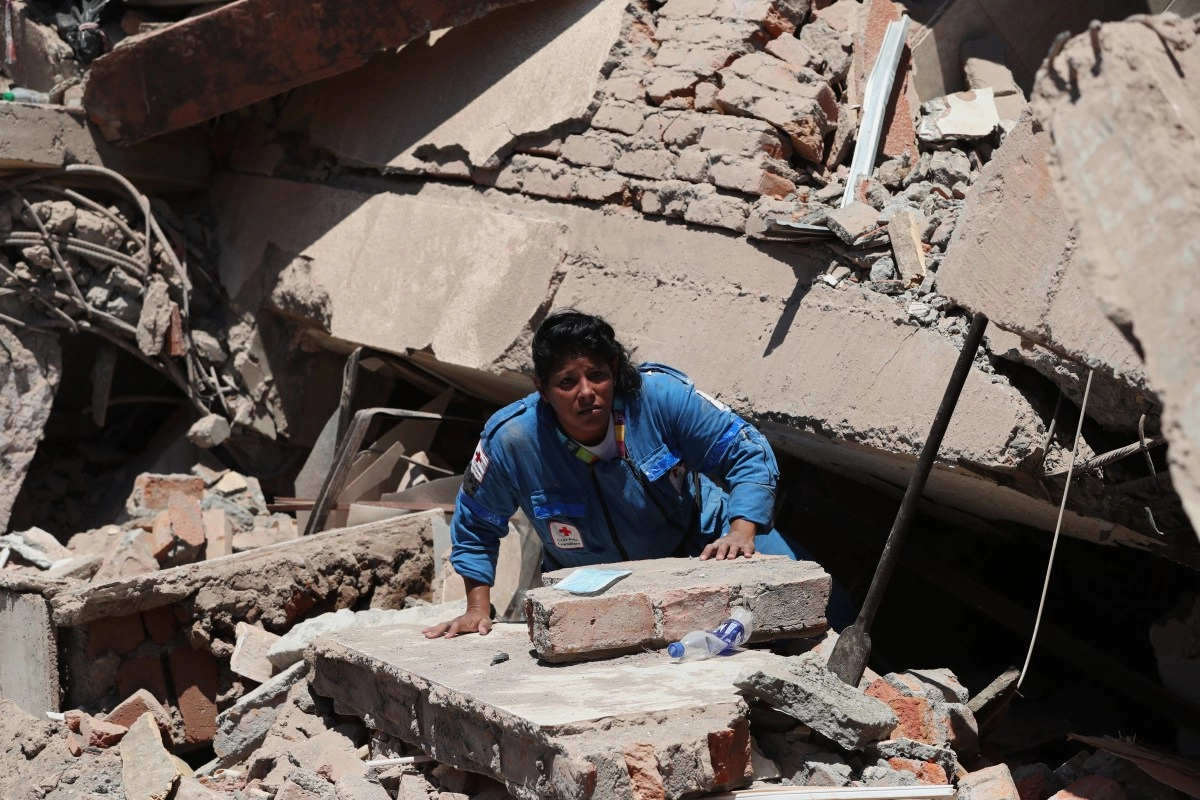

The temporal proximity between the 7.4 magnitude earthquake that hit Colombia on August 10 and the destructive earthquakes recorded in Venezuela during June may lead one to think that there is a direct connection between both episodes. But, geologically, the explanation is more complex.
Colombia is subject to the interaction of several tectonic plates and its western coast is part of an extensive seismically active region. Venezuela, on the other hand, presents much of its seismic threat in the interaction between the Caribbean and South American plates.
That two large earthquakes occur in the same continental region a few weeks apart does not automatically mean that one caused the other.
Can one big earthquake trigger another?
The United States Geological Survey (USGS) explains that a large earthquake can, in some cases, trigger seismic activity at great distances through the passage of its waves. This phenomenon is known as “dynamic triggering.”
However, when it occurs thousands of kilometers away, earthquakes triggered in this way are usually small and short-lived. USGS warns that it is not correct to consider two large earthquakes related just because they occurred a few days or weeks apart.
You can see: Colombia issues “declaration of emergency” due to the 7.4 magnitude earthquake that has already left more than 100 dead and dozens of injured
The historical connection with the US: an earthquake in Colombia has already reached California
History does show that a large enough earthquake off the coast of Colombia can have effects far beyond South America. On January 31, 1906, an 8.8 magnitude earthquake off Ecuador and Colombia generated a strong tsunami that caused between 500 and 1,500 deaths in the region.
The waves crossed the Pacific Ocean. According to USGS records, the tsunami was observed along the coast of Central America and reached as far as San Francisco, California, while to the west it reached Hawaii and Japan.
In Hilo, Hawaii, water movement was recorded about 12 and a half hours after the earthquake. The sea level experienced fluctuations of up to about 3.6 meters and the water reached railway tracks and sectors near the old dock.
This episode constitutes a particularly relevant precedent for the United States: it demonstrates that a large earthquake produced in the subduction zone of Ecuador and Colombia can generate a tsunami capable of crossing thousands of miles of the Pacific.
This Monday's Colombian earthquake was different. Reuters reported that it reached a revised magnitude of 7.4 and had a depth of about 107 kilometers, a far cry from the large shallow underwater earthquakes that typically pose the greatest tsunami threat.
You can see: What was the latest life rescue after an earthquake
Could California suffer an earthquake as big as those in South America?
California is one of the states with the highest seismic threat in the United States, but not all of its earthquakes are produced by the same mechanism. The famous San Andreas Fault is primarily a strike-slip fault: two blocks of crust move horizontally relative to each other.
This type of fault can generate extremely destructive earthquakes. The 1906 San Francisco earthquake, for example, reached approximately magnitude 7.8 and ruptured about 300 miles of the San Andreas Fault. At least 3,000 people died and some 225,000 were left homeless.
However, the largest earthquakes on the planet—those that can exceed magnitude 9—tend to occur in subduction zones, where one tectonic plate slides beneath another. The United States also has one of these zones.
You can see: They develop houses that rise during earthquakes: the ideal solution in a seismic country
The place in the US where an earthquake close to magnitude 9 can occur
The Cascadia subduction zone extends about 750 miles off the coasts of northern California, Oregon, Washington and into Canada. USGS considers that earthquakes of magnitude 8 to 9 are possible there.
The last known complete rupture occurred in 1700 and is estimated to have reached approximately magnitude 9. The tsunami generated crossed the Pacific and was even recorded in historical documents from Japan.
Geological evidence indicates that large earthquakes of magnitude 8 to 9 have occurred in Cascadia, on average, about every 500 years, although that does not mean they can be predicted on a regular schedule.
A major rupture of Cascadia could produce strong shaking and a tsunami that would primarily affect the coasts of Oregon, Washington and northern California.
You can see: What is the Pacific Ring of Fire and why 90% of the world's earthquakes occur in this area
Tsunamis from other countries also pose a threat to the US.
The United States does not need to experience an earthquake of its own to suffer the consequences of a tsunami. USGS notes that major earthquakes around the so-called Pacific Ring of Fire have generated waves that subsequently reached Alaska, Hawaii, California, Oregon and Washington.
One of the most serious examples occurred after the 9.2 magnitude earthquake in Alaska in 1964. The tsunami caused damage and casualties not only in Alaska, but also in Hawaii, California, Oregon and Washington.
For the central coast of California, USGS considers that one of the main threats is precisely distant tsunamis generated in large subduction zones.
The Ecuador-Colombia precedent of 1906 is part of that history: the consequences of a large earthquake in the Pacific do not necessarily end in the country where its epicenter is located.