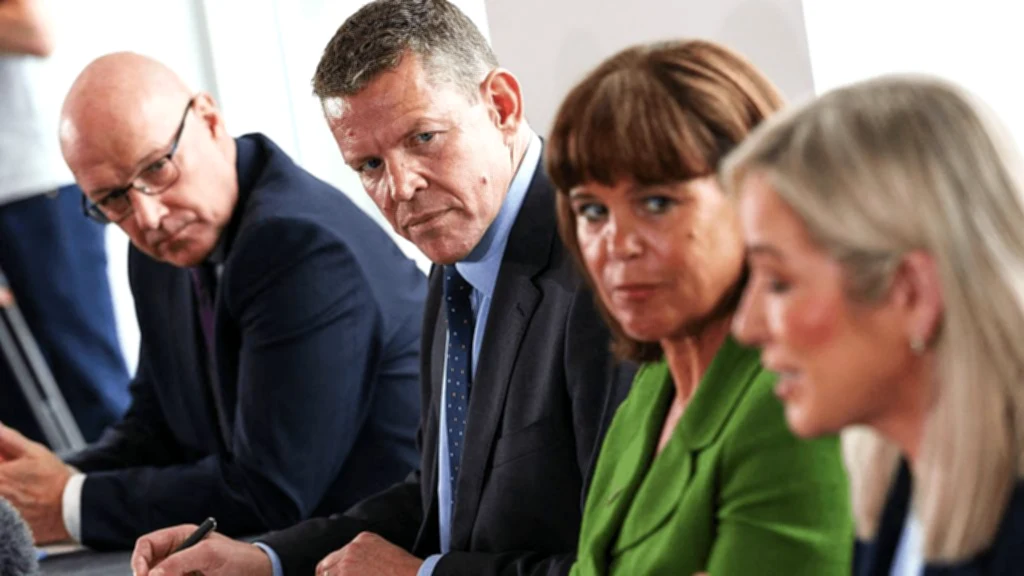

The prime ministers of Wales, Scotland and Northern Ireland have declared that “Westminster’s time is coming to an end” and that the UK government should “prepare” for a constitutional change.
Nationalist leaders of Plaid Cymru, Sinn Féin and the SNP, who want their countries to leave the UK, signed on Monday an agreement claiming that no Westminster government (the British government’s political headquarters in London) has the right to “block democracy.”
But while John Swinney of Scotland and Michelle O’Neill of Northern Ireland called for referendums at a joint press conference, Rhun ap Iorwerth of Wales refused to give a calendar to celebrate one in their country.
The Labour Party accused Plaid Cymru of wanting to use his power “to break up Britain.”
Ap Iorwerth will hold further talks with Swinney in his capacity as government leaders in the afternoon, and both are expected to sign an agreement on “future collaboration in areas of common interest.”
For the first time since decentralization began, Wales, Scotland and Northern Ireland have prime ministers wishing to leave the UK.
The three met on Monday as representatives of their respective parties, and Sinn Fein president Mary Lou McDonald was also present.
The memorandum of understanding said: “For those who observe us from these islands, for those who observe us from all over the world, there could not be a clearer sign that Westminster time is coming to an end.”
“No Westminster government has the right to block democracy or undermine the principle that our people will decide their own future.”
“We recognize that our parties have different constitutional positions and that each nation will determine its own future in its own way and at its proper time.”
A spokesman for Plaid Cymru said before the meeting that the “changing political landscape on these islands” fully justified “practical political cooperation” in areas such as energy, economy and collaboration with Europe.
They said that also included “the broader political and constitutional issues facing our nations and the right to self-determination.”
Ap Iorwerth stated that the May Welsh elections had been “a turning point for Wales” and that there was “a growing recognition that the Westminster model no longer works.”
Plaid Cymru had already ruled out holding a referendum on independence before the upcoming Senedd elections in 2030.
SNP leader Swinney said on Monday morning on Radio Wales Breakfast that it was a “significant and crucial moment for the UK” and that things had “changed forever.”
“The citizens of Scotland, Wales and Ireland have the right to self-determination,” he said.
“Fundamentally, our conversations today revolve around recognizing the importance of the moment we are living in.”
Sinn Fein vice president O’Neill said the interests of the people of the entire island of Ireland “have never been taken care of by those in Westminster.”
“H, change is happening on all these islands and we must be prepared for constitutional reform when it arrives,” he said.
“The election of three nationalist prime ministers for the first time on these islands is a clear indication that people are realizing that Westminster is not working for the people of the North, Scotland or Wales.”
Sinn Fein president Mary Lou McDonald told BBC Wales that Wales, Scotland and Ireland’s path to self-determination was different, and described the current climate as “historic times.”
“Of course, we have different national histories, but we have something very important in common, and it is our absolute insistence that it is up to the people of Ireland to decide the future of Ireland, to the people of Scotland to decide the future of Scotland and to the people of Wales to decide the future of Wales,” he said.
The meetings take place days after the issue of Scottish independence was again raised in the House of Commons.
During a questioning session to the prime minister on Wednesday, Andy Burnham appeared to indicate that a second referendum could be held in Scotland if there was clear public support for the vote.
He compared the situation with the conditions for a referendum on the border in Northern Ireland, explaining that the Holy Friday Agreement made it clear that the Secretary of State for Northern Ireland “would consider a referendum when there was a clear consensus in the country, when the public opinion had changed to the point that the proposal should be considered.”
“I would say the situation is exactly the same in Scotland,” he added.
Swinney welcomed the apparent change of tone before Burnham clarified that another Scottish referendum was still “out of the boundaries.”
In a referendum on independence from Scotland held in September 2014, the country voted to remain part of the United Kingdom for a margin of 55% versus 45%.
But the dynamic in Wales is different from that of Scotland.
Ap Iorwerth, who was named Wales' primary prime minister after the May Senedd elections, has ruled out promoting a referendum on Wales' independence during his party's first term in government, saying he wanted to lead a "national dialogue" on the issue.
His government intends to create a national commission to “set the foundations” for future plans for Wales’ independence.
Meanwhile, Welsh ministers are seeking to transfer additional powers to Wales, including in the field of police and youth justice.
Burnham has said he is “open” to the idea.
In Northern Ireland, the Prime Minister and the Deputy Prime Minister have identical powers and responsibilities, and Emma Little-Pengelly, of the Democratic Unionist Party (DUP), is the Deputy Prime Minister.
Little-Pengelly criticized O'Neill for attending Monday's talks.
The British government said: “The Prime Minister is committed to driving change in the four nations of the United Kingdom and he firmly believes in the union.”
Talks are likely to address the way the UK government finances self-governed nations.
Welsh ministers have long demanded that Barnett's funding formula be reformed, arguing that it is detrimental to Wales.
However, it is argued that Scotland benefits from this formula.
Before becoming prime minister, Burnham advocated the change, but in his recent visit to Wales restored importance to the possibility of a reform.
The leaders of the autonomous governments will meet with the prime minister next month.
Chris Bryant, Rhondda MP and Northern Ireland secretary, said: “Today Plaid Cymru meets to talk about how to work to disintegrate the UK.
“Since they came to power in Wales, apart from translating Star Wars into Welsh and that the NHS (National Health Service) waiting lists have begun to rise again, they can’t point out any particular achievement.”
Welsh Conservative leader Darren Millar said: “Rather than being obsessed with independence, the prime minister should focus on addressing the crisis that plagues the Welsh National Health Service and the decline in the level of education in Welsh schools.”
Reform UK Wales stated: “Plaid Cymru is showing its true nature by meeting with Sinn Féin and Scottish separatists.”
This article was originally written in English and we use an artificial intelligence tool to translate it. A BBC reporter reviewed the text before it was published. Find out more about how we use it.