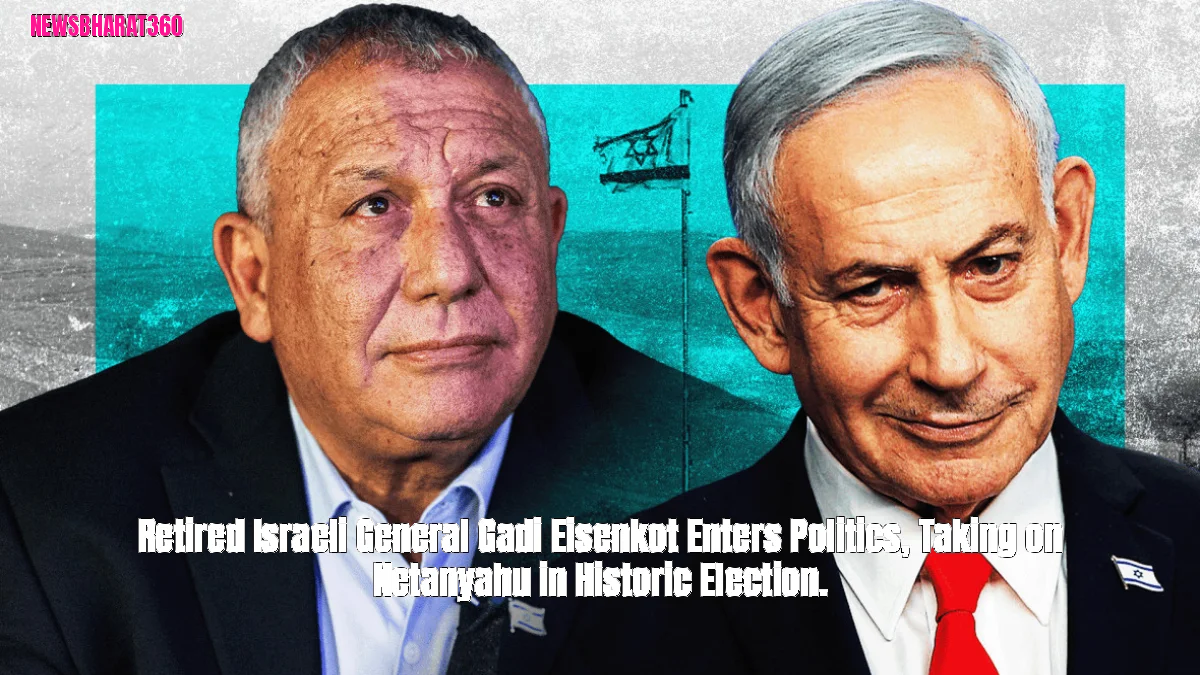

Israeli Prime Minister Benjamin Netanyahu's tenure may be at risk following the upcoming elections scheduled for Tuesday, potentially leading to a change in leadership.
Recent polls suggest that the Likud-led coalition, comprising the far-right and ultra-Orthodox parties, may not secure a sufficient majority in the upcoming government.
Former Israeli army chief Gadi Eisenkot is presenting an unexpected challenge to Israeli Prime Minister Benjamin Netanyahu, who has held power for nearly three decades.
Gadi Eisenkot, a relatively new figure in Israeli politics, was elected to the Knesset, the country's parliament, in 2022 as a member of the National Unity party. However, he later departed the party, citing ideological discrepancies.
Last year, the opposition figure formed his own centrist party, Yashar, which translates to "right" or "integral." He has since emerged as the primary electoral challenger to Prime Minister Netanyahu, who has faced recent criticism and accusations of corruption that he denies. Netanyahu has also been criticized for his handling of the Hamas attacks on October 7, 2023, and his proposed judicial reform plan, which sparked widespread protests in Israel.
Former Israeli Chief of Staff Gadi Eisenkot's decision to testify against Prime Minister Benjamin Netanyahu was influenced by a personal tragedy, one of several factors contributing to his change of heart.
Gal, a senior army sergeant and the youngest of five children, lost his life in December 2023 in a northern Gaza explosion. He was part of a mission to retrieve the remains of two Israeli hostages taken by Hamas on October 7.
Former Israeli Military Chief Eisenkot has yet to examine the personal belongings of his son, which were delivered to him in two boxes and are currently stored at his residence in Herzliya, a coastal town located north of Tel Aviv.
The individual stated in an April interview with Israeli public radio Kan Reshet Bet that he had yet to open the items in question and was continuing to delay doing so.
The death of Gal, coupled with the loss of two nephews in the Gaza campaign, has significantly influenced Eisenkot's political aspirations, particularly his perception that the Netanyahu government was unable to effectively prevent Hamas' unprecedented attacks.
In a recent interview with The Times of Israel, the individual expressed his determination to meet the high standards set by Gal, stating that he cannot alter the past but will strive to live up to the expectations.
Former Israeli Chief of Staff Gadi Eisenkot is calling for Prime Minister Benjamin Netanyahu and his government to assume accountability for their leadership following the October 7 attacks.
Former Israeli Defense Forces Chief of Staff Gadi Eisenkot joined the war cabinet formed by Prime Minister in response to the attacks, alongside other opposition figures, in a demonstration of national unity. However, he resigned in June 2024, citing concerns that Prime Minister Netanyahu had not taken swift enough action to secure the release of hostages held by Hamas.
Netanyahu has consistently disputed allegations that during his leadership, women and children were taken hostage and that necessary actions to secure their release were deliberately avoided.
Israeli Prime Minister Benjamin Netanyahu has stated that Gadi Eisenkot, in his capacity as a cabinet member, had expressed opposition to crucial military operations in the Gaza Strip.
During a June press conference, Netanyahu recalled comments made by former IDF Chief of Staff Gadi Eisenkot and others when they were stationed in Gaza, stating that a resolution could be achieved by negotiating an agreement, securing the release of hostages, and withdrawing from the territory.
Netanyahu stated that Eisenkot's strategy would have maintained the status quo, preventing Hamas from weakening and ensuring that all its leaders remained alive and in power.
Former Israeli Chief of Staff Gadi Eisenkot has disputed Prime Minister Benjamin Netanyahu's statements, requesting that he release the minutes of war cabinet meetings and voting records.
According to Nadav Eyal, a prominent Israeli journalist, the loss of his son has instilled in Eisenkot a profound sense of purpose and mission.
Eyal emphasized that the mission of his party, Yashar, extends beyond securing sufficient seats in the Knesset to potentially form an alternative coalition to that led by Netanyahu.
Gaza peace plans proposed by former Israeli Defense Forces Chief of Staff Gadi Eisenkot are contingent on excluding Hamas, with a goal of dismantling the organization within 18 months.
The Israeli father emphasized that his son's death was a direct result of Hamas's actions, specifically the war initiated by the militant group.
Retired General Expresses Skepticism Over Two-State Solution. In late August, he stated that those holding onto the idea of a two-state solution, where a Palestinian state coexists alongside an Israeli state, are living in "illusion.
Netanyahu plans to re-evaluate and improve Israel's diplomatic ties with the Palestinian Authority.
Israeli officials have stated that the Palestinian Authority should be granted autonomy to govern the 2.8 million Palestinians residing in the occupied West Bank.
Israeli Defense Forces Chief Eisenkot expressed support for expanding main settlement areas, but opposes plans to increase Jewish settlement presence in certain West Bank regions, particularly the E1 area in eastern Jerusalem, where a settlement expansion plan has been met with controversy.
In a recent statement, the individual pledged to remove Jewish extremists from Judea and Samaria, a region Israel refers to as the West Bank, which is currently occupied. This assertion appears to be a response to the international community's disapproval of settlements in the area.
A key campaign pledge of the candidate is to initiate a thorough investigation into the October 7 attacks, with the aim of examining potential shortcomings in the Israeli government's response.
Israel's primary news outlets have reported allegations that Netanyahu received advance warnings of a potential attack from Gaza, purportedly issued by officials from the United Arab Emirates and Egypt.
The prime minister has rejected the allegations, subsequently filing a lawsuit against the Israeli publication that first raised the complaint, and has declined to cooperate with a judicial inquiry, citing concerns about the impartiality of the investigating authority.
Coen 20 Commander Gadi Eisenkot has pledged to implement an emergency initiative to address the issue of highly skilled Israelis emigrating from the country and attract new immigrants to Israel.
Netanyahu's proposal includes plans to abolish exemptions from military service for ultra-Orthodox Jewish communities and Israeli Arabs, a contentious issue in Israel.
Efforts to broaden military service have faced opposition in the past, with previous attempts by Netanyahu's government sparking protests from ultra-Orthodox groups.
Gadi Eisenkot was born in Tiberias and spent his early years in Eilat, both locations situated outside of Israel's primary political hubs, Jerusalem and Tel Aviv. His parents, Moroccan immigrants who arrived in Israel in the 1950s, provided a humble upbringing for Eisenkot.
Gadi Eisenkot, a member of Israel's Mizrahi Jewish community, is notable for being the first of his background to achieve the position of Chief of Staff, but he is not the first to aspire to the role of Prime Minister. Prior to his tenure, other Mizrahi individuals had attempted to reach the highest office in the country, but none were successful.
David Remnick, editor of The New Yorker, who had previously interacted with Eisenkot during the campaign, notes that the candidate may challenge Netanyahu's reputation as a protector of vulnerable groups within Israeli society, such as the Mizrahi community.
Benjamin Netanyahu, a descendant of Eastern European Jewish heritage, spent his childhood in a residential area of Jerusalem, a background that differs from that of his counterpart, Gadi Eisenkot, who comes from more modest beginnings.
Gadi Eisenkot began his military career at 18 and served for 40 years, ultimately rising to the position of Chief of Staff, a role he held from 2015 to 2019.
During the Second Intifada, a four-year Palestinian uprising in the 2000s, Israeli forces under his command operated in the West Bank, where a total of over 4,000 lives were lost, including more than 3,000 Palestinians and approximately 1,000 Israelis.
Former Israeli Military Chief Eisenkot was closely aligned with the "Dahieh Doctrine," a military strategy that emphasizes the extensive use of force against civilian infrastructure in regions perceived as launching attacks against Israel.
Notwithstanding his vocal criticism of Israeli Prime Minister Netanyahu, the individual did not publicly condemn the Israeli military's response to the October 7 attacks.
Israel's former Chief of General Staff, Eisenkot, stated that the country feels compelled to defend itself and is urging a thorough examination of the origins of the current situation.
Mehdi Hasan, a journalist and commentator, recently expressed concerns in The Guardian that while Gadi Eisenkot's appointment as Israel's new military chief may not be a direct endorsement of Prime Minister Benjamin Netanyahu, it could still enable the continuation of similar expansionist and destructive policies in both the West Bank and Gaza.
According to Anshel Pfeffer, a correspondent for The Economist magazine covering Israel and author of a biography on Netanyahu, General Eisenkot does not subscribe to a pacifist ideology.
Pfeffer described the individual as having a serious demeanor.
Former IDF Chief of Staff Gadi Eisenkot's emergence as a direct rival to Prime Minister Benjamin Netanyahu was initially unexpected.
The primary contender for the position was previously seen as Naftali Bennett, the former prime minister, six months prior to the current time frame.
Gadi Eisenkot, the former Israeli military chief, is often characterized as having a distinct contrast to Prime Minister Benjamin Netanyahu in terms of his leadership style and public speaking abilities. While Netanyahu excels in the spotlight, Eisenkot tends to thrive in less conspicuous roles and is not known for his exceptional oratory skills.
Eisenkot's party is likely to emerge as the leading force in the polls, but it is not anticipated to secure the absolute majority of 61 deputies required to establish a government. As is customary in Israel, his party would therefore need to form a coalition with other political entities to achieve a governing majority.
Israeli Prime Minister Benjamin Netanyahu has consistently demonstrated his ability to lead, having presented himself as the Likud party's leader in ten national elections. Notably, he has successfully formed a coalition government on six separate occasions.
According to Netanyahu's campaign, General Gadi Eisenkot would require the backing of Arab-led parties in order to establish a governing coalition.
In Israel, Arab political parties have garnered significant support among the country's Arab citizen and resident population, which comprises over two million individuals, approximately 20% of the total population. Recent polls suggest that the four major Arab parties are poised to secure between 12 and 15 seats in the upcoming election.
In a recent campaign video, Israeli Prime Minister Benjamin Netanyahu posed a question, asking whether the goal is to establish a Jewish state or a Palestinian state.
Former Israeli Defense Forces Chief of Staff Gadi Eisenkot has expressed skepticism about the inclusion of Arab parties in his potential government, but has left the door open for cooperation with them in opposition to Prime Minister Benjamin Netanyahu in the Knesset.
Israeli Prime Minister Netanyahu has maintained his position due to his capacity to convince his supporters that casting their ballots for him is a crucial decision, according to Tel Aviv-based political analyst Dahlia Scheindlin.
The Israeli military's involvement in the situation has introduced a new dynamic, potentially altering the outcome, as noted by Scheindlin, who highlights the Israelis' considerable faith in their armed forces.
The original article was written in English and translated using an artificial intelligence tool, with a BBC reporter reviewing the content prior to publication for accuracy and quality.