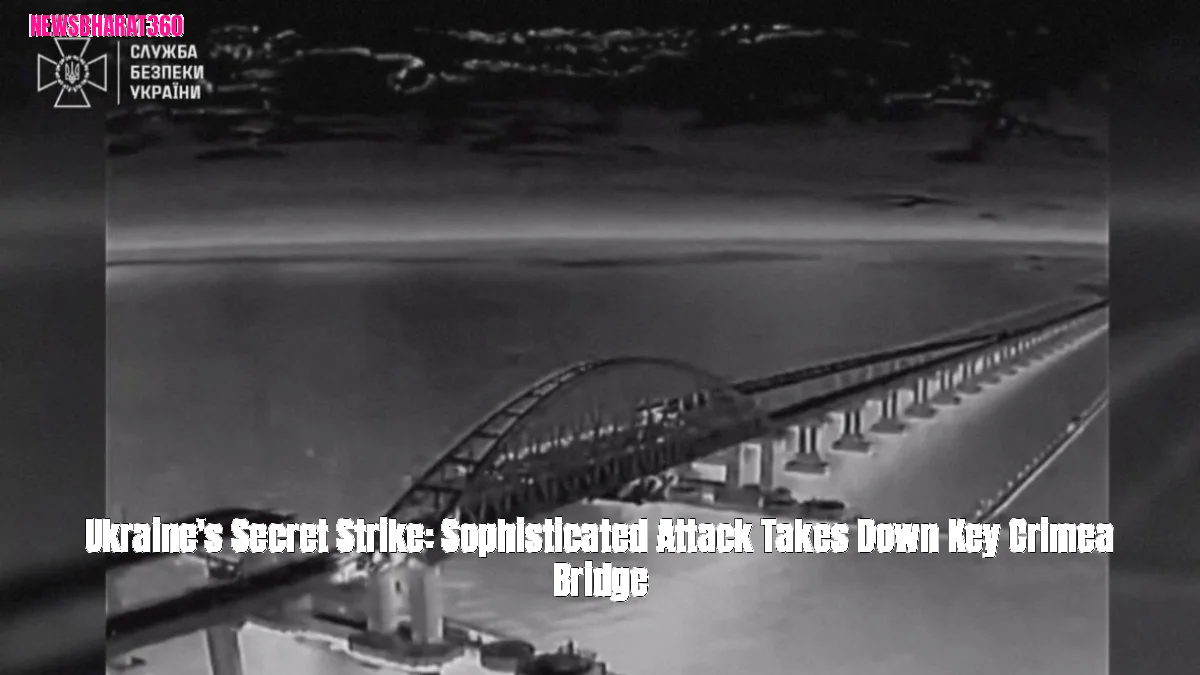

The Crimean bridge, spanning the Kerch Strait over the Black Sea, has become an iconic landmark following its completion.
Russia views the project as a symbol of its authority over sovereign Ukrainian land, reinforcing its claim to the territory. Conversely, Ukraine sees the infrastructure as a reminder of Moscow's control over the Crimea peninsula, a region it detests as occupied territory.
A critical segment of the 19-kilometer-long double-arc bridge has been destroyed, with the majority now submerged underwater, following a seven-stage operation by Ukrainian forces utilizing long-range weapons that culminated in a dramatic collapse.
Russian authorities have announced plans to restore the damaged bridge, with a commitment to construct it in an improved form.
Eight years following its opening, the bridge has emerged as a critical test of Kyiv's capacity to breach Moscow's military defenses and access even the most secure and heavily protected areas.
Ukrainian officials stated on Tuesday that the assault on the key Crimean bridge was conducted in a phased manner to breach multiple layers of defense.
Ukrainian President Volodymyr Zelensky stated that the country's Security Service and General Staff have been systematically dismantling air defense systems, radar installations, electronic warfare equipment and other designated targets over several weeks.
A significant incident occurred on November 16, when multiple drones attacked a bridge under the cover of darkness, disrupting traffic before it was eventually restored. While the bridge's arch suffered visible damage, the structure remained intact and did not collapse.
The initial assault proved to be a precursor to a more intricate and multifaceted attack.
A series of final attacks on November 17 delivered a decisive blow to the weakened structure of the arch.
A recently authenticated video, captured by a camera embedded in a Ukrainian-made Flamingo missile, documents the missile's trajectory as it targets the main section of a bridge, specifically heading towards the steel arches before the footage abruptly ends just prior to the impact.
Justin Bronk, an ammunition expert at the Royal United Services Institute, suggests that the Flamingo missile could have been modified to enable remote control, potentially enhancing its accuracy to a level where it could have struck the bridge's pillars.
According to Bronk, the missile's unique design features, particularly its robust construction, make it well-suited for targeting the bridge's reinforced concrete tracks and supports.
Ukrainian President Zelensky later confirmed that a combination of missiles and drones was employed in the assault, resulting in the collapse of a massive arch structure, measuring approximately 227 meters in length and weighing thousands of tons.
Satellite images taken from the northern coast of Crimea reveal a significant section of road, approximately 200 meters in length, has collapsed and been swept into the sea.
The damage to the bridge is significant and compromises its structural integrity. The curved section played a crucial role in supporting the bridge's main structure by dispersing loads and maintaining stability throughout the entire structure.
A supporting structure for the railway section of the bridge has remained intact, although it may have incurred damage. Initially, all traffic on the bridge was halted, but subsequently, train services were permitted to resume operation.
Colin Capriani, a structural engineer at Monash University in Melbourne, Australia, has described the damage to the main section of the bridge as "catastrophic" in an assessment.
Capriani stated that it is extremely challenging to envision the bridge's reconstruction, considering its proximity to Ukrainian military capabilities.
Severe damage to the bridge's roadway was inflicted in 2022 and 2023, yet the underlying structure withstood the assaults.
David MacKenzie, an expert from engineering consultancy COWI, noted that the critical and vulnerable section of the bridge has been affected. He emphasized that while the remaining bridge structure can be dismantled relatively swiftly, full restoration of traffic is expected to take more than a year.
Russian forces have established a significant military presence in Crimea, which serves as a strategic base for their operations. The peninsula is home to air bases, large troop deployments, training facilities, and artillery storage sites. Additionally, it is used as a staging ground for attacks against other parts of Ukraine, as well as a location for resupplying and refueling Russian troops operating in southern Ukraine.
Following a period of recurring bombing in Crimea, Ukraine has intensified its efforts to isolate the Russian-controlled peninsula, with a stated objective of rendering it an insular region.
The likelihood of a severe transportation and logistics crisis in Crimea has substantially heightened, although it is premature to speculate on the possibility of a complete blockade.
A remaining land corridor traverses through the territories of the Zaporizhia and Donetsk regions that are currently under occupation.
Ukraine has been implementing a systematic blockade of transport routes in northern Crimea, including bridges and border crossings in the Chongar region. This action has resulted in disruptions to the supply of essential goods, including fuel and military cargo.
Despite the closure of the Kerch Bridge, Moscow still has the option to utilize the ferry service that traverses the Kerch Strait, potentially mitigating the impact of the bridge's loss. However, the ferry's capacity is significantly limited, and any vessel operating in the Black Sea is now more susceptible to potential attacks.
The maritime supply of Crimea poses significant risks due to the extensive presence of Ukrainian naval and aerial drones in the region.
The remnants of the Crimean bridge, particularly its massive arch, pose a potential obstruction to the navigation channel, which could impede the passage of larger vessels and exacerbate logistical challenges for Azov Sea ports, particularly in Mariupol and Berdiansk.
The destruction of the bridge holds significant symbolic value, extending far beyond its immediate operational impact.
Russian President Vladimir Putin marked a significant milestone in 2018 by crossing the bridge connecting Russia to Crimea in a vehicle manufactured in Russia, underscoring the country's integration with the peninsula.
Russian President Vladimir Putin's large-scale invasion of Ukraine, which began nearly five years ago, continues to have a devastating impact on the country's civilian population. However, Ukraine's advances are now posing a significant threat to key Russian interests and symbols of power.
The original article was written in English and translated using an artificial intelligence tool, with a BBC reporter reviewing the text prior to publication for accuracy.