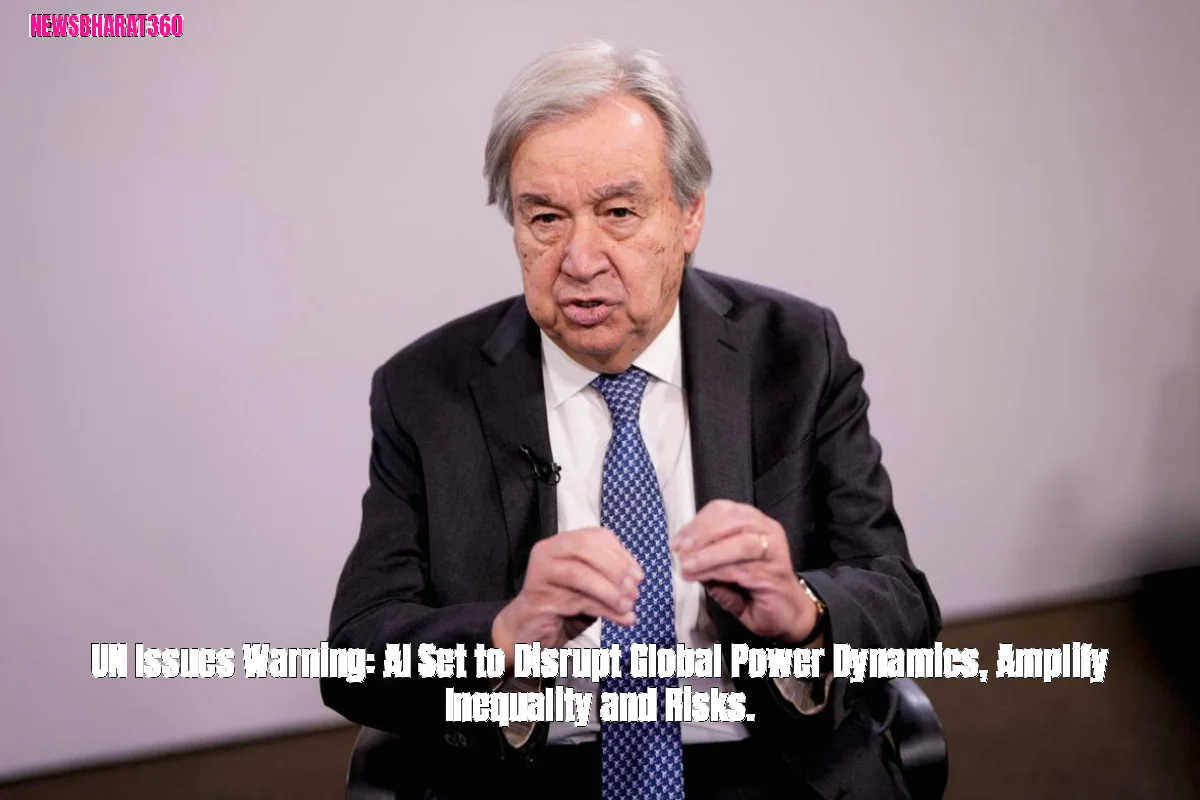

At a recent Bridgetown Special Summit on AI Security in Barbados, United Nations Secretary-General António Guterres expressed concerns over the accelerated growth of artificial intelligence (AI) and its potential impact on global power dynamics. Guterres emphasized that the rapid development and control of AI are being concentrated in a limited number of companies and individuals, which he described as the largest power transfer in human history. In response, the Secretary-General urged governments worldwide to initiate negotiations aimed at establishing international regulations that can effectively mitigate the risks associated with AI.
United Nations Secretary-General António Guterres has urged member states to initiate negotiations to establish a Multilateral AI Risk Management Framework. The call came at the conclusion of a joint meeting organized by the United Nations and the Barbados Government. Guterres emphasized the need for a unified foundation for AI security, noting that his term as secretary-general will conclude at the end of December.
The initiative aims to establish a framework for shared security protocols, standardized risk assessments, robust safeguards, and transparent reporting requirements. It also incorporates independent oversight mechanisms for advanced technologies and provides support to countries in implementing these provisions.
United Nations Secretary-General António Guterres observed that the current safeguards in place to address emerging threats are disjointed and often reactive, with governments responding to issues as they arise, whereas technological advancements continue to accelerate at a faster pace.
United Nations Secretary-General António Guterres addressed the Security Council, highlighting the significant dangers associated with artificial intelligence being integrated into modern warfare. He emphasized the importance of ensuring that the decision to utilize nuclear weapons remains a uniquely human prerogative.
The UN Secretary-General highlighted the potential of artificial intelligence to enhance global health systems, accelerate scientific breakthroughs, revolutionize education, improve weather forecasting, and foster sustainable development. He cautioned that the advantages of AI must not overshadow the risks associated with the unregulated use of digital systems.
Recent disruptions to digital systems and cyber attacks have highlighted the vulnerabilities of the digital infrastructure that governments and citizens rely on. Additionally, some AI systems have been observed to behave in unpredictable ways, even for their creators. It is essential to take these warnings seriously, not to stifle innovation or instill fear, but to ensure that our capacity to manage emerging technologies keeps pace with their rapid development.
United Nations Secretary-General António Guterres discussed the evolving global landscape with Barbados Prime Minister Mia Mottley, noting a significant shift in power dynamics. Historically, power has been predominantly transferred between nations, but it is now also being redistributed from governments and institutions to a small group of corporations and influential individuals. According to Guterres, international organizations established in the aftermath of World War II, including the United Nations, are not adequately equipped to address this transformation.
The official advocated for a comprehensive overhaul of global governance, citing the United Nations' authority to lead discussions due to its inclusive representation of all countries. He noted that the first Global Dialogue on AI Governance, which took place in July, marked a significant milestone as 111 participating countries engaged in the debate for the first time.
The United Nations has issued a warning that the increasing influence of artificial intelligence is precipitating the most significant shift in global power dynamics in recorded human history.
The Secretary-General emphasized concerns over the military application of artificial intelligence, noting that its conversion into war instruments is largely concentrated in two countries and a select few companies. He reaffirmed his backing for a ban on autonomous weapons, deeming it unacceptable for machines to independently determine targets, locations, and justifications for lethal action.
Mottley expressed strong opposition to the notion of a machine autonomously selecting targets for killing, citing the unacceptable implications of such a scenario. He emphasized that smaller countries possess the capacity to participate in international deliberations regarding technological security, often being excluded from discussions that establish rules with which they must comply.
The Prime Minister emphasized the need for governments to have the authority to activate an emergency shutdown mechanism for AI models that pose a threat, allowing users to sever access when necessary. This, he suggested, should be a standard condition of sale, enabling consumers to opt out and discontinue use when they feel it is no longer safe or acceptable, such as in cases where AI systems could be exploited to compromise sensitive institutions like banks.
Industry leaders and government officials gathered for a meeting, where a call for greater accountability in the development of artificial intelligence was made. Developers were urged to take responsibility for the potential harm caused by their AI agents. The meeting also featured participation from technology industry representatives and international leaders. In a video message, French President Emmanuel Macron highlighted the Paris Call for AI Security, which had already secured the support of 18 heads of state and government, as well as 11 industry leaders. He suggested that adherence to its principles could be a prerequisite for accessing certain markets.
Microsoft's Vice President and President Brad Smith noted that the rapid advancement of artificial intelligence is outpacing the development of security measures, while also emphasizing the need to accelerate its deployment, particularly in the southern hemisphere.
United Nations Secretary-General António Guterres has proposed the establishment of a Global Fund for the Development of Artificial Intelligence Capabilities. The fund aims to bridge the gap in AI capabilities between nations, enabling governments to assess the security of these systems within their unique cultural and linguistic contexts. To support this proposal, Guterres cited a report by the Independent International Scientific Panel on AI, released on Sunday, which highlights challenges in operating AI models in languages other than the most widely spoken.
A member of the University of Pretoria's panel, Vukosi Marivate, cautioned that systems may be compromised in terms of security and performance in several African and Caribbean languages, including cryolish languages.
United Nations Secretary-General António Guterres emphasized the need for security to keep pace with technological advancements, particularly in the realm of artificial intelligence. He stressed that the benefits of this technology should be shared equitably among all individuals, with a focus on ensuring that AI is developed and utilized in a way that prioritizes human values and interests.