
Moving around a city with heavy traffic doesn’t always require a large vehicle. Hyundai is exploring the opposite idea with a family of concepts that bet on small, electric vehicles capable of taking on different tasks.
Hyundai Palisade High Roof 2027 takes VIP luxury to another level
The proposal was born especially thinking of the conditions of markets like India, where narrow streets, congestion and last mile transport needs can turn a conventional car into an impractical solution.
You can read: 48,000 Toyota Tacoma must go to the workshop for a suspension problem
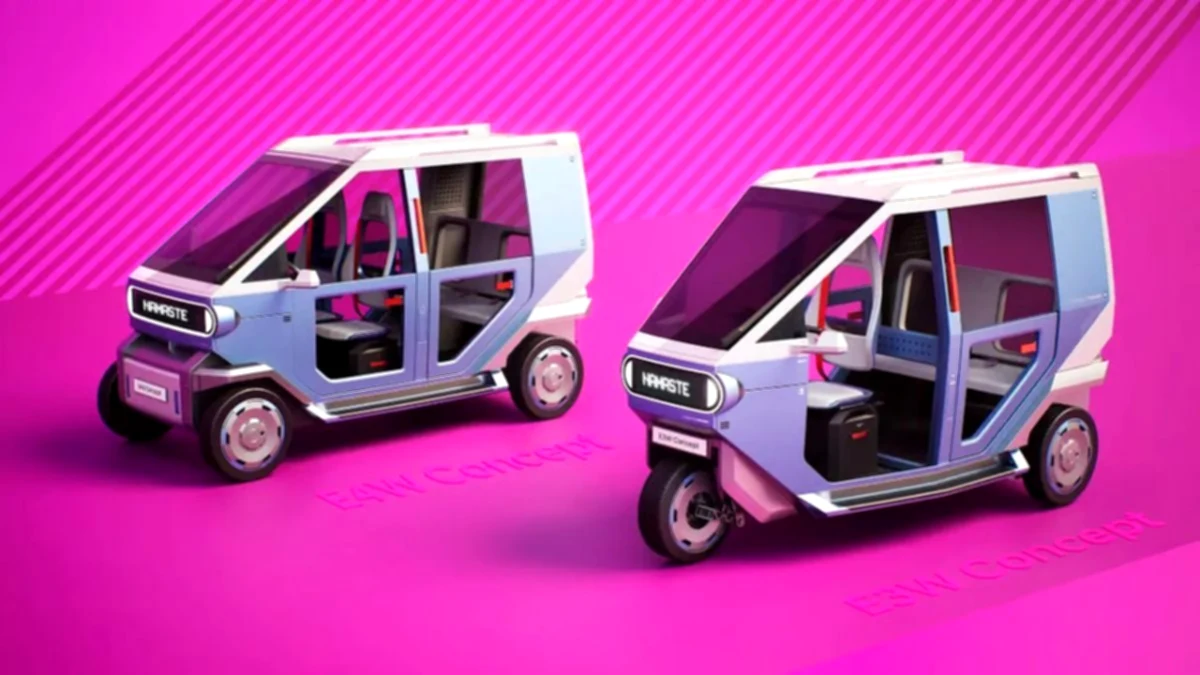
The project, developed together with TVS Motor, brings together two concepts known as E3W and E4W. One uses three wheels and the other four, but both share the intention to function as adaptable platforms.
The E3W is the most striking for its size and configuration. Its three-wheel architecture seeks to facilitate travel through congestioned urban sectors, while its design allows it to be used to transport people or goods.
There is one curious detail. The height of the vehicle can be modified and it is not just an aesthetic matter. Hyundai plans to raise it to tackle streets that could be flooded during heavy rainy seasons.
The brand has also thought about situations where access is complicated for conventional vehicles. An electric and compact configuration could be used for emergency services, distribution or shared transportation in areas where space is limited.
The proposal is not just about reducing dimensions. Hyundai explains that the E3W can be adapted to users with reduced mobility by means of a foldable seat that allows one person to accommodate in a wheelchair.
The interior seeks to take advantage of every available space. The flat floor and a longer axle distance allow free space for occupants, while the sloping umbrella is designed to improve the driver’s visibility.
Even some rather simple elements have a practical function. The vehicle has a support for phones and storage panels inspired by perforated systems, which can be reorganized according to the activity carried out.
Hyundai does not propose these concepts as simple miniautos for everyday travel.The intention is that they can assume different configurations depending on who uses them.
The last mile distribution is among the clearest possibilities, but shared mobility services, passenger transportation and emergency responses are also included. In all cases, the reduced size would be one of its main advantages.
The E4W extends that same idea with four wheels and reinforces the concept of a modular platform that can adapt to different urban needs.
The E3W and E4W are still concepts, but Hyundai is working on the possibility of bringing this proposal to the Indian market. Its evolution will depend on how the project advances and the specific needs of each territory.