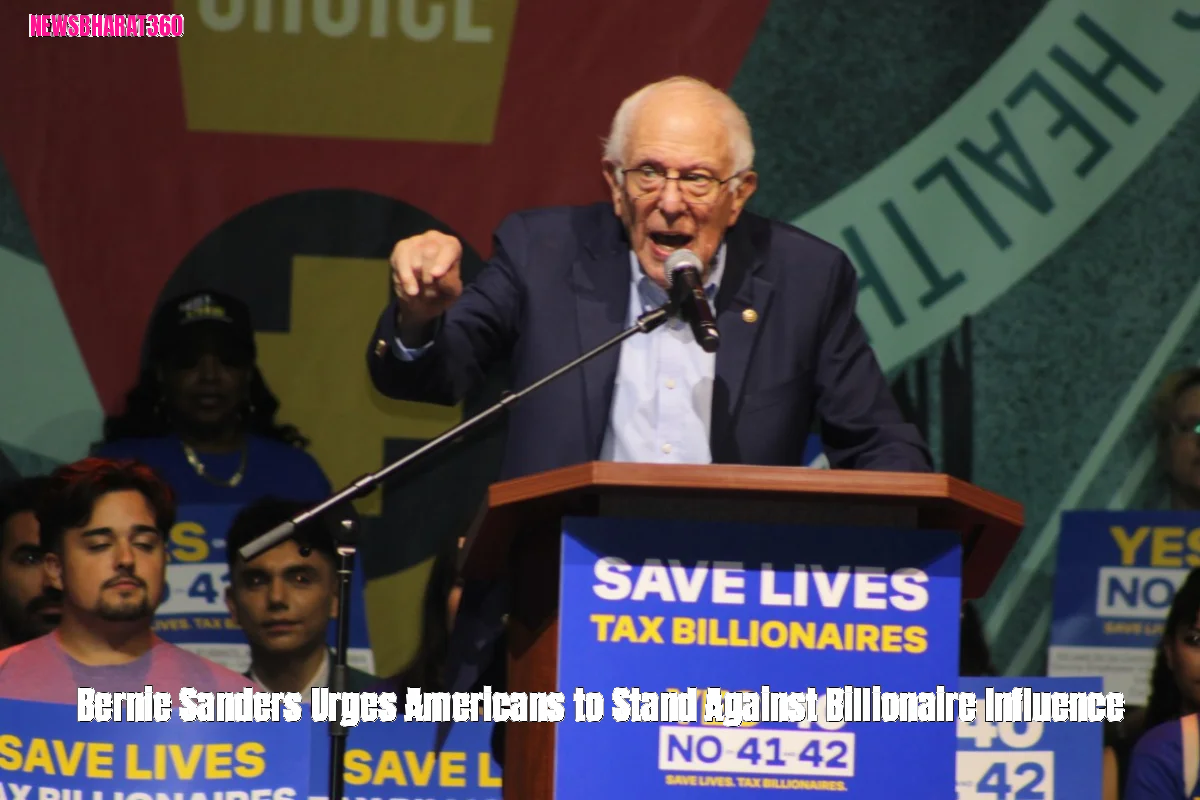

Vermont's independent Senator Bernie Sanders addressed a large gathering of progressive voters from Los Angeles, urging them to cast their ballots on November 3 in favor of Proposition 40, a $50 million tax measure that would primarily benefit approximately 250 Californian billionaires.
Senator Sanders emphasized that on November 3, Californian billionaires will likely face a significant lesson in the power of collective action, as workers unite to confront and potentially defeat them. He highlighted the significance of this issue, noting that it is unprecedented in US history for such a small group to hold such vast wealth and power.
Income and wealth disparities in the United States have reached unprecedented levels, with the top 1% holding more wealth than the remaining 93% of the population. Furthermore, the wealthiest individual, Elon Musk, owner of SpaceX, possesses a net worth that surpasses that of 53% of lower-income U.S. households.
Meta CEO Mark Zuckerberg and Google co-founder Sergey Brin were reportedly taken aback by comments made by Sanders in Los Angeles. Notably, Sergey Brin has individually donated $100 million to oppose Proposition 40. In contrast, cryptocurrency billionaire Chris Larsen has contributed $5 million in support of the election measure.
US Senator Bernie Sanders was joined by Congressman Ro Khanna, a Democrat from California, and artists including rapper Common, who during an impromptu performance called for billionaires to pay their fair share of taxes.
A congressman representing Silicon Valley stated that passage of Proposition 40 would prevent approximately 3.5 million Californians from losing access to their medical care.
A federal tax on billionaires is proposed to generate $4 trillion, which would be used to fund key social programs, including a universal healthcare system, free childcare services, university education, and technical training.
A proposed agenda for the United States has been outlined, focusing on maintaining human control over artificial intelligence by documenting its development. The plan also advocates for a minimum wage of $25 per hour, drawing parallels to the original New Deal. This initiative aligns with traditional New Deal Democratic values, differing from those of corporate Democrats, such as Senator Chuck Schumer, who are seen as being on the opposing side.
Congressman Khana is dedicated to utilizing his platform to advocate for a foreign policy approach that balances military strength with diplomatic engagement.
Representatives of the Democratic Party should prioritize two key issues: closing tax loopholes for billionaires and refraining from involvement in foreign conflicts. Specifically, the party should work towards ending the war in Iran. In fact, prior to publishing Jeffrey Epstein's archives, lawmakers had introduced a resolution on war powers more than seven months ago to prevent US involvement in a conflict with Iran. It is unfortunate that the president did not sign the war powers resolution, which had been submitted before the Epstein case law was enacted.
The speaker emphasized that if the US had not intervened, it would have avoided the high costs of gasoline and food, as well as the loss of soldiers and innocent civilians in Iran, potentially preventing a devastating war. He also acknowledged the need to acknowledge the complexities of the Middle East, specifically condemning the genocide in Gaza. The speaker advocated for withholding aid to Israel in response.
A prominent figure has expressed deep concern over the use of force against Palestinian children, emphasizing the need for a moral approach in policy-making. They argue that the influence of financial interests has compromised the country's ability to uphold its moral principles and make decisions based on the well-being of all individuals, particularly vulnerable populations.
The individual expressed indignation that Democratic politicians are siding with investors, including Sam Altman, Sergey Brin, and Peter Thiel, who collectively have invested approximately $200 billion in an effort to oppose Proposition 40.
Opponents are highly concerned about the proposal's approval, as they anticipate it will be well-received by voters. In an attempt to sway public opinion, they have introduced counter-proposals 41 and 42, which they claim contain misleading information.
At a recent event held at the Los Angeles Novo, artist Shepard Fairey, famous for his iconic portrait of former President Obama, displayed banners in support of the wealth tax campaign, which prominently featured behind the stage.
A campaign message urging voters to support Proposition 40 emphasizes that the measure, which would impose taxes on California's billionaires, represents a moral decision to address the disproportionate financial burden on this elite group.
A recent joint survey conducted by the University of California, Berkeley, and the Los Angeles Times found that nearly half of respondents, or approximately 45%, expressed support for Proposition 40, with 42% opposing the measure and 13% remaining undecided.
Two rival propositions, 41 and 42, have been introduced in the ballot, backed by California billionaires. If either of these propositions garners more votes, it would potentially override the outcome of Proposition 40, effectively rendering it invalid.
California Federation of Labor Unions President Lorena González expressed concern over the proliferation of misleading advertisements by the state's billionaires.
The individual emphasized the importance of educating voters to ensure they understand the nuances of the ballot, specifically that Proposal 40 requires a "yes" vote, while Proposals 41 and 42 necessitate "no" votes.
The speaker emphasized that a significant milestone will be achieved, specifically targeting the interests of the business class, billionaires, and corporate entities, including those who have supported Donald Trump and continue to undermine workers' rights.
A nurse working in the administrative department at Kaiser Permanente in Pasadena, California, expressed her endorsement of Proposition 40.
A viable alternative to address the health concerns of millions of individuals does not currently exist.
A proposed ballot initiative, Proposition 40, has been introduced by SEIU-UHW to mitigate the impact of federal cuts in health care funding, totaling $100 billion, which were approved by the Republican-led Congress and signed into law by President Trump in 2025.
Two competing ballot measures, Propositions 41 and 42, are set to appear on the November ballot, with a provision that would invalidate Proposition 40 if either of them receives a majority of votes.
In La Palma, a group of construction and trade workers voiced their dissent against Proposition 40 on a Monday morning.
Xóchitl Medrano, political director of California's Iron Workers District Council, expressed opposition to a proposed tax targeting billionaires, citing concerns it would inadvertently harm working families. The union, representing approximately 10,000 workers, fears the policy would deter private investment, jeopardizing jobs in the construction industry.
Medrano, speaking on behalf of iron workers, urged affiliates and California workers to reject Proposition 40 through a "no" vote.