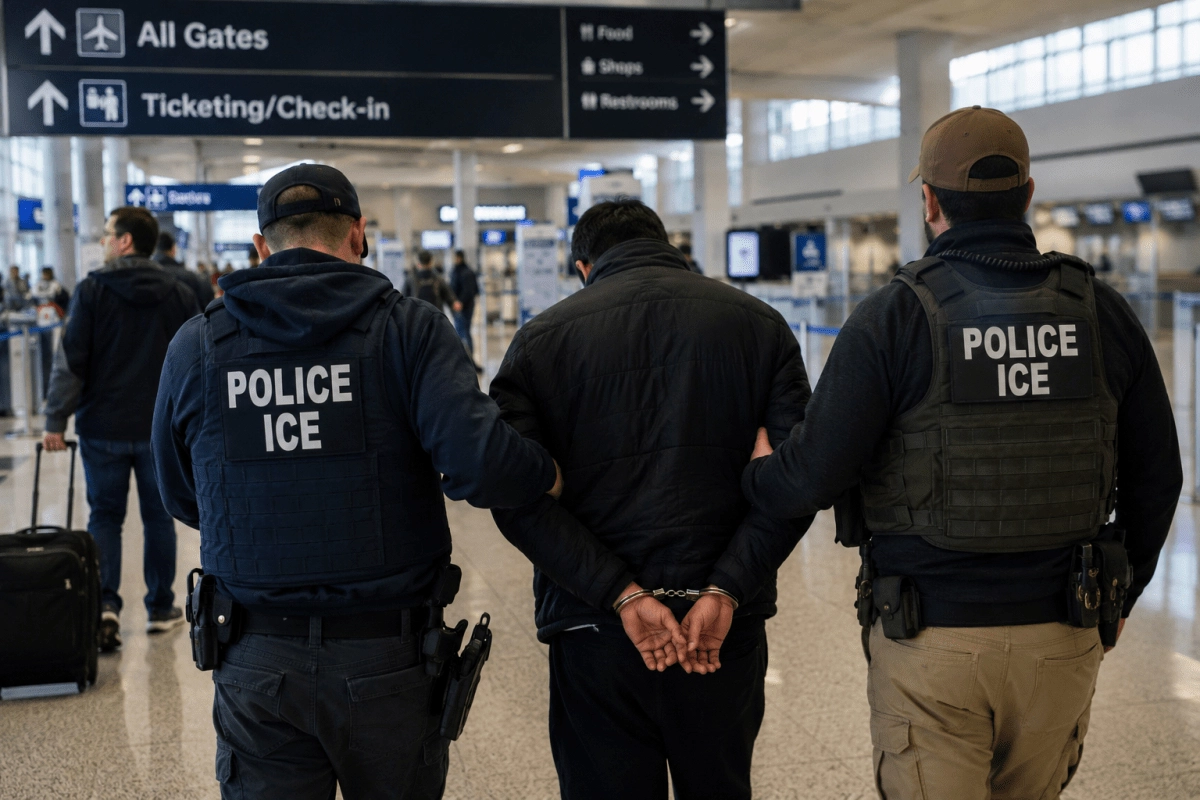

Immigration officials and flights are at odds with one another in the United States flights. As cases began to emerge in which airline employees refused to allow agents to enter areas connected to their flights or demanded judicial documentation before allowing them to proceed, the Immigration and Customs Enforcement Service ( ICE ) is now making more arrests of travelers in the country's terminals.
One of the most significant incidents occurred late in Dallas, Texas, when ICE officials attempted to board a Southwest Airlines flight while a man was arriving in Orlando. According to documents reviewed by The Wall Street Journal, company employees refused to let the officers table because they were carrying an operational immigration buy and not a judge order, according to records.
The situation does not suggest that Southwest has put together a basic plan to stop ICE activities. However, it is just one of a number of situations that is bringing in more strict regulations regarding how immigrant actions should be carried out inside airports.
As you can see, CHIRLA warns about ICE detention of immigrant travelers at the Los Angeles aircraft.
What transpired between ICE and Southwest in Dallas?
The incident occurred on July 25 while I was boarding a Southwest flight from Dallas to Orlando. The officials were eventually asked to board the plane and were later rearranged according to what The Wall Street Journal had previously reported.
An airline staff refused to let the passengers board the plane because the officers needed a court order that had to be signed by a judge. The officers then presented an operational immigration order. Additionally, the employees did not provide specific passenger details or let the agents to inspect the monitor used during the boarding process.
The Dallas incident wouldn't have been isolated. According to a person with knowledge of the situation, Southwest was the subject of at least half a dozen similar fights in the same document.
In another incident, which was also recorded at a airports in the south of the country, ICE requested cooperation from an airline to provide a boarding bridge and hold a passenger. According to the same report, that aircraft, whose name was not disclosed, refused to allow access.
Increases in airport customer detention
Immigration detention inside flights did not begin right away, but their speed and mode of operation appear to have changed. After receiving numerous reports of detained people while traveling domestically in the United States, the American Immigration Lawyers Association ( AILA ) issued an alert on July 27.
Among the reported cases, do not only look those who have received last imprisonment orders. Aliens were alerted about immigrant punishments without legal status and even some people who were being allowed to stay because pending immigration applications were being filed.
According to a state official with knowledge of the statistics, ICE made between one and three hundred arrests per day at US terminals in July, according to The Wall Street Journal. The number has not been made available by ICE as an official merged data.
The activities have been documented at locations ranging from gatekeepers and security gates to check-in bars and boarding bridge.
As you can see, ICE makes up to 36 airport detention per day, but carriers oppose them.
Why are flights concerned?
The discussion does not only revolve around emigration law. Airlines are accountable for the safety of their employees and passengers, and specific areas of the airport, such as boarding doors, boarding bridges, and aircraft, have certain controls.
At the end of July, members from the airline industry met with DHS ( Department of Homeland Security ) officials to talk about the rules for immigration controls in terminals and provide more details on how employees may behave when ICE tries to enter those areas.
The industry is in discussions with ICE and TSA to build procedures that prioritize safety when police action takes place in an airport, according to Airlines for America, an institution that represents big American companies.
For its component, Southwest asserted that it adheres to federal and state laws and has plans to check that regulators provide the necessary legal documents before disclosing details about its customers.
JetBlue added that it does not have a system to detect or record clients to the authorities for that reason and that it does not gather information about the immigration status of its passengers.
You can see that ICE has detained more than 12 000 people based on information collected from the organization that cares for immigrant kids.
Administrative and judicial orders are distinct from one another.
The key to understanding what transpired in Dallas is the difference between the two files. Within the immigration authorities ' personal composition, an ICE operational order can be issued. It has not been approved by an impartial assess before or after.
On the other hand, a prosecutor intervenes when a judge issues an order. The Fourth Amendment to the Constitution establishes requirements for research and arrest warrant release in accordance with possible cause and precision.
In some circumstances, ICE has large legal authority to hold immigration detentions. Additionally, federal law gives immigration brokers specific authority over certain matters involving transport and areas close to borders.
However, an operational order should not be taken as an automatic entry order into any public place that is controlled by a third party.
The regulations may vary depending on the location, who controls the location, whether consent is required, what is the goal of the entrance, and the specific circumstances of the operation. Additionally, federal laws state that a search warrant must be obtained in criminal investigations unless a recognized exception, for as consent or emergency circumstances, is granted.
Thus, the Southwest show does not permit us to simply accept the statement, "ICE don't provide a plane without a court order. " The complexity of the legitimate issue depends on the power being used and the specific situation.
Additionally, some citizens question whether ICE is stationed there.
Staff in the industry are becoming more concerned. One of the largest flight attendant unions in the world, the Association of Flight Attendants-CWA ( AFA ), established a system for its members to report incidents involving the presence of ICE agents at airports.
The firm expressed concern about potential security issues and agents ' access to particular airport locations. The union contends that immigration operations can result in strained situations when both passengers and employees are in close proximity.
Hence, it is not just a dialogue between ICE and passengers: airport authorities, unions, airlines, and employees are starting to get directly involved in the operations.
TSA and ICE work more closely together.
Coordination between national authorities is another factor contributing to the rise in detention. The Department of Homeland Security is a member of TSA and ICE. TSA has shared customer data with federal resources, as reported by The Wall Street Journal, so that ICE can spot potential detention targets before or during their moves. Since its peak, the engagement has reportedly caused hundreds of arrests.
DHS defended its activities and asserted that the government is implementing existing immigration laws and procedures.
The increased presence of the procedures is also helping to create a situation that was previously unheard of: arrests in front of other travellers, treatments near board gates, and agents trying to enter spaces managed by the airlines themselves.
You ICE detain a passenger on a trip within the United States?
A person's safety on a private trip is compromised by their traveling. A number of recent reports of arrests of people who were traveling within the United States, including some with pending immigration techniques, were confirmed by AILA.
This also does not mean that anyone with a process in progress can be legally detained or automatically deported. The status and rights of each traveler depend on their specific immigration status, the applications submitted, possible prior orders and other factors.
What the recent trend does show is that an airport can no longer be considered a place outside of immigration operations.
The novelty now is different: as ICE brings these actions closer to the boarding gates and planes, airline companies are beginning to wonder where their obligation to collaborate ends and when they should require additional judicial authorization. The Southwest episode in Dallas shows that this discussion is no longer theoretical.