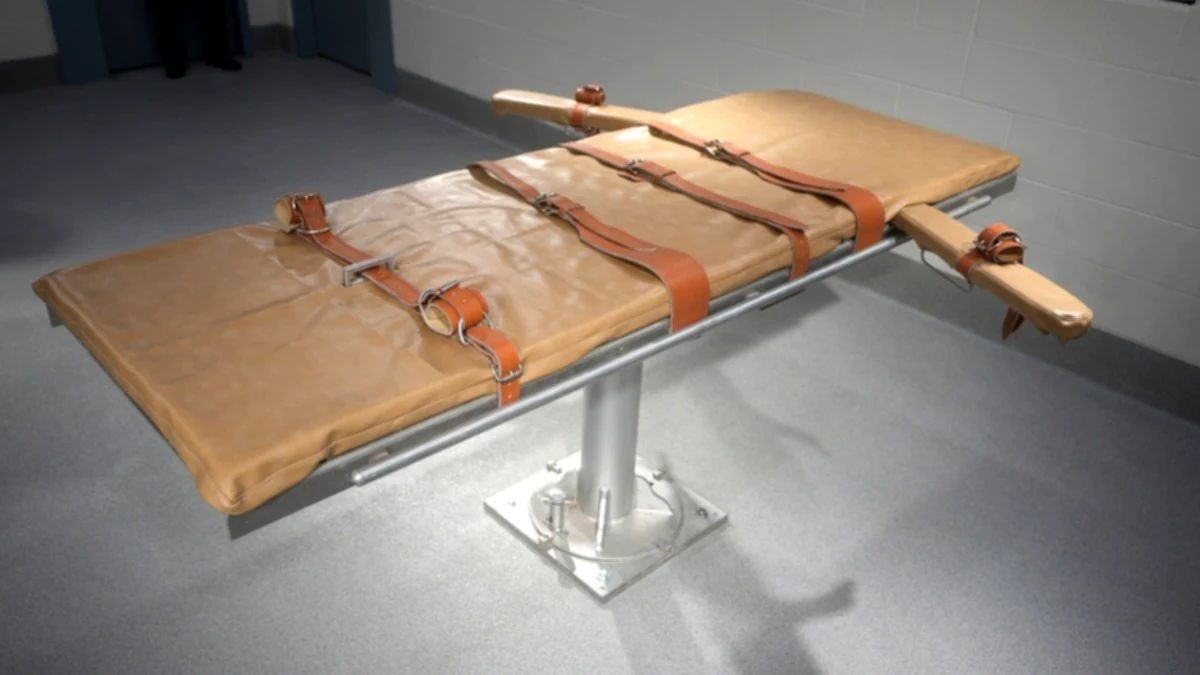

After putting her in the death chamber for 30 years, the U. S. justice ordered Christa Pike's execution on Wednesday for the gruesome death she committed as a teenager in 1995.
However, Pike managed to survive two doses of the lethal injection and spent the rest of his days in a" important state" in Tennessee, according to his attorneys.
His situation reopens the controversy over the death sentence, both domestically and internationally.
In the United States in 2025, according to an Amnesty International report, the number of executions was at its highest level ( 47 ) since 2009.
In its report," Death Condemnations and Deaths," the non-governmental business stated that the United States was the only nation in the region for the sixteenth consecutive year.
In 2025, Amnesty International recorded 2, 707 deaths worldwide, an boost of 78 % over the past year.
The firm, which examined the January to December 2025 time, acknowledges that the data on the state of the death sentence in some nations is insufficient and, in some cases, null, so the figures may be higher.
Venezuela was the first nation in the world to abolish the death penalty in 1863, a trailblazer in the global restrictions on it.
And despite the fact that this form of punishment has vanished from the area over the years, some Latin American nations still do not.
Career prison was introduced in Cuba in 1999 as a substitute for the death penalty.
The only exception to a ban in effect since 2000 was the 2003 killing of three younger Cubans who were alleged to have kidnapped a ship carrying victims in Havana with the intention of emigrating to the United States. They were found guilty of" serious offences of terrorism"
A fresh Criminal Code was approved by the Cuban National Assembly in 2022.
“As the main sanctions for the most serious criminal acts, perpetual deprivation of liberty or temporary deprivation of liberty for up to 30 years are envisaged, and the possibility of applying the death penalty isined, with exceptional character, in 23 criminal types of extreme gravity, and it is abolished in four crimes,” the Supreme People’s Court of Cuba said in May of that year.
The Cuban government urged that the situation not be looked at in isolation but rather be taken into account in a commentary to a request for information on the "moratorium on the use of the death penalty" made by the Office of the UN High Commissioner for Human Rights ( UNHCR ) in 2023.
Based on their ethical and moral beliefs and strong sense of humanism, the Cuban people are confident that the state will eventually have conditions for the end of the death penalty, according to the statement.
To improve Cuba's economic, political, and social development in a environment of peace, Cuba must be fully assured of regard for its sovereignty and the existence of the Caribbean nation itself, but that decision will need to be related to the cessation of the United States government's policy of aggression.
He added that the sanction's program had a "very outstanding" quality.
It is important to point out that the Caribbean courts have never imposed the death penalty in many years and that this has not happened since 2003.
All Latin American nations have ratified the American Convention on Human Rights or the San Jose Pact, with the exception of Cuba.
This convention forbids states from extending the dying penalty's application to crimes that were not at the time of its adoption. Addition of others would require that they deny the deal, which many experts believe to be "unlikely. "
The Guatemalan Constitutional Court declared the death sentence for murder illegal in 2016.
Additionally, it declared the death penalty's application for five crimes covered by the Criminal Code illegal in 2017.
According to the Inter-American Commission on Human Rights ( CIDH)," and it abrogated the references to the death penalty that allowed it to be used under the Anti-Narcoactivity Act. "
There is hardly ever a murder that includes or has the death penalty in place, according to Martin Guzman, the judge's director, in October 2017.
Amnesty International applauded the Constitutional Court's decision in the same year because it represented a significant step in the direction of the overall elimination of the death sentence in Guatemala.
He did point out that this prohibition could still be imposed under the Military Code.
In the group's 2025 record, Guatemala appears as one of the "abolitionist countries solely for common crimes," meaning those that have laws enshrine the death sentence for crimes that are punishable by the military by the criminal code or those that are committed under exceptional circumstances.
In the case of the Military Code, according to Eddy Morales, a practitioner in crime and criminal law, the punishment is provided for by Decree 214 of 1878.
Morales told BBC Mundo from Ciudad de Guatemala that" the death sentence has not been removed from the Constitution in Guatemala. "
The circumstances for which the dying sentence may not be imposed are outlined in Article 18 of the Guatemalan Constitution:
a ) based on assumptions,
b) for women
c ) to those over the age of 60.
( d ) the politicians who commit political and common crimes,
( e ) to those whose extradition has been granted in accordance with this condition.
Morales points out that because the nation is a signatory to the San Jose Pact and is subject to CIDH restrictions, the application of the death penalty is really minimal.
The pro claimed that the truth is that it does not or could be met with all the conditions set forth in the San Jose Pact.
It is a legitimate legislation in place that is not good, meaning that it is not appropriate; therefore, because it accepts what the San Jose Pact regulates, its app is void in the Guatemalan Criminal Code.
There are people and leaders of maid who have received sentences sentenced to thousands of years, "instead of the death penalty because its implementation is quite limited," according to the expert. Instead of imposing that sentence, the judges have put in a number of years of imprisonment.
Brazil, Chile, El Salvador, and Peru are among Amnesty International's list of nations that "abolish just typical offences. "
The death penalty was replaced by a 40-year word in different legal texts in Chile in 2001, but the Code of Military Justiceincludes the death penalty for a number of war crimes.
Gonzalo Youseff Quiros, a criminal attorney from Chile, claimed that "it was eliminated from non-military crimes and that it was used in the military for really severe cases.
The law of El Salvador states that" the death sentence may only be imposed in the circumstances set forth by martial law during the state of global war. "
Betrayal, spying, and rebellion are crimes that the Code of Military Justice covers in" the time of global war. "
According to the Magna Carta of 1993," the murder of treason to the land in the event of battle, and the offense of extremism, in accordance with the laws and treaties of which Peru is a party," the law also reserves its application.
Amnesty International claims that Brazil has abolished the death penalty for frequent acts.
Only serious crimes, such as those committed during a battle, are still subject to the death penalty.
Antigua and Barbuda, the Bahamas, Barbados, Belize, Dominica, Guyana, Jamaica, San Cristóbal con Nieves, San Vicente con las Granadinas, Santa Luca, and Trinidad y Tobago are among the nations in the region of America that still use the death penalty for serious crimes, according to the document.
Marcos González Daz, a blogger, wrote this.