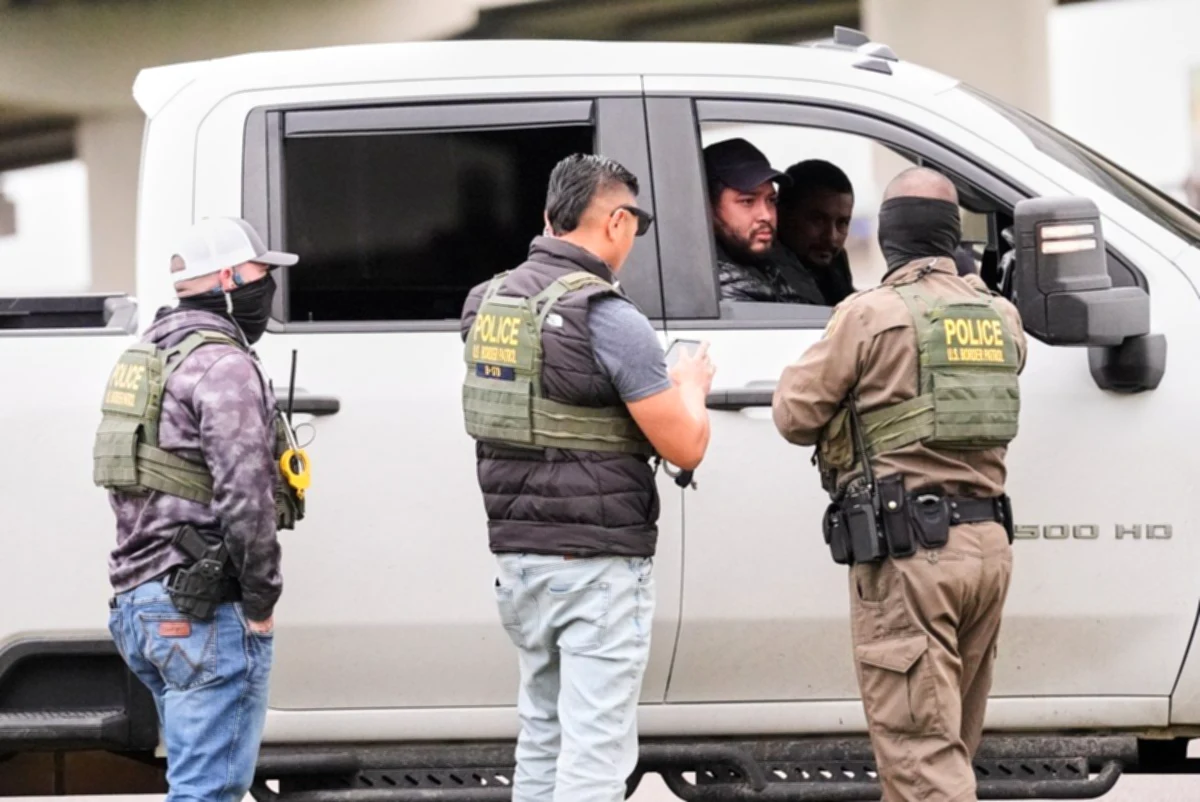

The Immigration and Customs Control Service (ICE) has just changed the rules for its traffic stops, with new measures aimed at limiting higher-risk situations during these operations.
From now on, their agents will not be able to start a high-speed chase when a driver decides not to stop. In those cases, they will have to take note of the vehicle data and use it to locate and investigate it later, according to a new internal memorandum of the agency.
The change comes after several operations that ended up shooting drivers during clashes with federal immigration agents. The new instructions also stipulate that only personnel who have completed specialized training will be able to take control of a vehicle stop, while agents who do not have such preparation will be limited to support tasks.
The document was signed by Marcus D. Charles, associate executive director of ICE, and sent to the agents of the Execution and Deportation Operations Division (ERO). Among the new provisions is established that vehicles used to make stops must have lights and sirenes that allow the public to identify them as police units.
Officers will also have to wear and activate their body cameras during this type of intervention. The measure seeks to leave an audiovisual record of the acts and establish clearer rules on the behavior of officials during a detention.
Training will be another essential requirement. Only those who have completed one of five specific courses can directly perform a vehicle stop. Officials who have not received such preparation may cooperate, but shall not be authorised to drive during the operation or to assume the primary responsibility for the intervention.
The new policy especially changes the response of agents when a vehicle is not stopped. Instead of initiating a high-speed pursuit, they will have to record data that allows the car to be identified and continue the investigation by other ways.
The ban seeks to reduce one of the scenarios considered most dangerous during migration operations: a stop that ends in a persecution by street traffic or residential areas. In this type of situation, the risk is not limited to the driver and agents, but can also reach passengers, pedestrians and other automakers.
The new rules do not eliminate the tools used to immobilize vehicles. Officers who have received specific training will be able to resort to “pinning”, a technique that consists of using another vehicle or a physical barrier to prevent a car from continuing to advance.
They will also be able to use strap bands to defuse tires, although this tool will be reserved for officials who have received the corresponding training.
The decision to change the procedures comes after a series of violent encounters during vehicle arrests by federal immigration agents. Since last year, officials have used their weapons in more than a dozen of these incidents, with at least four people killed and several wounded.
The situation has raised concerns within the Donald Trump administration about how traffic stops should be handled, considered delicate interventions because they can quickly shift from a routine review to a persecution or confrontation.
After the deadly shootings recorded in Maine and Texas in July, officers were instructed to temporarily suspend most vehicle arrests. However, the break was brief and Trump publicly called for ICE to resume these operations, considering they represent an important tool to combat crime.
One of the episodes that now falls under special attention is that of Wilber Rafael Garces Perez, a 28-year-old shooter who was shot during an ICE intervention in Austin, Texas, on September 20.
During a court hearing related to his case, prosecutors presented surveillance images showing an ICE agent following Garces Perez at high speed through residential streets after a first traffic stop.
The testimony also revealed that the agent who fired at the dealer did not carry a body camera. Another official involved had a camera, but traveled in a different car and, according to the court, turned it off during the persecution.
Authorities argue that Garces Perez struck an agent with the mirror on the driver’s side and that later that official opened fire on the vehicle. One of the bullets hit the dealer in the back.
Garces Perez faces federal charges for aggression, but his lawyers reject the prosecutors' version and qualify the charges as retaliation. The defense also argues that the available images do not fully show the moment he allegedly tried to escape.
The Austin case is not the only incident of this type that has raised questions. On July 7, an ICE agent shot Lorenzo Salgado Araujo, a 52-year-old Mexican immigrant, during an operation in Houston, Texas.
The events occurred as the Trump administration intensified its actions to locate and detain immigrants as part of its migration control and deportation strategy.
A census published in July by The Washington Post recorded at least 17 drivers shot during federal immigration agents' operations since Trump's return to the White House. The register includes actions by ICE and other federal agencies related to the enforcement of migration laws. According to the report, six people died.
The changes in vehicle arrests come at a time when ICE is facing strong pressure to increase its immigrant arrests and deportations. The agency has recorded record numbers of arrests during Trump’s second term, as it expands its operations and increases the number of agents available.
The expansion of staff has also raised questions about the preparation of some officials who have begun to participate in operations. This is precisely why the new memorandum puts special emphasis on compulsory training before allowing an officer to direct a vehicle arrest.
Neither ICE nor the Department of Homeland Security have offered public comments on the new guidelines. The document, however, sets out a concrete change in the way agents will have to respond when a driver does not stop and sets additional requirements on training, body cameras, official vehicles and use of certain tools.
The new policy enters a context of increasing scrutiny over migration operations and the level of force used during ICE interventions, especially those that start with a simple traffic stop and end up involving persecution or shootings.