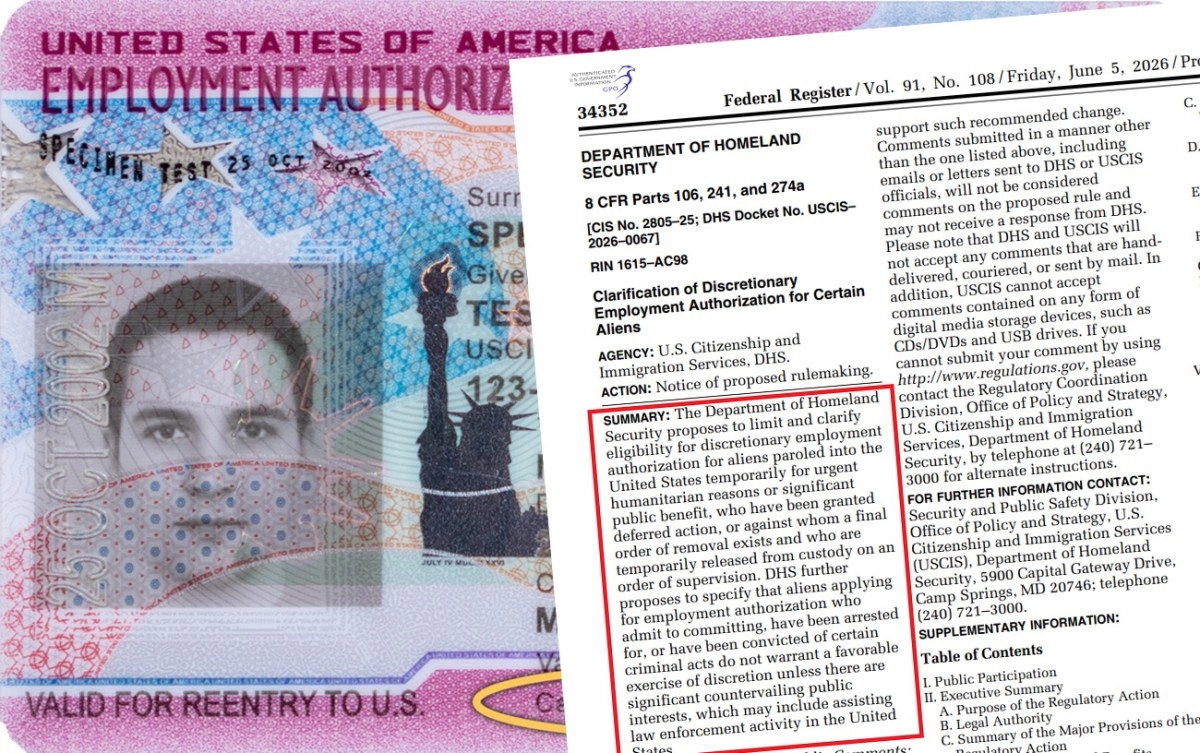

Immigrants with some type of 'parole', deferred action on deportation or temporarily released in the US could face complications in obtaining an Employment Authorization Document (EAD) under a new rule proposed by the Department of Homeland Security (DHS).
“[It is] proposed to limit and clarify the requirements for discretionary employment authorization for aliens who have temporarily entered the United States under parole for urgent humanitarian reasons or for a significant public benefit, who have been granted deferred action, or against whom there is a final order of deportation,” states the proposed rule published in the Federal Register.
Getting a work permit in the US will be even more complicated for immigrants who admit to having committed a crime or have been arrested.
It is also indicated that the new rule would affect those “who have been temporarily released from custody under a supervision order,” referring to people who were detained by the Immigration and Customs Enforcement agency (ICE) and who are released, but must have regular appointments with such agency.
Part of the rule asks immigrants to demonstrate that they have extraordinary financial need, so that immigration officials will review their petition.
“The proposed rule will also require foreigners in these categories to demonstrate their economic need for employment and justify a favorable exercise of discretion,” it states.
Even people who already have an employment permit, but want to renew it, must prove that they have a job and are under the E-Verify system.
“DHS also proposes to require that aliens applying for renewal or subsequent applications for employment authorization in these categories be employed or seek employment with an employer that participates in E-Verify, the electronic employment eligibility verification program administered by USCIS,” the proposal states.
Biometric information will be essential in most cases, before the agency processes EAD requests, with the objective of avoiding granting such authorization to those who have committed a crime, but also in case the person is part of a gang.
“[For] where there is evidence that the alien is a member of a gang or terrorist organization, it does not justify a favorable exercise of discretion, unless there are significant competing public interests, which may include the presence of the alien in the United States to collaborate with law enforcement in that country,” the DHS notes.
Before the publication of the final rule, 60 days were given to receive public comments, which must be considered by the authorities before issuing the guidelines.
And the work permits would be for a maximum of one year.
The DHS also intends to shorten the validity period of EADs to no more than one year, this depends on each case, but the agency is based on the H.R.1 law, known as the “Big and Beautiful Law”, which establishes new validity periods for employment authorization based on Temporary Protected Status (TPS), for example.
Based on that law, DHS seeks to align other work permits under specific visas, as well as repeat biometric data in document renewals.
Aaron Reichlin-Melnick, a senior fellow at the American Immigration Council, warned that the Trump administration's new rule could affect thousands of families.
“The Trump administration is also proposing to limit many work permits to just one year before renewal, affecting people seeking permanent residency through marriage to a U.S. citizen, spouses of H-1B visa holders, asylum seekers and others,” Reichlin-Melnick said.
The expert criticized in a broad message in X that, instead of facilitating legal immigration processes, the Trump administration makes them more complex and generates instability.
“We are deeply concerned that the new USCIS proposal will create greater instability and chaos for families, businesses and communities,” he said.