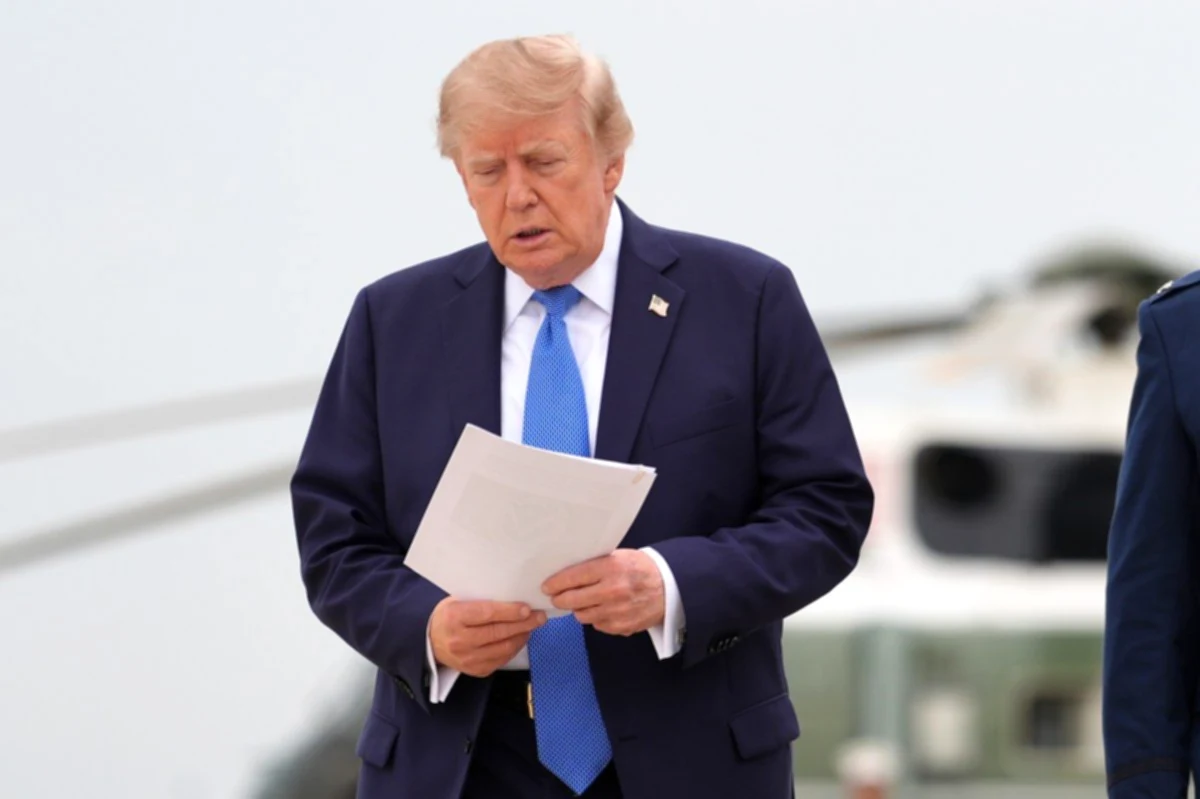
President Donald Trump said this Sunday that the United States will “substantially reduce” the joint military exercises it carries out with South Korea.
In a post on Truth Social, Trump made a veiled criticism of the South Korean government's refusal to support the US in the “denuclearization” of Iran. In addition, he cited his very good relations with North Korean leader Kim Jong Un.
“Not only are these exercises expensive, and much of these costs are paid by the United States of America (as usual!), but they send a totally inappropriate and hostile signal to a country that, since Donald J. Trump has been president, has been peaceful and respectful,” the president wrote.
The decision comes after Pyongyang carried out ballistic missile tests this month, which are prohibited by the United Nations.
Although he said it was “too late to cancel” the joint exercises with South Korea, scheduled to begin on Monday, he said he would ask US Defense Secretary Pete Hegseth that they be “substantially reduced.”
South Korea's rejection of Iran
In his post this Sunday, the US president noted that South Korea had recently refused to join the United States in “denuclearizing” Iran.
"I recently asked the President of South Korea if they would like to join us in denuclearizing the Islamic Republic of Iran, and he said, 'No, thank you!'" Trump wrote.
Last week, military leaders from the United States and South Korea held a joint press conference to announce the Ulchi Freedom Shield program.
They indicated that the 11-day event would be of a similar magnitude to previous years, with the participation of some 18,000 South Korean soldiers.
During the press conference, commanders also mentioned the deployment of North Korean troops to help Russia in its war against Ukraine.
U.S. military spokesman Ryan Donald said “our training takes that threat into account,” referring to North Korean soldiers returning from the battlefield.
North Korea's Foreign Ministry spoke out on Friday about its neighbors' joint military exercises, reiterating its rejection of any threat or challenge through its right to self-defense.
The joint exercises come days after South Korea, the United States and Japan detected North Korea's second missile test in just a few days.
Pyongyang has accelerated its efforts to expand its nuclear and missile programs since the 2019 failure of Kim Jong Un's high-level diplomacy with Trump during his first term in the White House.
Trump became the first sitting US president to set foot on North Korean soil when he visited seven years ago.
Trump's scathing comment about South Korea in his social media post appeared to hint at possible frustration with Seoul for refusing to make direct military or logistical contributions to the US war against Iran.
He has also expressed discontent with other allies for their reluctance to get involved in the conflict, including Japan, France and the United Kingdom.
The decision to reduce the scale of joint military exercises with South Korea is not without precedent.
He himself completely suspended the exercises in 2018, during denuclearization negotiations with Kim.
Exercises were reduced again in 2020 during the Covid-19 pandemic.