
“These are days of many mixed feelings.”
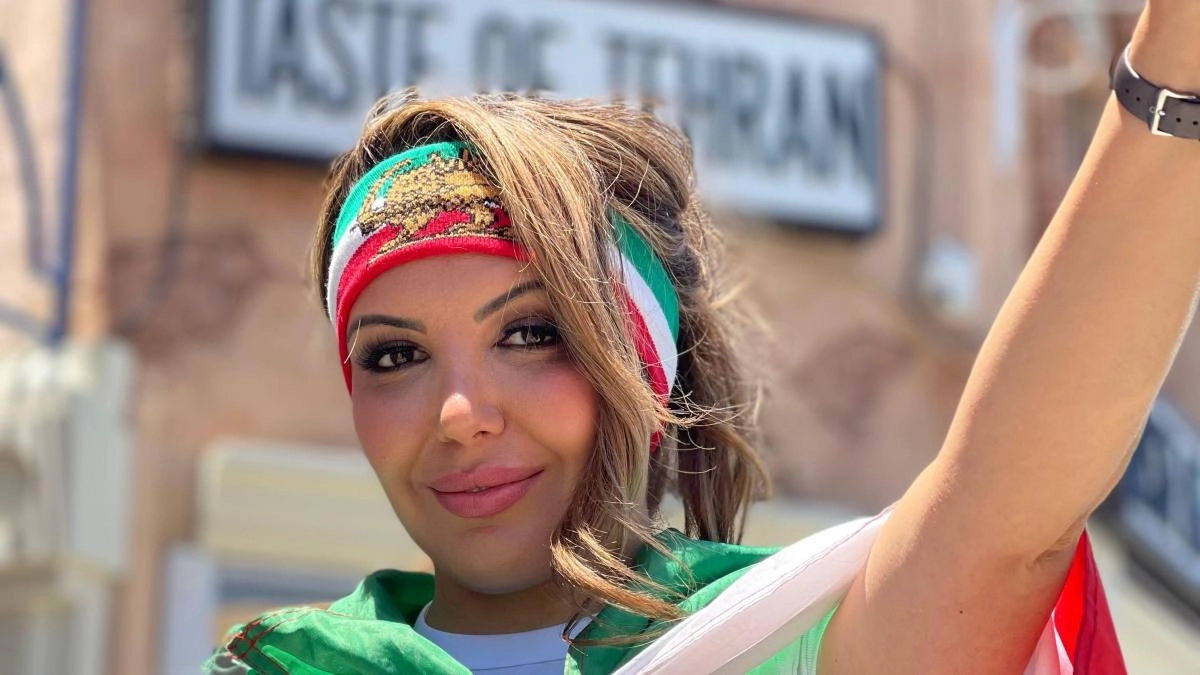
On Monday at noon, an Iranian-American woman who asked to withhold her identity for safety reasons was waiting for the Uber that would take her to the SoFi stadium in Los Angeles, where in a few hours her country's national team would debut in the World Cup against New Zealand.
“We want to see our team and see it win, but at the same time we reject the Islamic Republic of Iran,” the blogger specialized in Persian gastronomy explained to BBC Mundo.
Her outfit reaffirmed her message. She wore on her shoulders and as a hairband the flag prior to the Islamic revolution of 1979, tricolor like the current one (green, white and red) but with a lion and a sun in the center instead of the symbol that represents the word 'Allah'.
Converted into a banner of dissidence, it is today strictly prohibited in Iran and FIFA has vetoed its use in stadiums and other World Cup facilities for not being official and for its political component.
Although that didn't stop some fans from showing it in the SoFi stands.
Where it is ubiquitous is in “Teherángeles”.
Also known as “Little Persia,” this area of ​​western Los Angeles that includes part of the affluent Beverly Hills has concentrated a good number of Iranian restaurants and businesses for decades and is a meeting point for visitors and the large diaspora that resides in the city.
Of the 750,000 Iranians and Iranian-Americans in the country, more than half live in California, according to 2024 census estimates.
And for this community made up of emigrants in different waves, mostly after the Islamic revolution and the war with Iraq (1980-1988) but also more recently, the World Cup has become an issue of extreme sensitivity in the context of a war that the US and Israel started on February 28.
BBC Mundo visited the area the day after the announcement of a preliminary ceasefire agreement between the US and Iran, a kind of memorandum of understanding whose full text has not yet been published and which leaves the thorniest issues for future negotiations.
Divisive and controversial
“The diaspora is made up of people with different points of view,” Parsa Tafreshi, who flew from New York to Los Angeles to watch the game, told BBC Mundo.
"There are those who think that supporting the team is bad because they consider that it represents the government. Others may oppose the regime, but they are still on the side of the team. And there are those who encourage it without caring about anything else," he explained.
He is part of the fans and came, like his family, prepared to celebrate, dressed in t-shirts that read “Iran,” necklaces, caps, and tricolor paint on his cheeks.
“I grew up in this country and the first game I saw was the United States against Iran in 1998,” he said. “It was hard to see those two teams that in a way are part of me face each other, but I always wanted to see them play again,” he added, thinking about a scenario for which many combinations are needed and recognizing at the same time that the issue is controversial.
"All of this is very divisive, but at the end of the day, people want to be on the right side. And for me the right side is those who are with the Iranian people," he explained.
“I also think that, ultimately, when the players attack the goal, everyone in the stadium will cheer them on,” he said as if making a wish, before getting into the taxi that would take them to SoFi and that had just stopped in front of the Flames restaurant.
Specializing in Iranian food, says Ali Ju, who emigrated from Tehran just under four years ago.
"I myself have found myself in the dilemma of what to do, whether to watch the game or not. There was a time when I felt resentment towards the team, but now I hope they win," he admitted, while serving crispy rice, chicken kebab, shirazi salad and doogh, a typical fermented yogurt-based drink, at the Flames restaurant.
The one who claimed not to face any dilemma was Eric Saddith, owner of a Persian rug store a couple of blocks down, also on Westwood Boulevard.
"This is not my team. It does not represent Iran and supporting it is supporting the Islamic Revolutionary Guard Corps (IRGC, the powerful Iranian parallel army considered a terrorist organization by the US) and the Islamic Republic," he stressed.
“They are not with the people, they are with the government, a government that we all despise, here and in Iran,” he concluded. “A regime that imprisons and kills those who protest, as it has done to thousands.”
Saddith left his country in 1978, when the revolution was already brewing. “I left a year after him,” he says, pointing to the photos of Mohamed Reza Pahlavi, the last shah of Iran, which among antique rugs and tapestries decorate the wall and remind him of what he describes as “the glorious past” of his nation.
Deposed during the revolution, in his years of government the Shah promoted a Westernization of the country along with a strong repression against dissent. His escape on January 16, 1979 marked the end of more than 2,000 years of monarchy in Iran.
“Those were days of glory and not the days of now,” reflects Saddith. "Now look at the team, which had to settle in Tijuana. It's a shame that it's not even allowed to stay" on US soil.
Base camp in Tijuana
That the Iranian team had to establish its base camp in the Mexican border city is perhaps the most unusual story of this World Cup.
In March, with the war already underway, US President Donald Trump said that the Iranian team, which had planned to settle in Tucson, Arizona, was “free” to attend the World Cup although he could not “guarantee its safety.”
He then suggested that Italy, an unqualified team, should take its place in the championship. Given the comments, the Persian federation asked FIFA to move its matches to Mexico or Canada, the other two host countries.
The president of Mexico, Claudia Sheinbaum, was willing, but with logistics planned for years and reservations made, the body chaired by Gianni Infantino ended up rejecting the possibility.
The highest governing body of soccer, however, opened the door to the intermediate solution of removing the Iranian team from the US after the matches and Sheinbaum herself reported that Mexico would host it.
“They asked us if they could spend the night in Mexico and we said yes, no problem,” said the president during her morning conference on May 25.
The players sleep and train in Tijuana, in the stadium of the local team, the Tijuana Xoloitzcuintles club. On match days they travel to the neighboring country in the morning and return at night, just as they did this Monday.
This is how the rigid stay permit that the US granted to 55 of the 70 members of the Iranian delegation works.
“What other country in the world goes through that?” Saddith questioned in his carpet store, Farhad. “It is extremely embarrassing.”
And asked about the potential peace agreement, he responded with “I hope it works.”
"But you can't take the [Iran] regime seriously. They are just waiting for Trump to get out of office so they can go back to their ways of attacking other countries and oppressing and killing their own people," he immediately warned.
Meanwhile, Ju, the waiter at the Flames restaurant, was thinking about his remaining family in Tehran and was hopeful that after the announcement, their daily lives would be easier.
During a press conference on Sunday, national team captain Mehdi Taremi also faced more questions related to the political context than the sporting one.
"We play on behalf of every Iranian, whether in the diaspora or in Iran. People have different opinions, but we are here to unite people and we will try to bring joy to all Iranians. We do not get involved in politics. We are here to play football," he responded to one of them.
Upon their arrival at SoFi in Inglewood, dozens of members of the diaspora were waiting for them outside.
Some raised the flag prior to the Islamic revolution to demonstrate their displeasure with the current government and denounce that it uses sport as a facelift on an international level, others directed their messages to Trump, begging him not to negotiate with the Iranian leaders and to definitively promote a regime change.
Inside the stadium, just as Tafreshi, the fan who had arrived from New York, had wished, the fans cheered them on in every attack, applauded them for every goal and celebrated the 2-2 draw with New Zealand.
They will repeat the play on Sunday, June 21 to battle against the Belgian team, traveling from Tijuana to Los Angeles and then returning to Mexican territory.
And in the Iranian community of Los Angeles, some will once again face their dilemmas and contradictions, while others embrace their convictions.